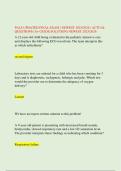
HESI Health Assessment Exam 2023Test Bank Correct 100%
For which clinical indicator associated with a complication of portal hypertension would the nurse assess the client? A. liver abscess B. intestinal obstruction C. perforation of the duodenum D. hemorrhage from esophageal varices {{Ans- c. The increased pressure within the portal circulatory system causes increased pressure in areas of portal systemic collateral circulation (most importantly, in the distal esophagus and proximal stomach). Hemorrhage is a possible complication. Liver abscesses may occur as a complication of intestinal infections, not portal hypertension. Intestinal obstruction may be caused by manipulation of the bowel during surgery, peritonitis, neurological disorders, or organic obstruction, not portal hypertension. Perforation of the duodenum usually is caused by peptic ulcers; it is not a direct result of portal hypertension or cirrhosis. A client with schizophrenia takes ziprasidone. Which conditions in the client may indicate a need to discontinue the medication? Select all that apply. One, some, or all responses may be correct. A. leukopenia B. tachycardia C. hypokalemia D. hypomagnesemia E. prolonged QT interval {{Ans- a, c, e Ziprasidone is a second-generation antipsychotic medication indicated for schizophrenia. The medication may cause leukopenia, hypokalemia, and hypomagnesemia. This medication may cause a prolonged QT interval, which indicates torsades de pointes. Bradycardia may occur in torsades de pointes but not tachycardia. A client is prone to hyponatremia. Which factors would the nurse identifythat can precipitate hyponatremia? Select all that apply. One, some, or all responses may be correct. A. wound drainage B. diuretic therapy C. GI suction D. parenteral infusion of 0.9% sodium chloride E. inappropriate anti-diuretic hormone (ADH) secretions {{Ans- a, b, c, e Wound drainage can result in hyponatremia from loss of sodium ions. Most diuretics interfere with sodium reabsorption in the nephrons and have the side effect of hyponatremia. Gastrointestinal fluids are rich in sodium ions, which are lost by GI suction. With the syndrome of inappropriate antidiuretic hormone (SIADH), high levels of the antidiuretic hormone (ADH) are produced, causing the body to retain water instead of excreting it normally in the urine. Parenteral infusion of 0.9% sodium chloride, an isotonic solution, should be compatible with body fluids; if given in excess, it may lead to hypernatremia. Which statements made by the client identify regulatory functions of the kidney? Select all that apply. One, some, or all responses may be correct. A. erythropoiesis B. acid base balance C. vitamin D activation D. blood pressure control E. fluid and electrolyte balance {{Ans- b, e Maintaining the acid-base balance of the body by selectively reabsorbing and secreting certain substances from the blood is a regulatory function of the kidneys. The kidneys also perform the regulatory function of electrolyte balance by regulating the reabsorption of certain electrolytes while eliminating others depending on their levels in the serum. The kidneys perform hormonal function by secreting a hormone called erythropoietin that aids in synthesis of red blood cells (erythropoiesis). Activation of vitamin D is a hormonal function of the kidneys. The kidneys perform hormonal function by secreting the hormone renin that assists in blood pressure control. Which signs would the nurse expect to observe in a client with small cell carcinoma of the lung who develops syndrome of inappropriate antidiuretic hormone (SIADH)? Select all that apply. One, some, or all responses may be correct. 1 Oliguria 2 Seizures 3 Vomiting 4 Polydipsia 5 Polyphagia {{Ans- 1, 2, 3 Cancerous cells of small cell lung cancer can produce antidiuretic hormone, which causes fluid retention, resulting in increased blood volume and decreased urine volume. Fluid retention associated with SIADH can cause cerebral edema, resulting in confusion and seizures. Fluid retention resulting in hyponatremia causes nausea and vomiting. The client will have nausea and vomiting, resulting in a decreased oral fluid and food intake. Which urinary diagnostic test does not require any dietary or activity restrictions for the clie nt before or after the test? 1 Renal scan 2 Renal biopsy 3 Renal arteriogram 4 Concentration test {{Ans- 1 A renal scan does not require any dietary or activity restrictions. A renal biopsy requires bed rest for 24 hours after the procedure. A renal arteriogram requires the client to maintain bed rest with affected leg straight. A concentration test requires the client to fast after a given time in the evening. The nurse identifies that a client's urinary output is less than 40 mL/h over the past 3 hours. Which action would the nurse take? 1 Assess breath sounds and obtain vital signs. 2 Decrease the intravenous flow rate and increase oral fluids. 3 Insert an indwelling catheter to facilitate emptying of the bladder. 4 Check for dependent edema by assessing the lower extremities {{Ans- 1 The imbalance in intake and output, with a decreasing urinary output, may indicate kidney failure. The retention of excess body fluid can precipitate the development of heart failure. Assessing breath sounds and obtaining the vital signs are necessary when monitoring for these complications. In the presence of hypervolemia, oral and intravenous fluid intake should be decreased. There are no data to support a problem with the excretion of urine; the problem is with insufficient production. The insertion of a urinary retention catheter requires a health care provider's prescription. Checking for dependent edema by assessing the lower extremities is an appropriate assessment after respirations and vital signs are assessed. A client had a laparoscopic cholecystectomy. Postoperatively, the client experiences nausea and vomiting and is admitted overnight for observation and hydration. What would the nurse include in the teaching plan when preparing this client for discharge? Select all that apply. One, some, or all responses may be correct. 1 Wash the puncture sites with strong soap and hot water daily. 2 Call the health care provider for a fever of 100°F (37.8°C) or higher more for 2 days. 3 Remove the tape strips over the puncture sites 1 week after surgery. 4 Check the puncture sites daily for redness, tenderness, swelling, heat, or drainage. 5 Ease the discomfort from the gas used to insufflate the abdomen during surgery by applying a heating pad to the left shoulder. {{Ans- 2, 4 Which complication is most likely to occur in the immediate postoperative period after a client has had a splenectomy? 1 Infection 2 Peritonitis 3 Hemorrhage 4 Intestinal obstruction {{Ans- 3 Because the spleen is highly vascular, hemorrhage may occur in the immediate postoperative period. Although risk for some types of infection is higher after splenectomy because of lower immunoglobulin levels, risk for immediate postoperative infection is not higher than usual after splenectomy. Peritonitis is possible after splenectomy, but it would not be apparent in the immediate postoperative period and is not a common complication. The incidence of intestinal obstruction is not higher than for other abdominal surgery, and symptoms would not be apparent in the immediate postoperative period. A high school student arrives at the local blood drive center to donate blood for the first time. As the site is being prepared for needle insertion, the student becomes agitated, starts to hyperventilate, and complains of dizziness and tingling of the hands. Which would the nurse instruct the student to do? 1 Breathe into cupped hands. 2 Pant using rapid, shallow breaths. 3 Use a rapid deep-breathing pattern. 4 Hold the breath for as long as possible. {{Ans- 1 Breathing into cupped hands allows carbon dioxide to reenter the lungs, which will increase the serum bicarbonate level, relieving the respiratory alkalosis that is occurring as a result of hyperventilation. Which major group of substances in human milk are of special importance to the newborn and cannot be reproduced in a bottle formula? 1 Amino acids 2 Gamma globulins 3 Essential electrolytes 4 Complex carbohydrates {{Ans- 2 The gamma globulin antibodies in human milk provide the infant with immunity against all or most of the pathogens that the mother has encountered. Amino acids and essential electrolytes are present in commercial formulas. Complex carbohydrates are not required by the infant. Which instruction on infection prevention would the nurse include when providing discharge education to a client who received a cadaveric renal transplant? Select all that apply. One, some, or all responses may be correct. 1 Avoid eating from buffets. 2 Obtain annual flu vaccinations. 3 Perform regular hand hygiene. 4 Stay away from crowded areas. 5 Report a temperature greater than 100.5°F. {{Ans- 1,2,3,4,5 Clients who receive an organ transplant need to take immunosuppressant medications for the rest of their lives to prevent organ rejection. These medications put the client at increased risk for infection. The nurse would provide infection prevention teaching to the client after renal transplant, which would include instructions to avoid eating from buffets, get an annual flu vaccine, practice regular hand hygiene, and avoid crowded areas. Clients would also be instructed to report a temperature greater than 100.5°F to their health care provider as it could indicate infection or organ rejection and requires treatment. Which malnourished condition may predispose a client to secondary immunodeficiency? 1 Cachexia 2 Cirrhosis 3 Diabetes mellitus 4 Hodgkin lymphoma {{Ans- 1 Cachexia is a nutrition disorder that may occur because of wasting of muscle mass and weight, resulting in a secondary immunodeficiency disorder. Cirrhosis, diabetes mellitus, and Hodgkin lymphoma also lead to secondary immunodeficiency disorder, but these are not malnutrition disorders. Which dietary modifications help improve the nutritional status of a client with acquired immunodeficiency syndrome (AIDS)? 1 Refraining from consuming fatty foods 2 Refraining from consuming frequent meals 3 Refraining from consuming high-calorie foods 4 Refraining from consuming high-protein foods {{Ans- 1 Many clients with AIDS become intolerant to fat due to the disease and the antiretroviral medications. The client should be instructed to refrain from consuming fatty foods. The client should be encouraged to eat small and frequent meals to improve nutritional status. High-calorie and high-protein foods are beneficial to clients with AIDS because they provide energy and build immunity. Which statement describes a client's tidal volume? 1 Tidal volume is the volume of air inhaled and exhaled with each breath. 2. Tidal volume is the amount of air remaining in the lungs after forced expiration. 3 Tidal volume is the additional air forcefully inhaled after normal inhalation. 4 Tidal volume is the additional air forcefully exhaled after normal exhalation. {{Ans- 1 ......................................................................................CONTINUE
Escuela, estudio y materia
Información del documento
- Subido en
- 27 de junio de 2023
- Número de páginas
- 517
- Escrito en
- 2022/2023
- Tipo
- Examen
- Contiene
- Preguntas y respuestas
Temas
-
hesi health assessment
-
hesi health assessment exam 2023test bank