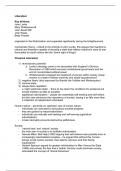
Liberalism
Key thinkers:
John Locke
Mary Wollstonecraft
John Stuart Mill
John Rawls
Betty Friedan
originated in the Reformation and expanded significantly during the Enlightenment
mechanistic theory – linked to the writings of John Locke, this argues that mankind is
rational and therefore capable of devising a state that reflects mankind’s need (it was
formulated to rebuff notions like the ‘divine right of kings’)
Classical Liberalism
1) revolutionary potential
a. Locke’s ideology came to be associated with England’s Glorious
Revolution of 1688 which secured constitutional government and the
end of concentrated political power
b. Wollstonecraft contested the treatment of women within society (‘keep
women in a state of listless inactivity and stupid acquiescence’)
2) negative liberty (also espoused by liberals like Voltaire and Montesquieu)
3) minimal state
4) laissez-faire capitalism
- a ‘night watchman state’ – there to law down the conditions for existence but
should interfere as little as possible
- egotistical individualism – people are essentially self-seeking and self-reliant,
but this view minimizes the importance of society, seeing it as little more than
a collection of independent individuals
Human nature – generally an optimistic view of human nature
- individuals are motivated to bring about societal progress
- they are guided by reason/rationalism
- individuals are naturally self-seeking and self-serving (egotistical
individualism)
- innate rationality prevents destructive selfishness
Society
- ‘natural laws’ and ‘natural’ society
- the main aim of society is to facilitate individualism
- Samuel Miles’ Self Help (1859) arguing that self-reliance was possible even in
increasingly industrialized societies – he argued that without this ‘human
beings would remain stunted, their talents unknown and their liberty
squandered’
- Herbert Spencer argued for greater individualism in Man Versus the State
(1884) and echoes the fear that a ‘feeble’ minority could dominate society,
articulated the concept of ‘Social Darwinism’
Key thinkers:
John Locke
Mary Wollstonecraft
John Stuart Mill
John Rawls
Betty Friedan
originated in the Reformation and expanded significantly during the Enlightenment
mechanistic theory – linked to the writings of John Locke, this argues that mankind is
rational and therefore capable of devising a state that reflects mankind’s need (it was
formulated to rebuff notions like the ‘divine right of kings’)
Classical Liberalism
1) revolutionary potential
a. Locke’s ideology came to be associated with England’s Glorious
Revolution of 1688 which secured constitutional government and the
end of concentrated political power
b. Wollstonecraft contested the treatment of women within society (‘keep
women in a state of listless inactivity and stupid acquiescence’)
2) negative liberty (also espoused by liberals like Voltaire and Montesquieu)
3) minimal state
4) laissez-faire capitalism
- a ‘night watchman state’ – there to law down the conditions for existence but
should interfere as little as possible
- egotistical individualism – people are essentially self-seeking and self-reliant,
but this view minimizes the importance of society, seeing it as little more than
a collection of independent individuals
Human nature – generally an optimistic view of human nature
- individuals are motivated to bring about societal progress
- they are guided by reason/rationalism
- individuals are naturally self-seeking and self-serving (egotistical
individualism)
- innate rationality prevents destructive selfishness
Society
- ‘natural laws’ and ‘natural’ society
- the main aim of society is to facilitate individualism
- Samuel Miles’ Self Help (1859) arguing that self-reliance was possible even in
increasingly industrialized societies – he argued that without this ‘human
beings would remain stunted, their talents unknown and their liberty
squandered’
- Herbert Spencer argued for greater individualism in Man Versus the State
(1884) and echoes the fear that a ‘feeble’ minority could dominate society,
articulated the concept of ‘Social Darwinism’