
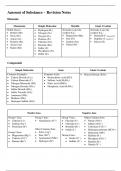
Amount of Substance – Revision Notes
Elements
Monatomic Simple Molecular Metallic Giant Covalent
(Noble Gases) • Hydrogen (H2) (Formula is just the (Formula is just the
• Helium (He) • Nitrogen (N2) symbol) E.g.: symbol) E.g.:
• Neon (Ne) • Oxygen (O2) • Magnesium (Mg) • Diamond (C (Diamond))
• Argon (Ar) • Fluorine (F2) • Iron (Fe) • Graphite (C (graphite))
• Krypton (Kr) • Chlorine (Cl2) • Sodium (Na) • Silicon (Si)
• Xenon (Xe) • Bromine (Br2) • Nickel (Ni)
• Radon (Rn) • Iodine (I2)
• Phosphorus (P4)
• Sulfur (S2)
Compounds
Simple Molecular Ionic Giant Covalent
Common Examples: Common Acids: • Silicon Dioxide (SiO2)
• Carbon Dioxide (Co2) • Hydrochloric Acid (HCl)
• Carbon Monoxide (C) • Sulfuric Acid (H2SO4)
• Nitrogen Monoxide (NO) • Nitric Acid (HNO3)
• Nitrogen Dioxide (NO2) • Phosphoric Acid (H3PO4)
• Sulfur Dioxide (SO2)
• Sulfur Trioxide (SO3)
• Ammonia (NH3)
• Methane (CH4)
• Hydrogen Sulfide (H2S)
Positive Ions Negative Ions
Group 1 Ions: Group 3 Ions: Group 7 Ions: Other Common Ions:
• Lithium (Li+) • Aluminium (Al3+) • Fluoride (F–) • Nitrate (NO3–)
• Sodium (Na+) • Chloride (Cl–) • Sulfate (SO42–)
• Potassium (K+) • Bromide (Br–) • Carbonate (CO32–)
Other Common Ions: • Iodide (I–) • Hydrogencarbonate (HCO3–)
Group 2 Ions: • Silver (Ag+) • Hydroxide (OH–)
• Magnesium (Mg2+) • Zinc (Zn2+) Group 6 Ions: • Hydride (H–)
• Calcium (Ca2+) • Ammonium (NH4+) • Oxide (O2–) • Phosphate (PO43–)
• Barium (Ba2+) • Hydrogen (H+) • Sulfide (S2–) • Hydride (H–)
• Nitride (N3–)
, 12
3.1.2.1 Can you describe relative atomic mass and relative molecular mass in terms of C?
Can you define relative atomic mass (Ar)?
Can you define relative molecular mass (Mr)?
Relative Atomic Mass (Ar): The average mass of an element (taking into account all of its isotopes) relative to 1/12 the
mass of a 12C atom.
3.1.2.2 Can you define the Avogadro constant as the number of particles in a mole?
Can you describe the mole as applied to electrons, atoms, molecules, ions, formulae and equations?
Can you use the Avogadro constant to carry out calculations?
Can you use mass of substance, Mr, and amount in moles to carry out calculations?
• One mole contains 6.022 x 10²³ (L) atoms/ions/etc
Moles = Mass (g) n = _m_ Mr = Mass (g) x L
Mr Mr
3.1.2.2 Can you measure the concentration of a substance in solution, measured in mol dm–3?
Moles (mol) = Concentration (mol/dm-3) x Volume (dm3) n = cv
Mass (g) = Concentration (g/dm-3) x Volume (dm3)
Concentration (g/dm-3) = Concentration (mol/dm-3) x Mr
For two solutions with the same number of moles: C1V1 = C2V2
, 3.1.2.3 Do you know the ideal gas equation pV = nRT with the variables in SI units?
Can you use the ideal gas equation pV = nRT in calculations?
Avogadro’s Law states that equal volumes of gas at the same temperature and pressure contain equal numbers of
molecules.
1 mole of any gas occupies 24dm3 at room temperature and pressure.
Moles (mol) = Volume (dm3) Moles (mol) = Volume (cm3)
24 24000
Ideal Gas Equation:
Pressure (Pa) x Volume (m3) = Moles (mol) x Universal Gas Constant (Jk-1mol-1) x Temperature (K)
Pressure (Pa): Volume (m3): Universal Gas Constant: Temperature (K):
• 1000 Pa = 1 kPa • 1m3 = 1x10³ dm3 (1,000 dm3) = 8.31JK-1mol-1 • 0°C = 273K
• 1 atm = 101 kPa • 1m3 = 1x106 cm3 (1,000,000cm3) • 0K = -273°C
PV = nRT
Worked Example:
Calculate the relative molecular mass of a gas which has a density of 2.615
g dm-3 at 298K and 1 atm. PV = nRT
P = 1 atm = 101 kPa = 1.01x10⁵ Pa n = _P_
V RT
R = 8.31 Jk-1mol-1
T = 298K _m_ = _P_
ρ = 2.615 g dm-3 = 2615 g m-3 Mr V RT
_ρ_ = _P_
Mr RT
Mr = ρRT
P
Mr = 2615 x 8.31 x 298
1.01x10⁵
Mr = 64.1 (3sf)


