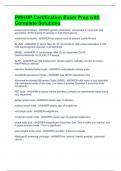
PMHNP Certification Exam Prep with Complete Solutions
autosomal dominant - ANSWER-genetic inheritance. will present in more than one generation. 50/50 chance of passing on trait (Huningtons) autosomal recessive - ANSWER-two copies must be present (cystic fibrosis SLUMS - ANSWER-11 items. Max 30, 27-30 normal for high school education, 21-60 mild neurocognitive disorder, 0-20 dementia MMSE - ANSWER-11 components. Max 30, no impairment 24-30 Delirium/dementia 18-23 mild, 0-7 severe SLAP - ANSWER-suicide assessment. Social support, Lethality, Access to means, Plan/Previous attempt Hamilton Anxiety Rating scale - ANSWER-most popular anxiety scale Vanderbilt Assessment Scale - ANSWER-free ADHD assessment tool Abnormal Involuntary Movement Scale (AIMS) - ANSWER-total score is less important than monitoring areas of the body. 2 or more is positive. Question 7 examines trunk movements PET scan - ANSWER-localizes mental activities, primarily as experimental basis and is very expensive tender lymph node - ANSWER-classic sign of infection rubbery lymph node - ANSWER-classic sign of lymphoma soft lymph node - ANSWER-insignificant nontender lymph node - ANSWER-classic sign of potential malignancy lymph node size - ANSWER-insignificant if less than 2cm, 3cm in axilla and inguinal. but if supraclavicular fossa, >1cm is significant lasts longest in the urine - ANSWER-cannabis. 3 days to 4 weeks Medicare B screening coverage - ANSWER-for cervical, breast, prostate, colorectal cancer top 4 killers of adults in US - ANSWER-heart disease, cancer, lower resp disease, CVA lung cancer - ANSWER-highest cancer mortality in women and men, primary prevention - ANSWER-PROMOTES health PRIOR. healthy diet, exercise, avoiding things secondary prevention - ANSWER-focuses on early identification and treatment of existing problems. includes REGULAR exams and screening like pap tertiary prevention - ANSWER-rehab and restoration of health hepatitis A vaccine - ANSWER-for military, travelers to endemic areas, men who have sex with men low T4 - ANSWER-indicates disease state is due to thyroid gland hyperthyroid - ANSWER-low TSH, high or normal T4 mimics mania hypothyroid - ANSWER-high TSH, low T4 mimics depression Chlamydia treatment - ANSWER-zithromax OR doxy. report to health department Gonorrhea - ANSWER-rocephin 250mg IM one dose + ziethromax 1gm one dose Syphilis - ANSWER-benzathine penicillin G 2.4 million units IM. how often depends on the stage. doxy if allergic Structure of the mind - ANSWER-Id: unconscious instinctual drives, pleasure principle Ego: rational, maintains harmony between id and superego Superego: perfection principles, forms the conscious relief behaviors - ANSWER-actions, healthy and not healthy, to reduce stress Goals of therapy - ANSWER-make the unconscious conscious and strengthen the ego so that behavior is based more on reality and less on instinctual drives Interpersonal Therapy - ANSWER-Harry Stack Sullivan good me, bad me, not me Transactional Analysis - ANSWER-Eric Berne Ego states include the Parent (shoulds), the Adult (gather information) and the Child (feelings, impulses Goal is to assist client to make new decisions about present behavior and life Gestalt Therapy - ANSWER-Frederick Perls Focuses on the now psychoanalytic psychotherapy - ANSWER-is best matched with the client with MATURE defenses, some object constancy Person centered therapy - ANSWER-Carl Rogers qualities of therapist are accurate empathy, warmth, unconditional positive regard. Does NOT include history taking Motivational Interviewing - ANSWER-based on collaboration between therapist and client, evoking or drawing out the clients ideas about the change, emphasizing autonomy of the client Stages of change - ANSWER-pre contemplation contemplation preparation action maintenance relapse Behavioral Therapy - ANSWER-Pavolov, Skinner, Bandura, Wolpe Differs fundamentally from psychodynamic approach "why" is not useful how behavior impacts functioning and affect currently Rational Emotive Therapy - ANSWER-Albert Ellis personal relationship is not essential goal to eliminate clinents self defeating outlook on life psychopathology has similiar set of underlying irrational beliefs Cognitive Behavioral Therapy - ANSWER-Aaron Beck each disorder has its own typical cognitive content requiring differing treatment approaches socratic dialogue - ANSWER-7 types of questions: memory, translation, interpretation, application, analysis, synthesis, evaluation psychologically minded - ANSWER-persons capacity for self examination, self reflection, introspection and personal insight Supportive psychotherapy - ANSWER-reinforces patients healthy and adaptive thought pattresn and functional behaviors, aiming to reduce intrapsychic conflicts, minimizing symptoms of mental disorders ego strength - ANSWER-deal with demands of id, super ego and reality. helps us maintain emotional stability and cope with internal and external strength phases of therapeutic relationship - ANSWER-orientation working termination orientation - ANSWER-establish trust and set parameters with addressing immediate issues, establishing each others roles, communicate in general therapeutic goals, contracting, establish confidentiality, termination working - ANSWER-collect information, apply problem solving skills to patient situation, enhance self esteem, support positive changes in behavior, work through patient resistance to change behaviors, help patient develop adaptive coping skills, lay ground work for termination termination - ANSWER-occurs when therapeutic goals are realized, review of therapeutic accomplishments, communicate methods for patient to sustain and grow his mental health, discussion of feelings concerning termination are explored, guidelines for further communication are established therapeutic milieu - ANSWER-management of therapeutic environment to facilitate the therapeutic process. involves multidisciplinary team promotes therapeutic environment - ANSWER-structure, involvement, containment, support, validation role of NP in the milieu - ANSWER-ensure physiological needs are met, encourage independence, reality orientation, medication management, 1-1 relationship, setting limits, teaching ideal group size - ANSWER-8 group membership - ANSWER-open ended (can join anytime) close ended (pre-determined, fixed time frame Yaloms therapeutic/curative factors of group - ANSWER-universality, hope, education, self esteem, correct maladaptive behavior, social skills, role modeling, insight, security, emotion expression, existential factors leadership styles - ANSWER-autocratic, democratic, laissez-faire Family System Theory - ANSWER-Murray Bowen triangles genograms focus on family relationships and not the individual
Escuela, estudio y materia
- Institución
- PMHNP
- Grado
- PMHNP
Información del documento
- Subido en
- 12 de junio de 2023
- Número de páginas
- 20
- Escrito en
- 2022/2023
- Tipo
- Examen
- Contiene
- Preguntas y respuestas
Temas
- pmhnp
- autosomal dominant
- autosomal recessive
- slums
- mmse
-
pmhnp certification exam prep

Documento también disponible en un lote