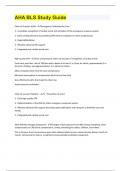
AHA BLS Study Guide | Questions With 100% Correct Answers | Verified
Chain of Survival: Adult - Emergency Cardiovascular Care 1 - Immediate recognition of cardiac arrest and activation of the emergency response system 2 - Early cardiopulmonary resuscitation (CPR) with an emphasis on chest compressions 3 - Rapid defibrillation 4 - Effective advanced life support 5 - Integrated post-cardiac arrest care High-quality CPR - Start compressions within 10 seconds of recognition of cardiac arrest. Push hard, push fast: rate of 100/min with a depth of at least 2 in (5cm) for adults, approximately 2 in (5cm) for children, and approximately 1.5 in (4cm) for infants. Allow complete chest recoil for each compression. Minimize interruptions in compressions (limit to less than 10s). Give effective breaths that make the chest rise. Avoid excessive ventilation. Chain of survival: Pediatric - 1 - Prevention of arrest 2 - Early high-quality CPR 3 - Rapid activation of the EMS (or other emergency response) system 4 - Effective advanced life support (including rapid stabilization and transport to definitive care and rehab) 5 - Integrated post-cardiac arrest care 2010 AHA Key Changes (sequence) - Changes in BLS sequence from ABC (airway, breathing, chest compressions) to CAB (chest compressions, airway, breathing) for adults, children, and infants. This is because chest compressions were often delayed while rescuer opened airway, deliver mouth-tomouth, retrieve barrier device, or gathered and assembled ventilation equipment
Escuela, estudio y materia
- Institución
- AHA BLS Study
- Grado
- AHA BLS Study
Información del documento
- Subido en
- 9 de junio de 2023
- Número de páginas
- 11
- Escrito en
- 2022/2023
- Tipo
- Examen
- Contiene
- Preguntas y respuestas
Temas

Documento también disponible en un lote