LESSON 6
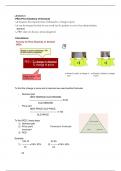
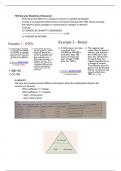
.PED (Price Elasticity of Demand)
⤷It measures the responsiveness of demand to a change in price
⤷It can be measured so that we can work out if a product or service has elastic/inelastic
demand
⤷ PED value are always a minus (negativo)
.Calculations
To find the change in price and in demand we need another formulas
- Demand part
NEW DEMAND-OLD DEMAND
-------------------------------------------- X100
OLD DEMAND
- Price part
NEW PRICE-OLD PRICE
----------------------------------- X 100
OLD PRICE
To find PED 3 easy steps
1) Demand part
2) Price part Formula+ Formula
inversa⇒
3) PED
Example:
100-75 £7-£5
1) ---------- x100= 33% 2) --------- x100= 40%
75 £5
33
, 3) -----= 0.825%
40
ELASTIC: Demand changes a lot with changes in price( Price sensitive) . Customers
would react a lot to the change in price.
When the % change in quantity demanded is greater than the % change in
price the answer will be greater (>) than 1
INELASTIC: Very little change in demand with a change in price. Customers would react
not much at the change in price.
When the % change in quantity demanded is less than the % change in price
the answer will be less than (<) 1
(Luxury product (like petrol) tend to be inelastic bc we have to buy them)
.Factors influencing PED
.PED and total revenue
.When a business changes its price there will
be a change in demand and therefore a change
in total revenue. It would be useful for a
business to know what effect a particular price
change might have on total revenue.
.Formula⇒ PRICE (P) X QUANTITY SOLD
Then si guarda la differenza tra primo prezzo e
secondo: TR1:1000, TR2:720 = (1000-720=£280)
Quindi si dice che: The price reduction from £10 to £6 has resulted in a £280 fall in TR.
.PED (Price Elasticity of Demand)
⤷It measures the responsiveness of demand to a change in price
⤷It can be measured so that we can work out if a product or service has elastic/inelastic
demand
⤷ PED value are always a minus (negativo)
.Calculations
To find the change in price and in demand we need another formulas
- Demand part
NEW DEMAND-OLD DEMAND
-------------------------------------------- X100
OLD DEMAND
- Price part
NEW PRICE-OLD PRICE
----------------------------------- X 100
OLD PRICE
To find PED 3 easy steps
1) Demand part
2) Price part Formula+ Formula
inversa⇒
3) PED
Example:
100-75 £7-£5
1) ---------- x100= 33% 2) --------- x100= 40%
75 £5
33
, 3) -----= 0.825%
40
ELASTIC: Demand changes a lot with changes in price( Price sensitive) . Customers
would react a lot to the change in price.
When the % change in quantity demanded is greater than the % change in
price the answer will be greater (>) than 1
INELASTIC: Very little change in demand with a change in price. Customers would react
not much at the change in price.
When the % change in quantity demanded is less than the % change in price
the answer will be less than (<) 1
(Luxury product (like petrol) tend to be inelastic bc we have to buy them)
.Factors influencing PED
.PED and total revenue
.When a business changes its price there will
be a change in demand and therefore a change
in total revenue. It would be useful for a
business to know what effect a particular price
change might have on total revenue.
.Formula⇒ PRICE (P) X QUANTITY SOLD
Then si guarda la differenza tra primo prezzo e
secondo: TR1:1000, TR2:720 = (1000-720=£280)
Quindi si dice che: The price reduction from £10 to £6 has resulted in a £280 fall in TR.