CHEM 103
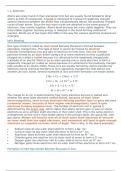
5.1: BONDING Atoms are rarely found in their elemental form but are usually found bonded to other atoms as part of compounds. A bond is composed of a group of negatively charged valence electrons between the atoms that simultaneously attract the positively charged nuclei of both atoms. Since the two atom nuclei are attracted to the same group of electrons, they remain together. Atoms bond because are more stable together. They are more stable together because energy is released in the bond-forming exothermic reaction. Bonds are of two types that differ in the way the valence electrons involved are arranged. Ionic Bonding One type of bond is called an ionic bond because the bond is formed between oppositely charged ions. This type of bond is said to be formed by electron transfer (simultaneous loss and gain of electrons to form ions). Ions are charged particles formed by an atom either losing one or more electrons to form a positively charged ion (called a cation because it is attracted to the negatively charged pole (cathode) of an electric field) or by an atom gaining one or more electrons to form a negatively charged ion (called an anion because it is attracted to the positively charged pole (anode) of an electric field). These ions are usually formed by atoms transferring electrons during chemical reactions to form oppositely charged ions that attract one another (an ionic bond). Several examples of ions and their formation are shown below: 2 Na + Cl2 → 2 Na+ + 2 Cl2 Ca + O2 → 2 Ca+2 + 2 O-2 2 K + S → 2 K+ + S-2 Al + N → Al+3 + N-3 The charge on an ion is determined by how many electrons are lost or gained and whether the atom loses electrons (metal atoms, because of their lower electronegativity, tend to lose electrons forming positive ions) or gains electrons (nonmetal atoms, because of their higher electronegativity, tend to gain electrons forming negative ions). The number of electrons lost or gained is determined by the octet rule, which states that atoms tend to gain or lose (or share) electrons so as to achieve eight electrons in their outer shell. This is the same electron arrangement as that of the most stable atoms in the periodic table, the group VIII, inert gas atoms. Metals will tend to lose all of their outer shell electrons to uncover an inner shell that has eight electrons, and nonmetals will tend to gain enough electrons to complete an outer shell of eight. That is why, in the above examples: Sodium loses its one outer shell electron to form a Na+ ion. Calcium loses its two outer shell electrons to form a Ca+2 ion. Aluminum loses its th
Escuela, estudio y materia
- Institución
-
Portage Learning
- Grado
-
CHEM 103
Información del documento
- Subido en
- 4 de junio de 2023
- Número de páginas
- 28
- Escrito en
- 2022/2023
- Tipo
- Otro
- Personaje
- Desconocido
Temas
-
chem 103

Documento también disponible en un lote