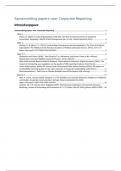
Samenvatting papers voor Corporate Reporting
Inhoudsopgave
Samenvatting papers voor Corporate Reporting............................................................................................. 1
Week 1..................................................................................................................................................................2
Power, M. (2007). Turning Organizations Inside Out: The Rise of Internal Control. In Organized
Uncertainty: Designing a World of Risk Management (pp. 34–65). Oxford University Press.........................2
Week 2..................................................................................................................................................................4
Huising, R., & Silbey, S. S. (2013). Constructing Consequences for Noncompliance: The Case of Academic
Laboratories. The ANNALS of the American Academy of Political and Social Science, 649(1), 157–177.
https://doi.org/10.1177/0002716213492633.................................................................................................4
Week 3-5...............................................................................................................................................................6
Glazerman and Cohen (2020). “Non-Financial” Is a Misnomer, but Doesn’t Have to Be a Missed
Opportunity, Journal of Applied Corporate Finance, 32 (2), 108-116,............................................................6
Ruba Subhi Hamed, Basiem Khalil Al-Shattarat, Wasim Khalil Al-Shattarat, Khaled Hussainey (2021). The
impact of introducing new regulations on the quality of CSR reporting: Evidence from the UK....................7
Imran Abbas Jadoon, Akhter Ali, Usman Ayub, Muhammad Tahir, Raheel Mumtaz (2020). The impact of
sustainability reporting quality on the value relevance of corporate sustainability performance.................9
Recommendations | Task Force on Climate-Related Financial Disclosures (fsb-tcfd.org)............................11
Week 6-7............................................................................................................................................................13
Ghio, A. and R., Verona (2020). Chapters 1-3. The Evolution of Corporate Disclosure Insights on Traditional
and Modern Corporate Communication, Springer Nature Switzerland AG 2020,
https://doi.org/10.1007/978-3-030-42299-8................................................................................................13
Graham, J.R., C.R. Harvey and S. Rajgopal (2005). The Economic Implications of Corporate Financial
Reporting, Journal of Accounting and Economics 40, 3–73, https://doi:10.1016/j.jacceco.2005.01.002....30
,Week 1
Power, M. (2007). Turning Organizations Inside Out: The Rise of
Internal Control. In Organized Uncertainty: Designing a World of
Risk Management (pp. 34–65). Oxford University Press.
Organizations concerned with corporate governance have grown rapidly in the 1990s. These
frameworks embody two intertwined logics:
1. a neoliberal managerial logic which draws heavily on the intellectual resources of economics
and principal-agent theory as well as from practical disciplines such as accounting; and
2. a rights-based participative logic which draws from democratic and critical theories (Drori,
2006).
Governance discourse has created a new political economy of internal control; internal control and
risk management have become demanded as core values of a new ‘grammar’ or ‘policy paradigm’
(Hall, 1989) for corporate governance. The traditional approach is about bureaucracy and command
& control. Because bureaucracies always faced issues with pragmatically adjusting to local necessities
the regulation was modernized as enforced self-regulation.
Because of this new way of reporting, firms have to comply with a regulator’s recommendation, or if
they choose not to, explain reasons for deviation; signals how regulation is centered around a
formally regulated form of “earned” trust; trust is earned when organizations volunteer to
regulations, rules, codes or when they provide proof of better management, e.g., through
certifications; cooperative style of enforcement. Advantages: allows firms to be innovative, create
tailored systems of internal control; disadvantages: ‘explain’ could come with a lot of extra costs and
uncertainty about whether alternative forms of control will hold up in courts / audits.
Besides this, business risk audits differ from traditional auditing. Modern corporate governance laws
(like SOX) mandate that audits must be made OR firms should purchase advice (consulting) about
internal control and risk management. Managing future developments is more important than
complying to accounting standards. Business risk audits differ from traditional auditing through their
strategic aspects, timely information (not tied to balance sheet) and a higher proportion of
consulting.
Efforts to redesign the external audit, both to be more business risk-based and also as a platform for
further assurance services, created a professional focus on internal controls and led to
experimentation in forms of private assurance for the management process. The idea of risk-based
internal control has become both a resource for regulation and a model for regulation itself.
The definition of internal control has always varied in nuance and scope, but this vagueness has been
important to its recent significance. Internal control is a ‘boundary object’ in so far as policymakers in
many domains can think of ‘better internal control’ as a desirable solution path. Managerial and
insurance practices also see the concept of internal control a basis for rethinking and representing
themselves with renewed strategic importance; and stakeholder organizations can hold organizations
to account for the quality of their self-control.
Control systems and monitoring may figure abstractly in principle-agent theories of organizational
design, but the practice by which corporations, corner shops, clubs, and churches maintain a basic
level of financial and non-financial control over resources, has hardly been worthy of serious
intellectual attention.
, Internal control has been fashioned as a mode of organizing and processing uncertainty which
demands the externalization, justification, and audibility of organizational control arrangements.
Internal control and management systems translate primary or first-order risks into systems and
control risks. Diverse risk content gets transformed into an auditable process via warning
mechanisms, compliance violation alerts and ‘near miss’ reports.
Internal control does not simply make governance ‘better’, it brings a certain style of governance into
existence which reaches into every corner of organizational life. Internal control instrumentalizes
neoliberal logics of governance. Rationalized control systems will continue to be regarded as a
legitimate response to crisis, even as their limitations are recognized, because they express this
dominant logic of governing.
Inhoudsopgave
Samenvatting papers voor Corporate Reporting............................................................................................. 1
Week 1..................................................................................................................................................................2
Power, M. (2007). Turning Organizations Inside Out: The Rise of Internal Control. In Organized
Uncertainty: Designing a World of Risk Management (pp. 34–65). Oxford University Press.........................2
Week 2..................................................................................................................................................................4
Huising, R., & Silbey, S. S. (2013). Constructing Consequences for Noncompliance: The Case of Academic
Laboratories. The ANNALS of the American Academy of Political and Social Science, 649(1), 157–177.
https://doi.org/10.1177/0002716213492633.................................................................................................4
Week 3-5...............................................................................................................................................................6
Glazerman and Cohen (2020). “Non-Financial” Is a Misnomer, but Doesn’t Have to Be a Missed
Opportunity, Journal of Applied Corporate Finance, 32 (2), 108-116,............................................................6
Ruba Subhi Hamed, Basiem Khalil Al-Shattarat, Wasim Khalil Al-Shattarat, Khaled Hussainey (2021). The
impact of introducing new regulations on the quality of CSR reporting: Evidence from the UK....................7
Imran Abbas Jadoon, Akhter Ali, Usman Ayub, Muhammad Tahir, Raheel Mumtaz (2020). The impact of
sustainability reporting quality on the value relevance of corporate sustainability performance.................9
Recommendations | Task Force on Climate-Related Financial Disclosures (fsb-tcfd.org)............................11
Week 6-7............................................................................................................................................................13
Ghio, A. and R., Verona (2020). Chapters 1-3. The Evolution of Corporate Disclosure Insights on Traditional
and Modern Corporate Communication, Springer Nature Switzerland AG 2020,
https://doi.org/10.1007/978-3-030-42299-8................................................................................................13
Graham, J.R., C.R. Harvey and S. Rajgopal (2005). The Economic Implications of Corporate Financial
Reporting, Journal of Accounting and Economics 40, 3–73, https://doi:10.1016/j.jacceco.2005.01.002....30
,Week 1
Power, M. (2007). Turning Organizations Inside Out: The Rise of
Internal Control. In Organized Uncertainty: Designing a World of
Risk Management (pp. 34–65). Oxford University Press.
Organizations concerned with corporate governance have grown rapidly in the 1990s. These
frameworks embody two intertwined logics:
1. a neoliberal managerial logic which draws heavily on the intellectual resources of economics
and principal-agent theory as well as from practical disciplines such as accounting; and
2. a rights-based participative logic which draws from democratic and critical theories (Drori,
2006).
Governance discourse has created a new political economy of internal control; internal control and
risk management have become demanded as core values of a new ‘grammar’ or ‘policy paradigm’
(Hall, 1989) for corporate governance. The traditional approach is about bureaucracy and command
& control. Because bureaucracies always faced issues with pragmatically adjusting to local necessities
the regulation was modernized as enforced self-regulation.
Because of this new way of reporting, firms have to comply with a regulator’s recommendation, or if
they choose not to, explain reasons for deviation; signals how regulation is centered around a
formally regulated form of “earned” trust; trust is earned when organizations volunteer to
regulations, rules, codes or when they provide proof of better management, e.g., through
certifications; cooperative style of enforcement. Advantages: allows firms to be innovative, create
tailored systems of internal control; disadvantages: ‘explain’ could come with a lot of extra costs and
uncertainty about whether alternative forms of control will hold up in courts / audits.
Besides this, business risk audits differ from traditional auditing. Modern corporate governance laws
(like SOX) mandate that audits must be made OR firms should purchase advice (consulting) about
internal control and risk management. Managing future developments is more important than
complying to accounting standards. Business risk audits differ from traditional auditing through their
strategic aspects, timely information (not tied to balance sheet) and a higher proportion of
consulting.
Efforts to redesign the external audit, both to be more business risk-based and also as a platform for
further assurance services, created a professional focus on internal controls and led to
experimentation in forms of private assurance for the management process. The idea of risk-based
internal control has become both a resource for regulation and a model for regulation itself.
The definition of internal control has always varied in nuance and scope, but this vagueness has been
important to its recent significance. Internal control is a ‘boundary object’ in so far as policymakers in
many domains can think of ‘better internal control’ as a desirable solution path. Managerial and
insurance practices also see the concept of internal control a basis for rethinking and representing
themselves with renewed strategic importance; and stakeholder organizations can hold organizations
to account for the quality of their self-control.
Control systems and monitoring may figure abstractly in principle-agent theories of organizational
design, but the practice by which corporations, corner shops, clubs, and churches maintain a basic
level of financial and non-financial control over resources, has hardly been worthy of serious
intellectual attention.
, Internal control has been fashioned as a mode of organizing and processing uncertainty which
demands the externalization, justification, and audibility of organizational control arrangements.
Internal control and management systems translate primary or first-order risks into systems and
control risks. Diverse risk content gets transformed into an auditable process via warning
mechanisms, compliance violation alerts and ‘near miss’ reports.
Internal control does not simply make governance ‘better’, it brings a certain style of governance into
existence which reaches into every corner of organizational life. Internal control instrumentalizes
neoliberal logics of governance. Rationalized control systems will continue to be regarded as a
legitimate response to crisis, even as their limitations are recognized, because they express this
dominant logic of governing.