
NR_506 Summary Notes For Exam Preparation.
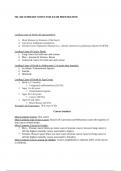
NR_506 Summary Notes For Exam Preparation. Leading cause of death (all ages/genders): 1. Heart disease (or diseases of the heart) 2. Cancer (or malignant neoplasms) 3. Chronic lower respiratory diseases (i.e., chronic obstructive pulmonary disease [COPD]) Leading Cause of Cancer Death 1. Lung Cancer for both men and woman 2. Men – prostate & Woman- Breast 3. Colorectal Cancer for both men and woman Leading Cause of Death in Adolescents (^ in males than females) 1. Accidents /Unintentional Injuries 2. Suicide 3. Homicide Leading Cause of Death by Age Group Birth to 12 months: Congenital malformations (20.3%) Ages 1 to 44 years: Unintentional injuries Ages 45 to 64 years: Cancer (30.9%) Ages 65 and older: Heart disease (25.6%) Average Life Expectancy: 78.8 years of life Cancer Statistics Most Common Cancer: skin cancer Most Common type of skin Cancer: Basal Cell Carcinoma and Melanoma causes the majority of skin cancer related deaths. Most Common Cancer by Gender Men – Prostate cancer (there are more cases of prostate cancer, however lung cancer is still the highest mortality cancer associated to males). Females- Breast Cancer (there are more cases of breast cancer, however lung cancer is still the highest mortality cancer associated to females). Most Common Cancer among all children: Acute Lymphoblastic Leukemia (34% of all cancers in children). Sensitivity vs. Specificity Sensitivity: is a good way of detecting those people who have the disease (i.e. true positive). Specificity: is a good way of detecting those people without the disease (i.e. true negative). Top Three Cancers in Children Leukemia (34%) Brain and nervous system tumors (27%) Neuroblastoma (7%) Health Promotion Aspirin Use to prevent Cardiovascular Disease or Colorectal Cancer Begin at age 50-59 with =/ 10 % risk for cardiovascular disease (ASCVD score) Breast Cancer Risk factors o age 50 or greater, o previous hx of breast CA, o two or more first * relatives o nulliparity, early menarche, late menopause (longer exposure to estrogen) o Obesity (adipose cells can synthesize small amounts of estrogen) Baseline mammogram starts at 50 years of age Repeat every 2 years from ages 50-74 years of age NOTE: Does NOT apply to those individuals with known genetic mutations (BRCA1 or 2), familial breast cancer history, history of chest radiation at a young age or previously diagnosed with high risk breast lesions, who may benefit from starting screenings at age 40. So, essentially if at high risk start screenings at age 40-49. Cervical Cancer Risk factors o Multiple sexual partners o Younger age onset of sex o Immunosuppressed and/ or smoking individuals. Age Group Recommendations for Pap/Liquid Cytology Age 20 years or younger Do not screen (even if sexually active with multiple partners). rare before age 21 Age 21 to 65 years Baseline at age 21 years. Screen every 3 years. Age 30 to 65 years Another option starting at age 30 years is to screen with combination of cytology plus human papillomavirus (HPV) testing every 5 years. Had hysterectomy with removal of cervix If hysterectomy with cervical removal was not due to cervical intraepithelial neoplasia (CIN grade 2) or cervical cancer, then can stop screening. Age Group Recommendations for Pap/Liquid Cytology Women older than 65 years who had adequate prior screening Do not screen if history of adequate prior screening and is otherwise not at high risk for cervical cancer. Colorectal Cancer Risk factors o Familial history of polyposis (multiple polyps on colon) o 1 st * relative with colon cancer o Chron’s disease (ulcerative colitis) Start at age 50-74 years of age is routine screenings Age 76-85 years of age: against routine screening, but may have individual considerations for screening. Screening Modalities for Colorectal Cancer o High-sensitivity fecal occult blood test (gFOBT) for three consecutive stool samples annually o Flexible sigmoidoscopy or CT colonography every 5 years o Colonoscopy every 10 years
Documentinformatie
- Geüpload op
- 1 juni 2023
- Aantal pagina's
- 80
- Geschreven in
- 2021/2022
- Type
- Samenvatting


