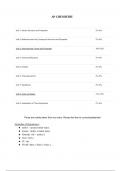
AP CHEMISTRY
Unit 1: Atomic Structure and Properties 7%–9%
Unit 2: Molecular and Ionic Compound Structure and Properties 7%–9%
Unit 3: Intermolecular Forces and Properties 18%–22%
Unit 4: Chemical Reactions 7%–9%
Unit 5: Kinetics 7%–9%
Unit 6: Thermodynamics 7%–9%
Unit 7: Equilibrium 7%–9%
Unit 8: Acids and Bases 11%–15%
Unit 9: Applications of Thermodynamics 7%–9%
These are mainly taken from my notes. Please feel free to correct/update/add
Formulas of Importance:
★ moles = grams/molar mass.
★ grams= moles x molar mass
★ Molarity (M) = moles/L
★ M1V1=M2V2
★ PV=nrt
★ PTotal=Pgas 1+Pgas 2+Pgas 3…
, ★ Pgas1=x1Ptotal, x=mole fraction of a gas
★ c= wavelength x frequency λ= wavelength V= frequency; C= λ x V, λ = C/V
★ Average Atomic mass: (percent abundance one)/100 x mass one + (percent abundance
two)/100 x mass two…
★ Formal charge= Ve - nonbinding electrons (dots) - bond lines
★ △Hrxn = Hproducts- Hreactents
★ q= m x cp x △T; where m=mass, cp=heat capacity for h20 (4.18 J/gk), and △T=change
in temperature.
★ △H Rxn = Σnp△Hf(products)- Σnp△Hf(reactants)
★ △H Rxn = Σ△H(bonds broken/reactents)- Σ△H(bonds formed/products) opposite of
normal
★ A — > B, Rate = -△A/△t= △B/△t
★ Zero Order: [A]= -kt + [A]
★ First order: ln [A[= -kt + ln [A]
★ Second Order: 1/[A]= kt+ 1/[A]
★ At Q=K, the system is at equilibrium.
★ At Q>K, system will shift left to reach equilibrium, making more products
★ At Q<K, the system will shift to the right to reach equilibrium, making more products
★ Ka+ [H3O+][A-]/[HA]
★ HA (aq) + H2O (l) ⟶ H3O+(aq) + A- (aq)
★
Conversions To Know:
Kelvin = C + 273
Compounds To Know:
Polyatomic; NH+ (Ammonium), NO2^(-4) (Nitrate), SO4^(-2) (Sulfate)
Salts; Li+, Na+, K+, Cs+, Rb+
Strong Acids: HCL, HNO3, H2SO4, HCLO4…classes (hcl) break (hbr) internet (hi), not (hno3) sorry
(hso4), clock clock 34 (hclo3 and hclo4) (credit to youtube comment)
Soluble Ions: Alkali metals (Group I: Na+, K+, etc.), Sodium, Na+
Potassium, K+, Ammonium, NH4+, Nitrate, NO3–
Unit One:
General Concepts:
, ● All atoms of a given element are identical in mass and properties
● Compounds are formed by different types of atoms
● A chemical reaction is a rearrangement of atoms
● "Building Blocks" - Electrons, Neutrons and Protons
● Electrons orbit the nucleus
● Neutrons do not contribute to charge, but do contribute to mass
● Protons contribute to mass and charge, and are equal to electrons but with an opposite
charge
● Protons & Neutrons form the nucleus
● Electrons travel around the nucleus, bound to it by electrical force
● Closer charges have more effect on each other
● Opposite charges attract, like charges repel
● Protons determine what element an atom is
● Neutrons give it a varying mass
● An element with a certain number of neutrons is called an isotope
● If/When an isotope has a charge, it is denoted by a subscript
- Atomic Theory
Atomic Number refers to the number of protons in an atom
A mole is an avogadro's number of atoms, 6.02 × 10^23 mol-
If neutral, same number of protons and electrons
Mass Number = Protons and Neutrons
Average atomic mass is the average mass of an isotope
Ionic compounds are made of a positively charged cation and a negatively charged anion
Covalent compounds involve nonmetals bonding together
- Mass Spectroscopy
For finding average atomic mass, you must change to decimal form
Measures mass per charge
Higher mass per charge means a higher radius
Mass/Charge and radius are directly proportional
- Mole Conversions and Applications
The molar mass of a substance is the number of grams there are in a mol.
Molar mass is important as it allows us to convert between mass, moles and the number of
particles. moles = grams/molar mass.
Unit 1: Atomic Structure and Properties 7%–9%
Unit 2: Molecular and Ionic Compound Structure and Properties 7%–9%
Unit 3: Intermolecular Forces and Properties 18%–22%
Unit 4: Chemical Reactions 7%–9%
Unit 5: Kinetics 7%–9%
Unit 6: Thermodynamics 7%–9%
Unit 7: Equilibrium 7%–9%
Unit 8: Acids and Bases 11%–15%
Unit 9: Applications of Thermodynamics 7%–9%
These are mainly taken from my notes. Please feel free to correct/update/add
Formulas of Importance:
★ moles = grams/molar mass.
★ grams= moles x molar mass
★ Molarity (M) = moles/L
★ M1V1=M2V2
★ PV=nrt
★ PTotal=Pgas 1+Pgas 2+Pgas 3…
, ★ Pgas1=x1Ptotal, x=mole fraction of a gas
★ c= wavelength x frequency λ= wavelength V= frequency; C= λ x V, λ = C/V
★ Average Atomic mass: (percent abundance one)/100 x mass one + (percent abundance
two)/100 x mass two…
★ Formal charge= Ve - nonbinding electrons (dots) - bond lines
★ △Hrxn = Hproducts- Hreactents
★ q= m x cp x △T; where m=mass, cp=heat capacity for h20 (4.18 J/gk), and △T=change
in temperature.
★ △H Rxn = Σnp△Hf(products)- Σnp△Hf(reactants)
★ △H Rxn = Σ△H(bonds broken/reactents)- Σ△H(bonds formed/products) opposite of
normal
★ A — > B, Rate = -△A/△t= △B/△t
★ Zero Order: [A]= -kt + [A]
★ First order: ln [A[= -kt + ln [A]
★ Second Order: 1/[A]= kt+ 1/[A]
★ At Q=K, the system is at equilibrium.
★ At Q>K, system will shift left to reach equilibrium, making more products
★ At Q<K, the system will shift to the right to reach equilibrium, making more products
★ Ka+ [H3O+][A-]/[HA]
★ HA (aq) + H2O (l) ⟶ H3O+(aq) + A- (aq)
★
Conversions To Know:
Kelvin = C + 273
Compounds To Know:
Polyatomic; NH+ (Ammonium), NO2^(-4) (Nitrate), SO4^(-2) (Sulfate)
Salts; Li+, Na+, K+, Cs+, Rb+
Strong Acids: HCL, HNO3, H2SO4, HCLO4…classes (hcl) break (hbr) internet (hi), not (hno3) sorry
(hso4), clock clock 34 (hclo3 and hclo4) (credit to youtube comment)
Soluble Ions: Alkali metals (Group I: Na+, K+, etc.), Sodium, Na+
Potassium, K+, Ammonium, NH4+, Nitrate, NO3–
Unit One:
General Concepts:
, ● All atoms of a given element are identical in mass and properties
● Compounds are formed by different types of atoms
● A chemical reaction is a rearrangement of atoms
● "Building Blocks" - Electrons, Neutrons and Protons
● Electrons orbit the nucleus
● Neutrons do not contribute to charge, but do contribute to mass
● Protons contribute to mass and charge, and are equal to electrons but with an opposite
charge
● Protons & Neutrons form the nucleus
● Electrons travel around the nucleus, bound to it by electrical force
● Closer charges have more effect on each other
● Opposite charges attract, like charges repel
● Protons determine what element an atom is
● Neutrons give it a varying mass
● An element with a certain number of neutrons is called an isotope
● If/When an isotope has a charge, it is denoted by a subscript
- Atomic Theory
Atomic Number refers to the number of protons in an atom
A mole is an avogadro's number of atoms, 6.02 × 10^23 mol-
If neutral, same number of protons and electrons
Mass Number = Protons and Neutrons
Average atomic mass is the average mass of an isotope
Ionic compounds are made of a positively charged cation and a negatively charged anion
Covalent compounds involve nonmetals bonding together
- Mass Spectroscopy
For finding average atomic mass, you must change to decimal form
Measures mass per charge
Higher mass per charge means a higher radius
Mass/Charge and radius are directly proportional
- Mole Conversions and Applications
The molar mass of a substance is the number of grams there are in a mol.
Molar mass is important as it allows us to convert between mass, moles and the number of
particles. moles = grams/molar mass.