DIGITAL METHODS – K001194A
2022-2023
If you want to buy, reach out to me to discuss the price ! (stuviachat)
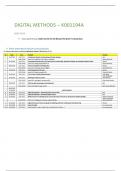
,CHAPTERS:
H1: big data
H2: Computational social science
H3: data viz
H4: collecting data from the web (scraping)
H5: guest lecture – the use of AI
H6: guest lecture – sensors and VR
H7: walkthrough + practical
H8: etno part 1
H9: etno part 2
H10: guest lecture: person specific
H11: digital trace data, intensive longitudinal modelling, predictive, and machine learning
12: exam info
→ practical session (R studio) and tasks are not included in this summary
2
,1. BIG DATA, CLOSE READING, DISTANT READING
When you think about data gathering in a traditional sense. you might think about people providing information
by themselves. For example, updating your profile and status on social media. But data are also collected from
online behavior. Think about cookies. So you can analyze data derived from given data, and data traces.
In our digital society, the availability of data can create opportunities and risks for social research. We can now
observe online experiments and collaborate in ways that were simply not possible in the past. We can also harm
people. Privacy for example. We als need to consider the messiness of online data. There are many differences
between data that is online available to us, and there is data that we’ve collected via a self-made survey.
SITUATING THE COURSE
There is a difference between people that consider themselves as social scientists/ communication scientists vs.
as data scientists.
• Communication scientists have training in studying social behavior. We are less familiar with the
opportunities that are being created by our digital society.
• Data scientists are familiar with the opportunities created by the digital society. These are people who have
lots of experience with using the tools that the digital world provided to them. But they are kinda new to
the study of social behavior.
➔ We both have our advantages and disadvantages. Data scientists had training in computer sciences and so
on. Those people have been the early adaptors of the tools provided by the digital age. Because they also have
the necessary skills and computational skills.
This is mentioned by Salganik (the author of the text that is reading material for this class (ufora)). This is a quote
from Salganik:
“The best way to create this powerful hybrid is not to focus on abstract social theory or fancy machine learning.
The best place to start is research design. If you think of social research as the process of asking and answering
questions about human behavior, then research design is the connective tissue; research design links questions
and answers (Salganik, 2017 p.6).”
CLOSE READING (QUALI)
There have been a lot of discussions about the value of the online realm/ online data. For example:
ethnographers still disagree on whether or not one can study an online community by only engaging with those
people online.
3
, Danah Boyd is someone who works with these ideas. She does online research on teens. She tries to make sense
of teens lives. For her it’s necessary to have a deep understanding of their practices, but also a connection in a
physical way. So, her research approach is basically:
• Starting off with immersing herself in teen pop culture and subcultures. She participates in all of these
online spaces (twitter, Instagram, she follows topics).
• Secondly, she does a participant observation and content analysis of traces on social media.
• Thirdly she does a deep hanging out in physical spaces.
o So, the emphasis of her research is still the classic ethnography where she looks at teens in a
physical environment.
• Finally, she’s also doing semi structured face-to-face interviews
A particular thing that she argues is that the online wing/ social media certainly makes it much easier to peek
into ppl’s lives, but it is also quite easy to misinterpret online traces. Boyd describes a particular situation that
makes this very clear:
Example: Gang isignia on MySpace profile –> indication of Gang involvement?
In 2005 she got a phone call from a college-researcher who was busy with college admissions for college that
year (think about Harvard, Yale, Oxford etc.)
The college was interested in an application of a young black man from a neighborhood of LA. He used to also
be involved in a notorious gang community. The man wrote an essay about leaving his gang behind. But then
they scammed his myspace profile. There they found that his page was still filled with gang shit. So there were
marks that still referred to the involvement with the gang. The man asked Boyd the following question: why
would he lie to us in his college essay? We can clearly find everything online. Boyd presented an alternative
explanation:
Alternative explanation:
“Without knowing the specific boy involved, I surmised that he was probably focused on fitting in, staying safe,
or, more directly, surviving in his home environment. Most likely he felt as though he needed to perform gang
affiliation online—especially if he was not affiliated—in order to make certain that he was not physically
vulnerable.’
➔ Importance of Close reading: interpretation based on detailed analysis.
4
2022-2023
If you want to buy, reach out to me to discuss the price ! (stuviachat)
,CHAPTERS:
H1: big data
H2: Computational social science
H3: data viz
H4: collecting data from the web (scraping)
H5: guest lecture – the use of AI
H6: guest lecture – sensors and VR
H7: walkthrough + practical
H8: etno part 1
H9: etno part 2
H10: guest lecture: person specific
H11: digital trace data, intensive longitudinal modelling, predictive, and machine learning
12: exam info
→ practical session (R studio) and tasks are not included in this summary
2
,1. BIG DATA, CLOSE READING, DISTANT READING
When you think about data gathering in a traditional sense. you might think about people providing information
by themselves. For example, updating your profile and status on social media. But data are also collected from
online behavior. Think about cookies. So you can analyze data derived from given data, and data traces.
In our digital society, the availability of data can create opportunities and risks for social research. We can now
observe online experiments and collaborate in ways that were simply not possible in the past. We can also harm
people. Privacy for example. We als need to consider the messiness of online data. There are many differences
between data that is online available to us, and there is data that we’ve collected via a self-made survey.
SITUATING THE COURSE
There is a difference between people that consider themselves as social scientists/ communication scientists vs.
as data scientists.
• Communication scientists have training in studying social behavior. We are less familiar with the
opportunities that are being created by our digital society.
• Data scientists are familiar with the opportunities created by the digital society. These are people who have
lots of experience with using the tools that the digital world provided to them. But they are kinda new to
the study of social behavior.
➔ We both have our advantages and disadvantages. Data scientists had training in computer sciences and so
on. Those people have been the early adaptors of the tools provided by the digital age. Because they also have
the necessary skills and computational skills.
This is mentioned by Salganik (the author of the text that is reading material for this class (ufora)). This is a quote
from Salganik:
“The best way to create this powerful hybrid is not to focus on abstract social theory or fancy machine learning.
The best place to start is research design. If you think of social research as the process of asking and answering
questions about human behavior, then research design is the connective tissue; research design links questions
and answers (Salganik, 2017 p.6).”
CLOSE READING (QUALI)
There have been a lot of discussions about the value of the online realm/ online data. For example:
ethnographers still disagree on whether or not one can study an online community by only engaging with those
people online.
3
, Danah Boyd is someone who works with these ideas. She does online research on teens. She tries to make sense
of teens lives. For her it’s necessary to have a deep understanding of their practices, but also a connection in a
physical way. So, her research approach is basically:
• Starting off with immersing herself in teen pop culture and subcultures. She participates in all of these
online spaces (twitter, Instagram, she follows topics).
• Secondly, she does a participant observation and content analysis of traces on social media.
• Thirdly she does a deep hanging out in physical spaces.
o So, the emphasis of her research is still the classic ethnography where she looks at teens in a
physical environment.
• Finally, she’s also doing semi structured face-to-face interviews
A particular thing that she argues is that the online wing/ social media certainly makes it much easier to peek
into ppl’s lives, but it is also quite easy to misinterpret online traces. Boyd describes a particular situation that
makes this very clear:
Example: Gang isignia on MySpace profile –> indication of Gang involvement?
In 2005 she got a phone call from a college-researcher who was busy with college admissions for college that
year (think about Harvard, Yale, Oxford etc.)
The college was interested in an application of a young black man from a neighborhood of LA. He used to also
be involved in a notorious gang community. The man wrote an essay about leaving his gang behind. But then
they scammed his myspace profile. There they found that his page was still filled with gang shit. So there were
marks that still referred to the involvement with the gang. The man asked Boyd the following question: why
would he lie to us in his college essay? We can clearly find everything online. Boyd presented an alternative
explanation:
Alternative explanation:
“Without knowing the specific boy involved, I surmised that he was probably focused on fitting in, staying safe,
or, more directly, surviving in his home environment. Most likely he felt as though he needed to perform gang
affiliation online—especially if he was not affiliated—in order to make certain that he was not physically
vulnerable.’
➔ Importance of Close reading: interpretation based on detailed analysis.
4