SOCIAL POLICY
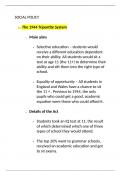
The 1944 Tripartite System
o Main aims
Selective education – students would
receive a different education dependent
on their ability. All students would sit a
test at age 11 (the 11+) to determine their
ability and sift them into the right type of
school.
Equality of opportunity – All students in
England and Wales have a chance to sit
the 11 + . Previous to 1944, the only
pupils who could get a good, academic
equation were those who could afford it.
o Details of the Act
Students took an IQ test at 11, the result
of which determined which one of three
types of school they would attend:
The top 20% went to grammar schools,
received an academic education and got
to sit exams.
, The bottom 80% went to secondary
moderns. These provided a more basic
education, and initially students didn’t sit
any exams.
There were also technical schools which
provided a vocational education, but
these died out fairly quickly.
o Evaluations
There were class inequalities – grammar
schools were mainly taken up by the
middle classes and secondary moderns by
the lower classes.
The IQ test determined pupils futures at a
very young age – no room for those who
developed later in life.
Some of the secondary moderns had very
low standards and labelled 80% of pupils
as failures.
1965 Comprehensives
o Main aims
The 1944 Tripartite System
o Main aims
Selective education – students would
receive a different education dependent
on their ability. All students would sit a
test at age 11 (the 11+) to determine their
ability and sift them into the right type of
school.
Equality of opportunity – All students in
England and Wales have a chance to sit
the 11 + . Previous to 1944, the only
pupils who could get a good, academic
equation were those who could afford it.
o Details of the Act
Students took an IQ test at 11, the result
of which determined which one of three
types of school they would attend:
The top 20% went to grammar schools,
received an academic education and got
to sit exams.
, The bottom 80% went to secondary
moderns. These provided a more basic
education, and initially students didn’t sit
any exams.
There were also technical schools which
provided a vocational education, but
these died out fairly quickly.
o Evaluations
There were class inequalities – grammar
schools were mainly taken up by the
middle classes and secondary moderns by
the lower classes.
The IQ test determined pupils futures at a
very young age – no room for those who
developed later in life.
Some of the secondary moderns had very
low standards and labelled 80% of pupils
as failures.
1965 Comprehensives
o Main aims