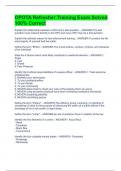
OPOTA Refresher Training Exam Solved 100% Correct
Explain the relationship between a SPO and a test question. - ANSWER-The test question must respond directly to the SPO and every SPO may be a test question. Explain the ultimate reason for law enforcement training. - ANSWER-To protect the life and property of yourself and the public. Define the term "Ethics" - ANSWER-The moral actions, conduct, motives, and character of an individual. State the 4 factors which most likely contribute to unethical behavior: - ANSWER-1. Anger 2. Lust 3. Greed 4. Peer Pressure Identify the 9 ethical responsibilities of a peace officer: - ANSWER-1. Treat everyone professionally 2. Maintain your self-respect 3. To your professionalism 4. To your family 5. To your community 6. NEVER allow doubt to cloud your view of the people whom you serve 7. NEVER using excessive physical force when controlling combative individuals 8. NEVER accepting gratuities 9. NEVER committing perjury Define the term "bribery": - ANSWER-The offering, giving, receiving, or soliciting of something of value for the purpose of influencing the action of a public official in the discharge of his or her public or legal duties. Define the term "crime": - ANSWER-An act of omission done in violation of the law. Identify the five elements of a crime: - ANSWER-- Actus Reus - Harm - Causation - Mens Rea - Concurrence Identify the four culpable mental states: - ANSWER-- Purposely - Knowingly - Recklessly - Negligently Define the term "jurisdiction": - ANSWER-A government's general power to exercise authority over all persons and things within it's territory. Define the term "venue": - ANSWER-The particular county or geographical area in which a court with jurisdiction may hear or determine a case, and in the territory of which the offense or any element of the offense was committed. Define the term "burden of proof": - ANSWER-The duty of proving facts disputed during trial. Define the term "statutory law": - ANSWER-The body of law derived from statutes rather than from constitutions or judicial decisions. Define the term "case law": - ANSWER-The law found in the collection of reported cases that form all of part of the body of law within a given jurisdiction. Define the term "force": - ANSWER-Any violence, compulsion, or constraint physically exerted by any means on or against a person or thing. Define the term "deadly force": - ANSWER-Any force which carries a substantial risk that it will proximately result in the death of any person. Define "physical harm to persons": - ANSWER-Any injury, illness or other physiological impairment, regardless of its gravity or duration. Define "physical harm to property": - ANSWER-Any tangible or intangible damage to property that, in any degree, results in loss to its value or interferes with its use of enjoyment. Define "serious physical harm to persons": - ANSWER-...requires hospitalization or prolonged psychiatric treatment. ...creates a substantial risk of death. ...results in permanent incapacity (partial, temporary, or substantial). ...results in permanent disfigurement (partial, temporary, or serious). ...involves acute or severe pain of such duration to result in substantial suffering; prolonged pain. Define "serious physical harm to property": - ANSWER-Either of the following: - Results in substantial loss to the value of the property or requires a substantial amount of time, effort or money to repair or replace; or - Temporarily prevents the use or enjoyment of the property or substantially interferes with its use or enjoyment for an extended period of time. Identify the 4 elements necessary to constitute an arrest: - ANSWER-1. An intent to arrest. 2. Under real or assumed legal authority. 3. Accompanied by an actual or constructive seizure or detention of the person. 4. Which is understood by the person arrested. Identify the 7 requirements of a valid arrest warrant: - ANSWER-1. Supported by probable cause. 2. Affidavit supported by oath or affirmation. 3. Person seized must be particularly described. 4. Warrant must state the nature of the offense. 5. Warrant must designate the officer or class of officers who are directed to comply with the order of the court. 6. Warrant must be issued in the name of the state or United States. 7. Warrant must be issued and signed by a neutrally detached judicial officer. Identify when probable cause exists: - ANSWER-The facts or circumstances within the officer's knowledge and of which he/she has reasonably trustworthy information sufficient to warrant a person to believe that an offense has been, or is being, committed by the person to be arrested. Identify the 4 requirements for the execution of a valid arrest warrant: - ANSWER-1. The executing officer must be specifically named or fall within the class designated on the warrant. 2. Warrant must be executed within the jurisdictional limits. 3. Arresting officer should make known his/her presence. 4. Officer usually must show the arrest warrant or advise the arrestee that a warrant has been issued. Identify the circumstances under which an arrest warrant may be executed in the home of a 3rd party: - ANSWER-1. Search warrant; or 2. Consent; or 3. Exigent circumstances.
Información del documento
- Subido en
- 17 de mayo de 2023
- Número de páginas
- 5
- Escrito en
- 2022/2023
- Tipo
- Examen
- Contiene
- Preguntas y respuestas