NURS 5333 Final Study Guide Compressed & Revised.
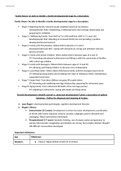
Family theory: be able to identify a family developmental stage by a description. Stage 1: Beginning family- Married couple establish home but no children Developmental Tasks: Establishing a satisfying home and marriage relationship and preparing for childbirth Stage 2: Childbearing Family- From birth of 1st child until that child is 2 ½ years old Developmental Task: Adjusting to increased family size and providing a positive developmental environment Stage 3: Family with Preschoolers- Oldest child is between 2 ½ and 6 Developmental tasks (DT): coping with demands on energy and attention with less privacy at home Stage 4: Family with School Children- When oldest child is between ages of 6 and 13 DT: Promoting educational achievement and fitting in with the community of families with school-age children Stage 5: Family with Teenagers- Oldest child is between ages of 13 and 20 DT: Allowing and helping children to become more independent Stage 6: Launching Centre- When oldest child leaves family until the youngest leaves home DT: Releasing young adults and accepting new ways of relating to them; maintaining a supportive home base Stage 7: Empty Nest- From time children are gone till couple retires DT: Renewing and redefining marriage relationship; preparing for retirement years Stage 8: Aging Family- From retirement till death of the marriage partner DT: Adjusting to retirement; coping with death and living alone. Growth/development: Identify normal vs. abnormal development if given a description of patient behaviors. Define the diagnosis and meaning of Autism. ● Jean Piaget—developmental psychologist; cognitive development theories ● Piaget’s Theory: Sensorimotor (0-2 years): Development is driven by motor development; coordination of senses with motor response, sensory curiosity. Language used for demands and cataloging. Object permanence developed. Preoperational (2-7 years): Symbolic thinking, use of proper syntax and grammar to express full concepts. Imagination and intuition are strong, but complex abstract thought still difficult. Conservation developed. Important milestones Age Milestones Newborn ● Vision is highly limited at birth (8-12 inches) ● Fixes on moving objects ● Prefers human face; establishes eye contact around one month of age ● Infant will tend to lay in flexed position; will turn head from side to side ● On horizontal suspension there will be some head sagging, but infant should not be hypotonic ● All primitive reflexes should be present Moro, grasp, rooting, tonic neck, etc. ● Infant should regain birthweight by 2 weeks and grow 30 g/day until 4 months of age ● (birth weight should double at this point) If they are premature, you have to correct for that ● Reacts to voice by one month of age—if child is not reacting, think of hearing loss ● Crying peaks around 6 weeks of age (up to 3 hours per day) 1 month old Reacts to voice, establishes eye contact 2 months old ● Infant is able to differentiate among patterns, colors, and consonants, but due to the baby’s yet-limited ability to communicate, this may be difficult to notice ● Infant should be able to track an object horizontally at 180 degrees—can track to midline ● Head lag should be gone and the head and trunk should be held in the same plane on horizontal suspension ● Social smile ● Will listen to voice and make cooing sounds—cooing is vocal development, not lang
Escuela, estudio y materia
- Institución
-
University Of Texas - Arlington
- Grado
-
NURS 5333
Información del documento
- Subido en
- 4 de mayo de 2023
- Número de páginas
- 87
- Escrito en
- 2022/2023
- Tipo
- Otro
- Personaje
- Desconocido
Temas

Documento también disponible en un lote