Hesi Nursing Mark Klimek Notes.
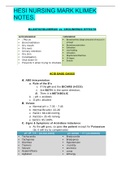
Mz.ANTICHOLINERGIC vs. CHOLINERGIC EFFECTS ANTICHOLINERGIC CHOLINERGIC • Mucus • Bronchodilation • Dry mouth • Dry eyes • Urinary retention • Dry skin • Constipation • Shut down GI • Prevents V when trying to intubate • Bronchorrhea (large amounts of mucus in airway) • Bronchoconstriction • Salivation • Lacrimating • Urination • Diaphoresis/Diarrhea • GI Upset • Emesis ACID BASE GASES A. ABG Interpretation a. Rule of the B’s i. If the pH and the BICARB (HCO3) ii. Are BOTH in the same direction, iii. Then it is METABOLIC b. pH = acidosis c. pH= alkaline B. Values a. Normal pH = 7.35 – 7.45 b. Normal Bicarb= 22-26 c. PaO2= 80-100 mmHg d. PaCO2= 35-45 mmHg e. SaO2= 95-100% C. Signs & Symptoms of Acid-Base Imbalance a. As the pH goes, so goes the patient except for Potassium (bc it will try to compensate) • Borborygmi ( bowel sounds) • Hypertension • Palpitations • Tetany • Anxiety/Panic • Poly • cardia arrest • suppressed, decreased, falling D. Causes of Acid-Base Imbalance a. First ask, “Is it Lung?” i. If YES- then it is Respiratory b. Then ask yourself: i. Are they Overventilating or Underventilating? 1. If Overventilating pick Alkalosis 2. If Underventilating pick Acidosis c. If not lung, then it’s Metabolic i. If the patient has prolonged gastric vomiting or suction, pick Metabolic Alkalosis ii. For everything else that isn’t lung, pick Metabolic Acidosis 1. Also, if you don’t know what to pick choose Metabolic Acidosis VENTILATOR ALARMS 1. High Pressure Alarms are triggered by resistance to air flow and can be caused by obstructions of three types: a. Kinked Tube i. NRS ACTION: Unkink it b. Water in tubing (caused by condensation) i. NRS ACTION: Empty it/Remove H2O c. Mucus in airway i. NRS ACTION: Turn, C&DB; only use suction if C&DB fails, as a last resort 2. Low Pressure Alarms are triggered by resistance to air flow and can be caused by disconnections of the: a. Tubing i. NRS ACTION: Pay attention to where tubing is…(contamination) ii. If on floor, change out iii. If on chest, clean with alcohol then put back on 3. Respiratory Alkalosis (Overventilation) means ventilator settings may be too HIGH. 4. Respiratory Acidosis (Underventilation) means ventilator settings may be too LOW. 5. To “Wean” To gradually and incrementally decrease with the goal of ridding all together ALCOHOLISM Note: Remember in a psych question if you are asked to prioritize DO NOT forget Maslow! Use the following priorities: 1. Physiological 2. Safety 3. Comfort 4. Psychological 5. Social 6. Spiritual Also, ALL PSYCH PATIENTS START AS MED SURG PATIENTS…RULE OUT ALL FEASIBLE MED ANSWERS BEFORE PICKING PSYCH ANSWERS 1. Psychodynamics of Alcoholism a. The #1 psychological problem in abuse is DENIAL. i. Definition: 1. Refusal to accept the reality of their problem. ii. Treatment: 1. Confront it by pointing out to the person the difference between what they say and what they do. 2. In contrast, support the denial of loss and grief (BC the use of denial is serving a functioning person) b. DEPENDENCY/CODEPENDENCY i. Dependency: When the abuser gets the significant other to do things for them or make decisions for them. ii. Codependency: When the significant other derives positive self-esteem from doing other things for or making decisions for the abuser. iii. Treatment: 1. Set boundary (limits) and enforce them. Agree in advance on what requests are allowed then enforce the agreement 2. Work on the self-esteem of the codependent person. c. MANIPULATION i. Definition: When the abuser gets the significant other to do things for him/her that are not in the best interest of the Significant Other. The nature of the act is dangerous or harmful to the significant other ii. Treatment: 1. Set limits and enforce 2. Its easier to treat than dependency/codependency because nobody likes to be manipulated 2. Wernicke’s (Korsakoff’s) Syndrome a. Psychosis induced by Vitamin B1 (Thiamine) deficiency. b. Primary symptom: amnesia with confabulation (making up stories to fill in memory loss—believe as true) c. Characteristics: i. Preventable 1. By giving B1 vitamins ii. Arrestable 1. Can stop from getting worse- not imply better iii. Irreversible 1. Dementia symptoms don’t get better—only worse 3. Antabuse/Revia a. Disulfiram (drugs used for alcoholism b. Aversion Therapy c. Onset and duration of effectiveness: 2 weeks i. Take drugs 2 weeks and builds up in blood to a level that when drinking alch will become horribly sick; if off for two weeks, will be able to drink without sickness again d. Patient teaching: Avoid ALL forms of alcohol to avoid nausea, vomiting, and possibly death, including: i. Mouthwash, aftershave, perfumes/cologne, insect repellant, vinigarettes (salad dressings), vanilla extract, elixirs (contains alch-OTC med), alcohol prep pad, alch sanitizers OVERDOSE VS. WITHDRAWAL First ask yourself, is the drug an upper or a downer? UPPERS DOWNERS Signs/Symptoms: • Tachycardia • Hypertension • Diarrhea • Agitation • Tremors • Clonus • Belligerence • Seizures • Exaggerated, shrill, high pitched cry • Difficult to console Signs/Symptoms: • Bradycardia • Hypotension • Constipation • Constricted pupils • Flaccidity • Respiratory arrest • Decreased core body temp Then ask yourself, “Are they talking about overdose or withdrawal?” Overdose/Intoxication Withdrawal “I have too much…” “I don’t have enough..” Too much upper: Everything is UP Too little upper: Everything is DOWN Too much downer Everything is DOWN Too little downer: Everything is UP Drug Addiction in the Newborn Always assume intoxication (first 24 hours after birth), then after this time, assume withdrawal Alcohol Withdrawal Syndrome vs. Delirium Tremens 1. Differences: a. Every alcoholic goes through alcohol withdrawal syndrome (AWS) (after 24 hours) b. Only a minority get delirium tremors (DT) c. AWS is not life threatening. DT’s can kill you. d. Patients with AWS are not dangerous to themselves or others. Patients with DTs are dangerous to self and others. AWS DT’s BOTH Semi-private-anywhere Private-near nurses station Anti-hypertensives Regular diet Clear liquids or NPO Tranquilizer Up Ad Lib (no activity restriction) Restricted bedrest (no bathroom privileges) B1 multi-vitamin (to prevent dementia) Do not restrain Should be restrained (2 pt leather restraints) 2 extremity restricted—arm on one side and leg on one, one upper extremity and one opposite lower extremity AMINOGLYCOSIDES 1. Think “A mean old mycin” 2. Powerful antibiotics—to treat severe, life-threatening, resistant infections 3. All aminoglycosides end in ‘mycin’, but not all drugs that end in mycin are aminoglycosides. For example.. a. Azithromycin, clarithromycin, erythromycin thromycin NOT 4. Examples of aminoglycosides: Streptomycin, Cleomycin, Tobramycin, Gentamicin, Vancomycin, Clindamycin 5. Toxic Effects: a. The most famous feature of the worlds most famous mouse (ears) i. Toxic effect: ototoxicity ii. Must monitor hearing, balance, tinnitus b. The human ear is shaped like a kidney i. Toxic effect: nephrotoxicity ii. Monitor: creatinine 1. Best indicator of kidney function 2. 0.6-1.2 mg/dL c. The number 8 drawn inside the ear reminds you of: i. Cranial nerve 8 (Drug toxic to) ii. Frequency of administration: Every 8 hours 6. Route of Administration a. Give IM or IV b. Do not give PO (not absorbed) except in these two cases: i. Hepatic encephalopathy 1. Also called Liver Coma, Ammonia-Induced Encephalopathy 2. When want a sterile bowel 3. Due to a high ammonia level ii. Pre-op Bowel surgery 1. REMEMBER this military sound off: a. NEOmycin b. KANmycin c. WHO CAN STERILIZE MY BOWEL? NEO KAN d. ^ PO, 2 bowel sterilizers 7. Trough and Peak Levels a. Reason for drawing TAP levels: narrow therapeutic range b. Time table: ROUTE TROUGH (lowest) PEAK (highest) Sublingual 30 min before next dose 5-10 mins after drug dissolve IV 30 min before next dose 15-30 min after drug finished IM 30 min before next dose 30-60 min after drug given SQ 30 min before next dose See diabetes lecture PO 30 min before next dose Forget about it. BIOTERRORISM 1. Categories of Biological Agents a. Category A (Most serious) i. Small pox ii. Tularemia iii. Anthrax iv. Plague v. Hemorrhagic fever [Ebola] vi. Botolism b. Category B i. All others. A long list. c. Category C i. Hanta virus ii. Nipeh virus 2. Category A Biological Agents a. Smallpox i. Inhaled transmission/on Airborne Precautions ii. Dies from septicemia. Blood infection. *only class A that dies from this. iii. Rash starts around mouth first (early ID & isolation is crucial to contain) b. Tularemia i. Inhaled ii. Chest symptoms (coughing, chest pain, sputum) iii. Dies from respiratory failure iv. Treat with Streptomycin (watch hearing and creatinine) c. Anthrax i. Spread by inhalation ii. Looks like flu (chest symptoms and achy muscles) iii. Dies from respiratory failure iv. Treat with Cipro, PCN, and streptoycin d. Plague i. Spread by inhalation ii. Has the 3 H’s: 1. Hemoptysis (coughing up blood) 2. Hematemesis (vomiting blood) 3. Hematochezia (bloody diarrhea) iii. Dies from respiratory failure and DIC iv. Treat with Doxycycline and Mycins v. No longer communicable after 24 hours of treatment e. Hemorrhagic Fever [Ebola] i. 21 day time frame ii. Primary symptoms are petechair and ecchymosis iii. High % fatal iv. Die of DIC f. Botolism i. Ingested (drink/eat) ii. Has 3 major symptoms: 1. Descending paralysis (starts at head-goes down to diaphragm) 2. Fever 3. But is alert iii. Dies from respiratory failure 3. Chemical Agents a. Mustard Gas Blisters (Vesicant, eventually cover airway) b. Cyanide Respiratory arrest. Treat with Sodium Thiosulfate IV c. Phosgine chloride Choking d. Sarin Nerve agent. i. Symptoms (Cholinergic Effects) 1. Bronchorrhea 2. Bronchoconstriction 3. Salivation 4. Lacrimating 5. Urination 6. Diaphoresis/diarrhea 7. GI upset 8. Emesis 4. All chemical agents require only soap and water cleansing except for Sarin, which requires a bleach a. Nursing Actions: Bioterrorism- Isolation, Antibiotics b. Chemical: Decontamination i. Send all suspected cases to decontamination center ii. Remove all clothing iii. Chemical hazard double bag iv. Incinerated v. Shower in soap and water (bleach- sarin) vi. Discharged in government clothes CALCIUM CHANNEL BLOCKERS Note: They are like Valium for your heart 1. Calcium Channel Blockers: Negative [ ino, chrono, dromo ] Dig is only drug that mixes + & - effects; other 99% either have + or - ACTION DEFINITION POSITIVE NEGATIVE Inotropic Strength of heartbeat Strong Weak Chronotropic Rate of heartbeat Fast Slow Dromotropic Conductivity Excitable Blocks/Slows conduction 2. What do Calcium Channel Blockers treat? (Indications) a. Antihypertensives (BP way UP-relaxes blood vessels) b. Antianginal (relaxes- reduces O2 demand) c. Anti Atrial Arrthymia (does not tx ventricular arrthymias) 3. Side Effects(): a. Headache b. Hypotension c. Bradycardia 4. Names of Calcium Channel Blockers a. –soptin (Verapeunil) b. –zem c. –dipine 5. Nursing Actions: before administrating – BP systolic lower than 100..if 100 hold and call Dr CARDIAC ARRYTHMIAS 1. Terminology a. “QRS depolarization” always refer to ventricular (not atrial, junctional, or nodal) b. “P wave” refers to atrial 2. Six rhythms tested on NCLEX a. Asystole i. A lack of QRS depolarization’s (a straight line) b. Atrial flutter i. Rapid P-wave depolarization’s in a saw-tooth (flutter) c. Atrial fibrillation i. Chaotic P-wave depolarization’s (lacks any discernable pattern) d. Ventricular fibrillation i. Chaotic QRS depolarization’s e. Ventricular tachycardia i. Wide, bizarre QRS’s ii. Tachy is always discernable repeating pattern f. Premature ventricular contractions (PVC) i. Periodic wide, bizarre QRS’s ii. Generally low to moderate priority. unless everyone else has a normal rhythm iii. Be concerned, if: 1. More than 6 per m
Información del documento
- Subido en
- 10 de abril de 2023
- Número de páginas
- 65
- Escrito en
- 2022/2023
- Tipo
- Notas de lectura
- Profesor(es)
- Mark klimek
- Contiene
- Todas las clases