

Unit 8
B: understand the impact of disorder on the physiology of the lymphatic system and
the associated corrective treatment.
P3
Structure of the lymphatic system
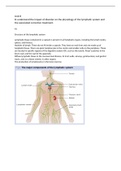
Lymphatic tissue contained in a capsule is present in all lymphatic organs, including the lymph nodes,
spleen, and thymus.
Nodules of lymph. These do not fit inside a capsule. They have an oval form and are made up of
lymphatic tissue. There are giant lymphocytes in the centre and smaller cells on the periphery. These
are located in specific regions of the digestive system (Gl), such as the tonsils, Peyer's patches in the
ileum wall, and the wall of the appendix.
Diffuse lymphatic tissue in the mucosal membranes, GI tract walls, airways, genitourinary and genital
tracts, and, to a lesser extent, in other organs.
The production of lymphocytes in the bone marrow.
, Spleen
The spleen, which is roughly the size of your fist, is the biggest lymphoid organ. It is an organ in your
belly with an oval shape. It is situated between your stomach and diaphragm under your left rib
cage. It combats any invasive pathogens in the blood (the spleen includes white blood cells that fight
infections). It regulates the quantity of platelets, which are tiny cells that help blood clot, white
blood cells, and red blood cells. Red blood cells that are damaged or old are removed from the blood
after screening. The spleen also plays a crucial role in the blood's purification process. Blood is
drained of its platelets and old, damaged blood cells, which are then destroyed. It rids the blood of
toxins, pathogens, viruses, and other foreign materials. Additionally, it preserves blood platelets and
disperses some components of ageing, degraded red blood cells into the bloodstream to be carried
to the liver or bone marrow for recycling (such as iron).
Thymus gland
The thymus gland of a lobulated lymphoid is found in the neck and thoracic cavities. The thymus
gland is not permanently a part of your body. It supports immune system development up to
puberty; following puberty, it begins to contract and is replaced by fat. The cortical and medullary
sections of the lobules are made up of different follicle types. The cortical portion, which is
predominantly made up of lymphocytes and is supported by epithelial cells, is located on the border
of the follicle. In comparison to the cortex, the medullary, which is found in the centre of the
follicles, has more epithelial cells and less lymphocytes. There are concentrically arranged epithelial
cells called Hassall's corpuscles, which have an unclear function. The main function of the thymus
gland is to produce T cells, which are responsible for protecting your organs from infection and
antibodies. T-cells, a type of white blood cell created to strengthen the immune system, mature in
B: understand the impact of disorder on the physiology of the lymphatic system and
the associated corrective treatment.
P3
Structure of the lymphatic system
Lymphatic tissue contained in a capsule is present in all lymphatic organs, including the lymph nodes,
spleen, and thymus.
Nodules of lymph. These do not fit inside a capsule. They have an oval form and are made up of
lymphatic tissue. There are giant lymphocytes in the centre and smaller cells on the periphery. These
are located in specific regions of the digestive system (Gl), such as the tonsils, Peyer's patches in the
ileum wall, and the wall of the appendix.
Diffuse lymphatic tissue in the mucosal membranes, GI tract walls, airways, genitourinary and genital
tracts, and, to a lesser extent, in other organs.
The production of lymphocytes in the bone marrow.
, Spleen
The spleen, which is roughly the size of your fist, is the biggest lymphoid organ. It is an organ in your
belly with an oval shape. It is situated between your stomach and diaphragm under your left rib
cage. It combats any invasive pathogens in the blood (the spleen includes white blood cells that fight
infections). It regulates the quantity of platelets, which are tiny cells that help blood clot, white
blood cells, and red blood cells. Red blood cells that are damaged or old are removed from the blood
after screening. The spleen also plays a crucial role in the blood's purification process. Blood is
drained of its platelets and old, damaged blood cells, which are then destroyed. It rids the blood of
toxins, pathogens, viruses, and other foreign materials. Additionally, it preserves blood platelets and
disperses some components of ageing, degraded red blood cells into the bloodstream to be carried
to the liver or bone marrow for recycling (such as iron).
Thymus gland
The thymus gland of a lobulated lymphoid is found in the neck and thoracic cavities. The thymus
gland is not permanently a part of your body. It supports immune system development up to
puberty; following puberty, it begins to contract and is replaced by fat. The cortical and medullary
sections of the lobules are made up of different follicle types. The cortical portion, which is
predominantly made up of lymphocytes and is supported by epithelial cells, is located on the border
of the follicle. In comparison to the cortex, the medullary, which is found in the centre of the
follicles, has more epithelial cells and less lymphocytes. There are concentrically arranged epithelial
cells called Hassall's corpuscles, which have an unclear function. The main function of the thymus
gland is to produce T cells, which are responsible for protecting your organs from infection and
antibodies. T-cells, a type of white blood cell created to strengthen the immune system, mature in

