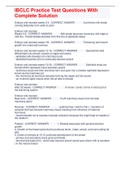
IBCLC Practice Test Questions With Complete Solution
IBCLC Practice Test Questions With Complete Solution Embryo and neonate weeks 3-4 - CORRECT ANSWER A primitive milk streak running bilaterally from axilla to groin Embryo and neonate Weeks 4-5 - CORRECT ANSWER Milk streak becomes mammary milk ridge or milk line . Paired breasts develop from this line of glandular tissue Embryo and neonate weeks 7/8 - CORRECT ANSWER Thickening and inward growth into chest wall continue Embryo and neonate weeks 12-16 - CORRECT ANSWER Specialized cells differentiate into smooth muscle of nipple and areola - epithelial cells develop into mammary buds - epithelial branches form to eventually become alveoli Embryo and neonate weeks 15-25 - CORRECT ANSWER Epithelial strips are formed which represent future secretory alveoli - lactiferous ducts and their branches form and open into a shallow epithelial depression known as the mammary pit - the mammary pit becomes elevated forming the nipple and the areola - an inverted nipple results when the pit fails to elevate Embryo and neonate After 32 weeks - CORRECT ANSWER A lumen ( canal ) forms in each part of the branching system Embryo and neonate Near term - CORRECT ANSWER 15-25 mammary ducts form the fetal mammary gland Neonate - CORRECT ANSWER - galactorrhea ( witch's milk ) : secretion of colostral like fluid neonate mammary tissue resulting from influence of maternal hormones - recommended not to express neonatal colostrum because this might lead to mastitis in the newborn Puberty - CORRECT ANSWER 1. Breasts keep pace with general physical growth 2. Growth of the breast parenchyma produces ducts , lobes, alveoli, and surrounding fat pad 3. Onset of menses at 10-12 continues development of the breast - primary and secondary ducts grow and divide . - terminal end buds form , which later become alveoli (small sacs where milk is secreted ) in the mature breast - proliferation and active growth of duct tissue takes place during each period and continues to about 35 years of age Pregnancy breast Development - CORRECT ANSWER 1. Complete development of mammary function occurs only in pregnancy 2. Breast size increases , skin appears thinner , and veins become more prominent 3. Areola diameter increases - Montgomery glands enlarge , and nipple pigment darkens Anomalies in breast Development - CORRECT ANSWER 1. Illnesses, chemo, therapeutic radiation to the chest , chest surgery , or injuries to the chest might affect development 2. Programmed apoptosis ( cell death ) has been suggested as one reason for lower breast cancer rates in bf women Exterior breast - CORRECT ANSWER Located in the superficial fascia ( fibrous tissue beneath skin) between 2nd rib and 6th intercostal space Tail of spence - CORRECT ANSWER Mammary glandular tissue that projects into the axillary region - distinguished from the supernumerary tissue because it connects to the duct system - potential are of milk pooling and mastitis Skin surface of Breast contains - CORRECT ANSWER Nipple, areola, and Montgomery glands Size - CORRECT ANSWER Not related to functional capacity Gives breast it's Shape and size - CORRECT ANSWER Fat composition Size may indicate - CORRECT ANSWER Milk storage potential Nipple - CORRECT ANSWER Conical elevation located slightly below center of areola Average diameter of Nipple - CORRECT ANSWER 1.6cm Average length of Nipple - CORRECT ANSWER 0.7 cm Hoe many milk Duct openings In nipple - CORRECT ANSWER 5-10 Smooth muscle fibers Function as a - CORRECT ANSWER Closure mechanism to keep milk from continuously leaking from the nipple The nipple is Densely innervated With - CORRECT ANSWER Sensory nerve endings What makes the nipple erect when contracted - CORRECT ANSWER Longitudinal inner muscles and outer circular and radial muscles Venostasis - CORRECT ANSWER Slows blood flow and decreases surface area Areola - CORRECT ANSWER Dark pigmented area that surrounds the nipple - elastic like nipple Average diameter Of areola - CORRECT ANSWER 6.4 cm
Escuela, estudio y materia
- Institución
- IBCLC
- Grado
- IBCLC
Información del documento
- Subido en
- 25 de marzo de 2023
- Número de páginas
- 59
- Escrito en
- 2022/2023
- Tipo
- Examen
- Contiene
- Preguntas y respuestas
Temas
- ibclc
- ibclc practice test
-
ibclc practice test questions with complete solution
-
embryo and neonate weeks 3 4
-
embryo and neonate weeks 4 5

Documento también disponible en un lote