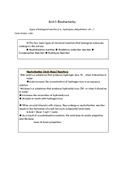
Unit 1: Biochemistry
Types of biological reaction (i.e., hydrolysis, dehydration, etc…)
Case studys, Labs
➔ The four main types of chemical reactions that biological molecules
undergo in the cell are
◆ Neutralization reaction ◆ Oxidation-reduction reaction ◆
Condensation Reaction ◆ Hydrolysis Reaction
Neutralization (Acid-Base) Reactions
➔An acid is a substance that produces hydrogen ions, H+ , when it dissolves in
water
◆acids increase the concentration of hydrogen ions in an aqueous
solution
➔A base is a substance that produces hydroxide ions, OH− m when it dissolves
in water
◆ Increases the convention of hydroxide ions
◆ Accepts or reacts with hydrogen ions
◆ When an acid interacts with a base, they undergo a neutralization reaction
results in the formation of a salt (an ionic compound) and water.
● Acid + Base → salt + water
◆ As a result of a neutralization reaction, the acid loses its acidic properties
and the base
loses its basic properties.
, Oxidation-Reduction Reactions
- Oxidation is a process where a molecule loses electrons and
becomes oxidized
◆ When one molecule undergoes oxidation, the reverse process must
also occur to another molecule.
➔ Reduction is a process
where a molecule accepts electrons from an oxidized molecule, and becomes
reduced
➔ Oxidations and reductions
occur at the same time, the whole reaction is called an oxidation
◆ Common type of redox
reaction :
Combustion reaction
● C3H8 + 5O2 → 3CO2 + 4H2O
○ The propane is oxidized, and the oxygen is reduced.
○ This reaction also releases a large amount of energy
◆ Cellular respiration is
another type of example
● C6H12O6 + 6CO2 → 6CO2 + 6H2O
- The energy released at each step in the series is stored in the form of
chemical bonds of molecules that are made during the process
Types of biological reaction (i.e., hydrolysis, dehydration, etc…)
Case studys, Labs
➔ The four main types of chemical reactions that biological molecules
undergo in the cell are
◆ Neutralization reaction ◆ Oxidation-reduction reaction ◆
Condensation Reaction ◆ Hydrolysis Reaction
Neutralization (Acid-Base) Reactions
➔An acid is a substance that produces hydrogen ions, H+ , when it dissolves in
water
◆acids increase the concentration of hydrogen ions in an aqueous
solution
➔A base is a substance that produces hydroxide ions, OH− m when it dissolves
in water
◆ Increases the convention of hydroxide ions
◆ Accepts or reacts with hydrogen ions
◆ When an acid interacts with a base, they undergo a neutralization reaction
results in the formation of a salt (an ionic compound) and water.
● Acid + Base → salt + water
◆ As a result of a neutralization reaction, the acid loses its acidic properties
and the base
loses its basic properties.
, Oxidation-Reduction Reactions
- Oxidation is a process where a molecule loses electrons and
becomes oxidized
◆ When one molecule undergoes oxidation, the reverse process must
also occur to another molecule.
➔ Reduction is a process
where a molecule accepts electrons from an oxidized molecule, and becomes
reduced
➔ Oxidations and reductions
occur at the same time, the whole reaction is called an oxidation
◆ Common type of redox
reaction :
Combustion reaction
● C3H8 + 5O2 → 3CO2 + 4H2O
○ The propane is oxidized, and the oxygen is reduced.
○ This reaction also releases a large amount of energy
◆ Cellular respiration is
another type of example
● C6H12O6 + 6CO2 → 6CO2 + 6H2O
- The energy released at each step in the series is stored in the form of
chemical bonds of molecules that are made during the process