Unit 2: Metabolic Processes
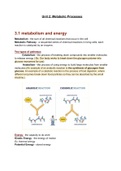
3.1 metabolism and energy
Metabolism - the sum of all chemical reactions that occur in the cell
Metabolic Pathway - a sequential series of chemical reactions in living cells; each
reaction is catalyzed by an enzyme.
Two types of pathways
Catabolism - the process of breaking down compounds into smaller molecules
to release energy ( Ex. Our body works to break down the glycogen polymer into
glucose monomers for use)
Anabolism - the process of using energy to build large molecules from smaller
molecules (An example of an anabolic reaction is the synthesis of glycogen from
glucose. An example of a catabolic reaction is the process of food digestion, where
different enzymes break down food particles so they can be absorbed by the small
intestine.)
Energy - the capacity to do work
Kinetic Energy - the energy of motion
Ex. thermal energy
Potential Energy - stored energy
, Ex. chemical energy stored in bonds, energy stored in electrochemical gradients
Bond Energy - the energy required to form or break a bond
(amount of energy to form = amount of energy to break)
Types of energy released include:
- Thermal energy (heat)
- Movement across a membrane (active transport)
- Muscle contraction (microfilaments)
- Emission of light
Reaction Pathways: the body will use the energy released from one reaction, to power
the next reaction
1) ATP → ADP + Energy
2) Energy + Carrier protein + solute → active transport
Biological Systems (including our own bodies) are open systems (both matter
and energy can be exchanged.
Any reaction that requires an input reaction that releases of energy is said to be
endergonic, which literally means "inward energy:
Reactions that release the excess free energy as heat and are said to be
exergonic, which literally means "outward energy."
3.1 metabolism and energy
Metabolism - the sum of all chemical reactions that occur in the cell
Metabolic Pathway - a sequential series of chemical reactions in living cells; each
reaction is catalyzed by an enzyme.
Two types of pathways
Catabolism - the process of breaking down compounds into smaller molecules
to release energy ( Ex. Our body works to break down the glycogen polymer into
glucose monomers for use)
Anabolism - the process of using energy to build large molecules from smaller
molecules (An example of an anabolic reaction is the synthesis of glycogen from
glucose. An example of a catabolic reaction is the process of food digestion, where
different enzymes break down food particles so they can be absorbed by the small
intestine.)
Energy - the capacity to do work
Kinetic Energy - the energy of motion
Ex. thermal energy
Potential Energy - stored energy
, Ex. chemical energy stored in bonds, energy stored in electrochemical gradients
Bond Energy - the energy required to form or break a bond
(amount of energy to form = amount of energy to break)
Types of energy released include:
- Thermal energy (heat)
- Movement across a membrane (active transport)
- Muscle contraction (microfilaments)
- Emission of light
Reaction Pathways: the body will use the energy released from one reaction, to power
the next reaction
1) ATP → ADP + Energy
2) Energy + Carrier protein + solute → active transport
Biological Systems (including our own bodies) are open systems (both matter
and energy can be exchanged.
Any reaction that requires an input reaction that releases of energy is said to be
endergonic, which literally means "inward energy:
Reactions that release the excess free energy as heat and are said to be
exergonic, which literally means "outward energy."