

IOP2602 – Organisational Psychology
LEARNING UNIT 4: Motivation concepts (CHAPTER 4)
1. What is motivation
Motivation the processes that account for an individual's intensity, direction and persistence of effort toward
attaining a goal.
3 key elements.
1. Intensity – concerned with how hard a person tries. This is the element that most focus on when we talk
about motivation.
2. Direction – benefits the organisation. Consider the quality of effort as well as intensity.
3. Persistence – measure of how long a person can maintain effort. Motivated individuals stay with a task
long enough to achieve their goals.
2. Early Theories of Motivational Ability
They represent a foundation from which contemporary theories have grown. Practicing managers still regularly use
these theories and their terminology in explaining employee motivation.
Marlow’s Hierarchy of Needs
• Physiological needs include hunger, thirst, shelter, sex and other bodily needs.
• Safety needs include security and protection from physical and emotional harm.
• Social needs include affection, a feeling of belonging, acceptance and friendship.
• Need for esteem includes internal esteem factors, such as self-respect, autonomy and achievement; and external esteem
factors, such as status, recognition and attention.
• Self-actualisation is the drive to become what you are capable of becoming, which includes growth, achieving your
potential and self-fulfilment.
Maslow separated the five needs into higher and lower orders. Physiological and safety needs were described as
lower-order needs and social, esteem, and self-actualisation as higher-order needs.
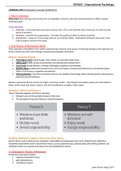
McGregor’s Theory X and Theory Y
Theory X (basically negative) and Theory Y (positive):
• Managers use a set of assumptions based on their view.
• The assumptions shape their behaviour towards employees.
Herzberg’s Motivation- Hygiene Theory (Two-factor theory)
Intrinsic factors, such as advancement, recognition, responsibility and achievement seem to be related to job satisfaction.
Dissatisfied respondents tend to cite extrinsic factors, such as supervision, pay, company policy and working conditions. Job
satisfaction factors are separate and distinct from job dissatisfaction factors.
3. Contemporary Theories of Motivation
Six theories in the section entitled
1. cognitive evaluation theory;
2. goal-setting theory;
3. self-efficacy theory;
Lyana Petzer Page 1 of 5
, IOP2602 – Organisational Psychology
4. reinforcement theory;
5. equity theory; and
6. expectancy theory
Self-determination theory theory proposes that people are driven by a need for autonomy as well as seek ways to
achieve competence and positive connection with others.
Cognitive evaluation theory
A version of self-determination theory which holds that allocating extrinsic rewards for behaviour that had been
previously intrinsically rewarding tends to decrease the overall level of motivation if the rewards are seen as
controlling.
Goal-setting theory
The basic premise is that specific and difficult goals, with self-generated feedback, result in higher performance.
• Difficult goals:
- focus and direct attention.
- energise the person to work harder.
- increase persistence.
- force people to be more effective and efficient.
• The relationship between goals and performance depends on:
- goal commitment (the more public the better!)
- task characteristics (simple, well learnt)
- culture (best match is in North America)
• Management by objectives (MBO) is a systematic way to utilise goal setting. Goals must be:
- Tangible
- Verifiable
- Measurable
❖ (MBO emphasises a participative setting of goals that are tangible, verifiable and measurable.
Self-efficacy theory
The basic premise is an individual’s belief that they are capable of performing a task.
• Higher efficacy is related to:
- greater confidence
- greater persistence in the face of difficulties
- a better response to negative feedback (work harder)
• Self-efficacy complements goal-setting theory.
Goal-setting theory and self-efficacy theory don’t compete with one another. The most important source of
increasing self-efficacy is what he calls enactive mastery – that is, gaining relevant experience with the task or job.
The 2nd source is vicarious modelling – or becoming more confident because you see someone else doing the task.
The 3rd source is verbal persuasion, which is becoming more confident because someone convinces you that you
have the skills necessary to be successful.
Lyana Petzer Page 2 of 5
LEARNING UNIT 4: Motivation concepts (CHAPTER 4)
1. What is motivation
Motivation the processes that account for an individual's intensity, direction and persistence of effort toward
attaining a goal.
3 key elements.
1. Intensity – concerned with how hard a person tries. This is the element that most focus on when we talk
about motivation.
2. Direction – benefits the organisation. Consider the quality of effort as well as intensity.
3. Persistence – measure of how long a person can maintain effort. Motivated individuals stay with a task
long enough to achieve their goals.
2. Early Theories of Motivational Ability
They represent a foundation from which contemporary theories have grown. Practicing managers still regularly use
these theories and their terminology in explaining employee motivation.
Marlow’s Hierarchy of Needs
• Physiological needs include hunger, thirst, shelter, sex and other bodily needs.
• Safety needs include security and protection from physical and emotional harm.
• Social needs include affection, a feeling of belonging, acceptance and friendship.
• Need for esteem includes internal esteem factors, such as self-respect, autonomy and achievement; and external esteem
factors, such as status, recognition and attention.
• Self-actualisation is the drive to become what you are capable of becoming, which includes growth, achieving your
potential and self-fulfilment.
Maslow separated the five needs into higher and lower orders. Physiological and safety needs were described as
lower-order needs and social, esteem, and self-actualisation as higher-order needs.
McGregor’s Theory X and Theory Y
Theory X (basically negative) and Theory Y (positive):
• Managers use a set of assumptions based on their view.
• The assumptions shape their behaviour towards employees.
Herzberg’s Motivation- Hygiene Theory (Two-factor theory)
Intrinsic factors, such as advancement, recognition, responsibility and achievement seem to be related to job satisfaction.
Dissatisfied respondents tend to cite extrinsic factors, such as supervision, pay, company policy and working conditions. Job
satisfaction factors are separate and distinct from job dissatisfaction factors.
3. Contemporary Theories of Motivation
Six theories in the section entitled
1. cognitive evaluation theory;
2. goal-setting theory;
3. self-efficacy theory;
Lyana Petzer Page 1 of 5
, IOP2602 – Organisational Psychology
4. reinforcement theory;
5. equity theory; and
6. expectancy theory
Self-determination theory theory proposes that people are driven by a need for autonomy as well as seek ways to
achieve competence and positive connection with others.
Cognitive evaluation theory
A version of self-determination theory which holds that allocating extrinsic rewards for behaviour that had been
previously intrinsically rewarding tends to decrease the overall level of motivation if the rewards are seen as
controlling.
Goal-setting theory
The basic premise is that specific and difficult goals, with self-generated feedback, result in higher performance.
• Difficult goals:
- focus and direct attention.
- energise the person to work harder.
- increase persistence.
- force people to be more effective and efficient.
• The relationship between goals and performance depends on:
- goal commitment (the more public the better!)
- task characteristics (simple, well learnt)
- culture (best match is in North America)
• Management by objectives (MBO) is a systematic way to utilise goal setting. Goals must be:
- Tangible
- Verifiable
- Measurable
❖ (MBO emphasises a participative setting of goals that are tangible, verifiable and measurable.
Self-efficacy theory
The basic premise is an individual’s belief that they are capable of performing a task.
• Higher efficacy is related to:
- greater confidence
- greater persistence in the face of difficulties
- a better response to negative feedback (work harder)
• Self-efficacy complements goal-setting theory.
Goal-setting theory and self-efficacy theory don’t compete with one another. The most important source of
increasing self-efficacy is what he calls enactive mastery – that is, gaining relevant experience with the task or job.
The 2nd source is vicarious modelling – or becoming more confident because you see someone else doing the task.
The 3rd source is verbal persuasion, which is becoming more confident because someone convinces you that you
have the skills necessary to be successful.
Lyana Petzer Page 2 of 5



