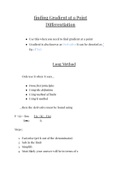
finding Gradient at a Point
Di erentiation
● Use this when you need to find gradient at a point
● Gradient is also known as Derivative it can be denoted as ‘
Eg ; F’(x)
Long Method
Only use it when it says…
● From first principles
● Using the definition
● Using method of limits
● Using h method
…then the derivative must be found using
F ‘ (x) = lim f (x + h) - f (x)
h➡0 h
Steps ;
1. Factorise (get h out of the denominator)
2. Sub in the limit
3. Simplify
4. Most likely your answer will be in terms of x
, The question could also say, at the point where x = 3
5. After you simplify your answer, f(x) = answer
6. Fill in the 3 in its whenever there's an x
7. f(3) = answer
Short Method
Use this always unless instructed di erently…
For example ;
F (x) = 4x2 - x3 - 2
1. Multiply exponent to coe cient
2. Minus one from exponent
3. If it’s a constant then make it 0
4x2 = 8x
- x3 = -3x2
-2=0
∴ F (x) = 8x - (-3x2)
Di erentiation
● Use this when you need to find gradient at a point
● Gradient is also known as Derivative it can be denoted as ‘
Eg ; F’(x)
Long Method
Only use it when it says…
● From first principles
● Using the definition
● Using method of limits
● Using h method
…then the derivative must be found using
F ‘ (x) = lim f (x + h) - f (x)
h➡0 h
Steps ;
1. Factorise (get h out of the denominator)
2. Sub in the limit
3. Simplify
4. Most likely your answer will be in terms of x
, The question could also say, at the point where x = 3
5. After you simplify your answer, f(x) = answer
6. Fill in the 3 in its whenever there's an x
7. f(3) = answer
Short Method
Use this always unless instructed di erently…
For example ;
F (x) = 4x2 - x3 - 2
1. Multiply exponent to coe cient
2. Minus one from exponent
3. If it’s a constant then make it 0
4x2 = 8x
- x3 = -3x2
-2=0
∴ F (x) = 8x - (-3x2)