100% de satisfacción garantizada Inmediatamente disponible después del pago Tanto en línea como en PDF No estas atado a nada 4.2 TrustPilot
logo-home
Examen

CALT Exam Prep_People Quiz Questions and Answers,100% CORRECT

Puntuación
-
Vendido
-
Páginas
4
Grado
A+
Subido en
13-02-2023
Escrito en
2022/2023

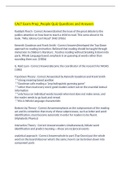
CALT Exam Prep_People Quiz Questions and Answers Rudolph Flesch - Correct AnswersStarted the issue of the great debate to the publics attention on how best to teach a child to read. This came about in his book. "Why Johnny Can't Read" (Mid 1950s) Kenneth Goodman and Frank Smith - Correct AnswersDeveloped the Top-Down approach to reading instruction. Believed that reading should be taught through immersion in children's literature . Teaches reading without breaking it down into parts. Whole Language based, emphasis is on guessing at words rather than sounding them out. (1980s) G. Reid Lyon - Correct AnswersBecame the coordinator of the research for NICHD. (1985) Top-Down Theory - Correct Answersled by Kenneth Goodman and Frank Smith **strong meaning-based position **Goodman calls reading a "psycholinguistic guessing game" **rather than read every word, good readers select out on the essential textual information **only focus on individual words/sounds when text does not make sense, and the reader needs to go back and reread **this is Whole Language characteristic Bottom-Up Theory - Correct Answersemphasis on the subprocesses of the reading act and its contention that many of these subprocesses, such as letter and word identification, must become automatic in order for readers to be fluent. (Alphabetic Phonics) Interactive Theory - Correct Answersreaders simultaneously initiate word identification and predict meaning----these are reciprocal events analytical approach - Correct Answerswhole to part (Top-Down) put the whole word on the board/discover what's the same, how it can be broken down into component parts synthetic approach - Correct Answerspart (letters) to whole words (bottom up) linguistics-based beginning reading approach - Correct AnswersLearning to recognize word families (bat, cat, hat, ) D. Berlin (1887) - Correct AnswersCoined the term "dys" -- meaning difficult, "lexia" -- meaning pertaining to words. James Hinshelwood (1917) - Correct Answers"word blindness" -- ophthalmologist from Scotland that discovered that the left hemisphere of the brain affected word storage Samuel Orton () - Correct AnswersNeuropsychiatrist from Columbia University in New York who first recognized dyslexia students in America. He discovered that approximately 10% of students will not learn using the whole words method. Also coined the term "strephosymbolia" (twisted words), which replaced the former term word blindness. Dr. Madonald Critchley (1964) - Correct AnswersEstablished term "developmental dyslexia" at the World Federation of Neurology meeting at the Scottish Rite Hospital. Marianne Frosig (1960) - Correct AnswersDid visual tracking research. Findings show there is no relationship between dyslexia and vision acuity. Isabelle Liberman () - Correct AnswersDid research on phonological awareness that linguistic information is stored in its phonological form (all word recognition requires letter-sound access). Also studied phonological processing deficits affecting the ability to make use of letter-sound associations as an effect of rapid retrieval problems. Discovered tapping exercises. Hugh Catts (1986) - Correct AnswersSpeech language pathologist working at the University of Kansas. Did remedial work for programs to improve phonological awareness. Keith Stanovich (1980) - Correct AnswersResearched the process of phonics and the need to attach sound to symbol. Readers with poor word recognition are more reliant on context than good readers (comprehension work). Bonita Blachman - Correct Answersprofessor at Syracuse University. Has done much research in the field of phonology and reading.Created Elkonian cards (kids who couldn't read couldn't segment sounds as well). Adolf Kusmaul - Correct Answers1877 - first used the term "word-blindness". Anna Gillingham - Correct Answers1930 - Psychologist and teacher in New York; along with Samuel T Orton at Columbia University, developed a non-traditional approach to teaching written language skills. Trained one teacher at a time, began working with Sally Childs and trained 50 teachers. Dr. Rudolf Berlin - Correct Answers1887 - ophthalmologist - introduced the term dyslexia Dr. W. Pringle Morgan - Correct Answers1896 - wrote first article in medical literature on "word blindness" in children Frank Smith - Correct AnswersWhole language. Founder of Whole language concept James Hinshelwood - Correct Answers1904 - reported 2 cases of "congenital word blindness", called for schools to establish procedures for screening as well as appropriate teaching of those that were identified with congenital word-blindness Joe Torgesen - Correct Answersnationally known for research on both the prevention and remediation of reading difficulties in young children as well as work on assessment of phonological awareness and reading Keith Stanovich - Correct AnswersHis research in the field of reading was fundamental to the emergence of today's scientific consensus about what reading is, how it works and what it does for the mind. The Matthew Effect Kenneth and Yetta Goodman - Correct AnswersWhole language, Drop Everythng and read, evaluation through miscues, founds of whole language

Mostrar más Leer menos
Institución
Grado


Ups! No podemos cargar tu documento ahora. Inténtalo de nuevo o contacta con soporte.

Escuela, estudio y materia

Grado

Información del documento

Subido en
13 de febrero de 2023
Número de páginas
4
Escrito en
2022/2023
Tipo
Examen
Contiene
Preguntas y respuestas

Temas

Vista previa del contenido

CALT Exam Prep_People Quiz Questions and Answers
Rudolph Flesch - Correct AnswersStarted the issue of the great debate to the
publics attention on how best to teach a child to read. This came about in his
book. "Why Johnny Can't Read" (Mid 1950s)

Kenneth Goodman and Frank Smith - Correct AnswersDeveloped the Top-Down
approach to reading instruction. Believed that reading should be taught through
immersion in children's literature . Teaches reading without breaking it down into
parts. Whole Language based, emphasis is on guessing at words rather than
sounding them out. (1980s)

G. Reid Lyon - Correct AnswersBecame the coordinator of the research for NICHD.
(1985)

Top-Down Theory - Correct Answersled by Kenneth Goodman and Frank Smith
**strong meaning-based position
**Goodman calls reading a "psycholinguistic guessing game"
**rather than read every word, good readers select out on the essential textual
information
**only focus on individual words/sounds when text does not make sense, and
the reader needs to go back and reread
**this is Whole Language characteristic

Bottom-Up Theory - Correct Answersemphasis on the subprocesses of the reading
act and its contention that many of these subprocesses, such as letter and word
identification, must become automatic in order for readers to be fluent.
(Alphabetic Phonics)

Interactive Theory - Correct Answersreaders simultaneously initiate word
identification and predict meaning----these are reciprocal events

analytical approach - Correct Answerswhole to part (Top-Down) put the whole
word on the board/discover what's the same, how it can be broken down into
component parts

$7.99
Accede al documento completo:

100% de satisfacción garantizada
Inmediatamente disponible después del pago
Tanto en línea como en PDF
No estas atado a nada


Documento también disponible en un lote

Conoce al vendedor

Seller avatar
Los indicadores de reputación están sujetos a la cantidad de artículos vendidos por una tarifa y las reseñas que ha recibido por esos documentos. Hay tres niveles: Bronce, Plata y Oro. Cuanto mayor reputación, más podrás confiar en la calidad del trabajo del vendedor.
ElonMusk Yale School Of Medicine
Seguir Necesitas iniciar sesión para seguir a otros usuarios o asignaturas
Vendido
186
Miembro desde
3 año
Número de seguidores
163
Documentos
1345
Última venta
4 semanas hace
chemistry

FOR THE BEST ASSIGNMENTS AND HOMEWORKS ,TO HELP AND TUTORING ALL KIND OF EXAMS I have done papers of various topics and complexities. I am punctual and always submit work on-deadline. I write engaging and informative content on all subjects. Send me your research papers, case studies, psychology papers, etc, and I’ll do them to the best of my abilities. Writing is my passion when it comes to academic work. I’ve got a good sense of structure and enjoy finding interesting ways to deliver information in any given paper. I love impressing clients with my work, and I am very punctual about deadlines. Send me your assignment and I’ll take it to the next level. I strive for my content to be of the highest quality. Your wishes come first— send me your requirements and I’ll make a piece of work with fresh ideas, consistent structure, and following the academic formatting rules. I'm an expert on major courses especially; All AQA, OCR, A & AS LEVELS AND GCSE, Chemistry, Psychology, Nursing, Mathematics. Human Resource Management. Quality work is my priority. I ensure scholarly standards in my documents. Use my work for GOOD GRADES. In requirement of case studies, test banks, exams and many other studies document our site helps in acquiring them all. If in need of any revision document you can go to the inbox and you will be attended to right away. SUCCESS and BEST OF LUCK.

Lee mas Leer menos
4.2

42 reseñas

5
27
4
7
3
3
2
1
1
4

Recientemente visto por ti

Por qué los estudiantes eligen Stuvia

Creado por compañeros estudiantes, verificado por reseñas

Calidad en la que puedes confiar: escrito por estudiantes que aprobaron y evaluado por otros que han usado estos resúmenes.

¿No estás satisfecho? Elige otro documento

¡No te preocupes! Puedes elegir directamente otro documento que se ajuste mejor a lo que buscas.

Paga como quieras, empieza a estudiar al instante

Sin suscripción, sin compromisos. Paga como estés acostumbrado con tarjeta de crédito y descarga tu documento PDF inmediatamente.

Student with book image

“Comprado, descargado y aprobado. Así de fácil puede ser.”

Alisha Student

Preguntas frecuentes