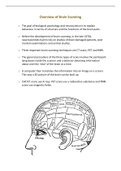
Overview of Brain Scanning
o The goal of biological psychology and neuroscience it to explain
behaviour in terms of structure and the functions of the brain parts.
o Before the development of brain scanning, in the late 1970s,
neuroscientists had to rely on studies of brain damaged patients, post
mortem examinations and animal studies.
o Three important brain scanning techniques are CT scans, PET and fMRI.
o The general procedure of the three types of scans involve the participant
lying down inside the scanner and a detector obtaining information
about one thin ‘slice’ of the brain at a time.
o A computer then translates the information into an image on a screen.
This way a 3D picture of the brain can be built up.
o CAT/CT scans use X-rays, PET scans use a radioactive substance and fMRI
scans use magnetic fields.
o The goal of biological psychology and neuroscience it to explain
behaviour in terms of structure and the functions of the brain parts.
o Before the development of brain scanning, in the late 1970s,
neuroscientists had to rely on studies of brain damaged patients, post
mortem examinations and animal studies.
o Three important brain scanning techniques are CT scans, PET and fMRI.
o The general procedure of the three types of scans involve the participant
lying down inside the scanner and a detector obtaining information
about one thin ‘slice’ of the brain at a time.
o A computer then translates the information into an image on a screen.
This way a 3D picture of the brain can be built up.
o CAT/CT scans use X-rays, PET scans use a radioactive substance and fMRI
scans use magnetic fields.