

Philosophy Summary
Lecture 1
Problem with facts today
- Why is it important to know the facts? Science gives certainty
- To make choices, decisions, policy
- Where do we usually look for facts?
- Science:
Natural facts (gay is natural)
Technological facts (cloning)
Social facts (differences between, use statistics to underline facts)
- Crowning achievement of the human mind
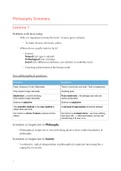
Two philosophical positions:
Scientism Scepticism
Facts, Science is Truth, Rationality There is more than one truth, Truth is experience
Only reason brings rationality Anything goes
Modernism = modern thinking Post modernism = Knowledge and truth are
Only reason brings rationality social construction
Science is objective Science is subjective
The scientific method is the only method to A carneval of approaches should be allowed
obtain facts and truth
Our mind is a mirror if nature, science mirrors Out mind is a crooked mirror - we know nothing
nature and never will —> We have biases, so how can
scientist say if its true or no
Scientism vs Scepticism in Philosophy
- Philosophical scepticism is critical thinking about science within boundaries of
philosophy
Scientism vs Scepticism in Society
- A relativistic, radical interpretation of philosophical scepticism becoming like a
raging fire on society
1
, - Relativistic = no absolute truth, reality, a radical interpretation of scepticism —>
May lead to fake facts
- Vaccination issue - anti vaccination vs medical doctors
Other examples? Flat earthers
Philosophy of science
- Philosophy = Love of wisdom
- Analyses the methods of inquiry used in the sciences
- Meta theory (= theory about theory)
- What are the sources of knowledge?
- What is science and how does it differ from non-science?
The Enlightenment (Kant)
- One of the greatest intellectual projects in human history
- When the lights went on
- Enlightenment emphasises reason and individualism instead of tradition
Today
- Central role for reason, science and technology as the driving force of development
- Besides progress also risks, challenges, downsides and responsibilities
- What is and has been the role of knowledge ? Trace role back to the roots of
philosophical thinking about knowledge and science
- Very powerful strategy for collective learning for human kind
- Enormous progress and development materially and morally
- Anthropocene = Anthro (Human), Cene (Recent)
- Human activity is now dominant influence on climate and the environment
- Humans are managers of the earth, science and technology made this possible
2
,Lecture 2 - Watt and Berg text
Naive Inquiry
- Informal, non systematic and random way of collecting and summarizing
information into naive theories (e.g. albinos are evil, witches)
- Illusion of knowledge
- Common sense: What we do in daily life
- Premodern thinking: Religious thinking, belief in a given truth (by a god)
- Non-sophisticated (random way of coming to a conclusion)
• Methods of knowing
- Tenacity: What is known to be true, naive very convinced of themselves
- Authority: High regarded person speaks the truth
- Reasonable man: Reason and logical consistency, discussion, common confusion
- Associations: Biases, post modernism, myths
Examples: Astrology, religion, conspiracy theories
Scientific Inquiry
- ‘highly controlled, systematic inquiry’ ‘observations and reasoning are error prone’
- Science shifts the focus of truth from single individuals to groups, by establishing a
set of mutually agreed upon rules for establishing truth
- Known as Scientific method, modern thinking
- Truth is an objective reality out thee and our ideas do not alter that reality
Examples: Empirical cycle, scientific journey, statistics
• Theory is key
- “A theory is a set of interrelated constructs (concepts), definitions, and propositions
that present a systematic view of phenomena by specifying relations among
variables, with the purpose of explaining and predicting the phenomena.”
3
, - Develop theories by using the scientific method: testing theories, control of
alternative explanations, attention for the nature of relationships, use observable
evidence
• Scientific method:
- The use and selection of concepts (variables)
- Linking concepts (variables) to propositions (hypotheses)
- Testing theories with observable evidence
- The definition of concepts (variables)
- The publication of definitions and procedures
- Control of alternative explanation
- Unbiased selection of evidence
- Reconciliation of theory and observation
4
Lecture 1
Problem with facts today
- Why is it important to know the facts? Science gives certainty
- To make choices, decisions, policy
- Where do we usually look for facts?
- Science:
Natural facts (gay is natural)
Technological facts (cloning)
Social facts (differences between, use statistics to underline facts)
- Crowning achievement of the human mind
Two philosophical positions:
Scientism Scepticism
Facts, Science is Truth, Rationality There is more than one truth, Truth is experience
Only reason brings rationality Anything goes
Modernism = modern thinking Post modernism = Knowledge and truth are
Only reason brings rationality social construction
Science is objective Science is subjective
The scientific method is the only method to A carneval of approaches should be allowed
obtain facts and truth
Our mind is a mirror if nature, science mirrors Out mind is a crooked mirror - we know nothing
nature and never will —> We have biases, so how can
scientist say if its true or no
Scientism vs Scepticism in Philosophy
- Philosophical scepticism is critical thinking about science within boundaries of
philosophy
Scientism vs Scepticism in Society
- A relativistic, radical interpretation of philosophical scepticism becoming like a
raging fire on society
1
, - Relativistic = no absolute truth, reality, a radical interpretation of scepticism —>
May lead to fake facts
- Vaccination issue - anti vaccination vs medical doctors
Other examples? Flat earthers
Philosophy of science
- Philosophy = Love of wisdom
- Analyses the methods of inquiry used in the sciences
- Meta theory (= theory about theory)
- What are the sources of knowledge?
- What is science and how does it differ from non-science?
The Enlightenment (Kant)
- One of the greatest intellectual projects in human history
- When the lights went on
- Enlightenment emphasises reason and individualism instead of tradition
Today
- Central role for reason, science and technology as the driving force of development
- Besides progress also risks, challenges, downsides and responsibilities
- What is and has been the role of knowledge ? Trace role back to the roots of
philosophical thinking about knowledge and science
- Very powerful strategy for collective learning for human kind
- Enormous progress and development materially and morally
- Anthropocene = Anthro (Human), Cene (Recent)
- Human activity is now dominant influence on climate and the environment
- Humans are managers of the earth, science and technology made this possible
2
,Lecture 2 - Watt and Berg text
Naive Inquiry
- Informal, non systematic and random way of collecting and summarizing
information into naive theories (e.g. albinos are evil, witches)
- Illusion of knowledge
- Common sense: What we do in daily life
- Premodern thinking: Religious thinking, belief in a given truth (by a god)
- Non-sophisticated (random way of coming to a conclusion)
• Methods of knowing
- Tenacity: What is known to be true, naive very convinced of themselves
- Authority: High regarded person speaks the truth
- Reasonable man: Reason and logical consistency, discussion, common confusion
- Associations: Biases, post modernism, myths
Examples: Astrology, religion, conspiracy theories
Scientific Inquiry
- ‘highly controlled, systematic inquiry’ ‘observations and reasoning are error prone’
- Science shifts the focus of truth from single individuals to groups, by establishing a
set of mutually agreed upon rules for establishing truth
- Known as Scientific method, modern thinking
- Truth is an objective reality out thee and our ideas do not alter that reality
Examples: Empirical cycle, scientific journey, statistics
• Theory is key
- “A theory is a set of interrelated constructs (concepts), definitions, and propositions
that present a systematic view of phenomena by specifying relations among
variables, with the purpose of explaining and predicting the phenomena.”
3
, - Develop theories by using the scientific method: testing theories, control of
alternative explanations, attention for the nature of relationships, use observable
evidence
• Scientific method:
- The use and selection of concepts (variables)
- Linking concepts (variables) to propositions (hypotheses)
- Testing theories with observable evidence
- The definition of concepts (variables)
- The publication of definitions and procedures
- Control of alternative explanation
- Unbiased selection of evidence
- Reconciliation of theory and observation
4

