

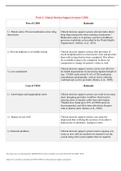
Week 5: Clinical Decision Support Systems (CDSS)
Pros of CDSS Rationale
1.) Patient safety: Prevent medication errors/ drug Clinical decision support systems alert providers about
interactions drug-drug interactions when ordering a medication.”
Medication safety is of primary concern to healthcare
provision worldwide as described by the World Health
Organization” (Jeffries, et al., 2021).
2.) Prevent duplicate or avoidable testing Clinical decision support systems alert providers of
recent hospitalization or recent doctor visits and provides
them with testing that has been completed. This allows
for avoidable testing to be completed. It allows for
comparison or change for patient’s status as well.
Clinical decision support systems can be cost-effective
3.) cost containment for health organizations by decreasing inpatient length of
stay. “CDSS could switch 91.6% of 202 medication
consultations automatically, with no errors, reducing
workload and cost for providers (Sutton, et al., 2020).
Cons of CDSS Rationale
1.) Alert fatigue and inappropriate alerts Clinical decision support systems can result in too many
alerts disrupting providers workflow which lead to
ignoring alerts eventually suffer from alert fatigue.
“Studies have found up to 95% of CDSS alerts are
inconsequential, and often times physicians disagree
with or distrust alerts (Sutton, et al., 2020).
2.) Impact on user skill Clinical decision support systems can create the
impression that verifying the accuracy of an order is
unnecessary or automatic, leading to errors.
3.) Financial problems Clinical decision support systems lead to ongoing cost
issues as new staff are needed to be trained to use the
system along with system updates that are required.
This study source was downloaded by 100000861564172 from CourseHero.com on 02-08-2023 08:52:50 GMT -06:00
https://www.coursehero.com/collection/103981474/Week-5-clinical-decision-support-systemsdocx/
Pros of CDSS Rationale
1.) Patient safety: Prevent medication errors/ drug Clinical decision support systems alert providers about
interactions drug-drug interactions when ordering a medication.”
Medication safety is of primary concern to healthcare
provision worldwide as described by the World Health
Organization” (Jeffries, et al., 2021).
2.) Prevent duplicate or avoidable testing Clinical decision support systems alert providers of
recent hospitalization or recent doctor visits and provides
them with testing that has been completed. This allows
for avoidable testing to be completed. It allows for
comparison or change for patient’s status as well.
Clinical decision support systems can be cost-effective
3.) cost containment for health organizations by decreasing inpatient length of
stay. “CDSS could switch 91.6% of 202 medication
consultations automatically, with no errors, reducing
workload and cost for providers (Sutton, et al., 2020).
Cons of CDSS Rationale
1.) Alert fatigue and inappropriate alerts Clinical decision support systems can result in too many
alerts disrupting providers workflow which lead to
ignoring alerts eventually suffer from alert fatigue.
“Studies have found up to 95% of CDSS alerts are
inconsequential, and often times physicians disagree
with or distrust alerts (Sutton, et al., 2020).
2.) Impact on user skill Clinical decision support systems can create the
impression that verifying the accuracy of an order is
unnecessary or automatic, leading to errors.
3.) Financial problems Clinical decision support systems lead to ongoing cost
issues as new staff are needed to be trained to use the
system along with system updates that are required.
This study source was downloaded by 100000861564172 from CourseHero.com on 02-08-2023 08:52:50 GMT -06:00
https://www.coursehero.com/collection/103981474/Week-5-clinical-decision-support-systemsdocx/


