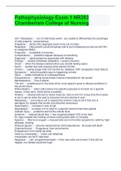
Pathophysiology Exam 1 NR283 Chamberlain College of Nursing
(CH 1)Dysplasia - out of order/looks weird - are unable to differentiate the size/shape of cells properly - precancerous Anaplasia - worse than dysplasia (even more out of order) Neoplasia - New growth (could be benign and is just multiplying too fast but still OK) or malignant (BAD) Prognosis - probability of recovery Complications - problems happen because of something Diagnosis - signs/symptoms associated with disease Etiology - causes of disease (idiopathic = cause unknown) Onset - when the disease started (when you started feeling signs) Acute - started now and ongoing (short period of time) Chronic - lasting longer than 3-6 months Ex: diabetes, CHF (congestive heart failure) Symptoms - what the patient says is happening to them Signs - visible indications of a disease/illness Exacerbations - getting worse/made it worse (intensified for the worse) Manifestations - how it affects The cell - smallest part of the body which must adapt to grow in altered conditions in the environment. Differentiation - when cells mature into specific purposes to function for a specific reason. If they don't, there will be a problem Atrophy - reduced sell size or tissue mass Ex: cast on arm for a long time the muscle is not in use so when the cast is removed, the arm shrinks in size. Metaplasia - one mature cell is replaced by another mature cell if that one is damaged. Ex: people that smoke (can become cancerous) Hypertrophy - increase in size of cell Hyperplasia - increase in # of cells Ex: pregnant women/mammary glands Cellular Injury - problems start at the cellular level Ischemia - reduced blood flow -> low oxygen/probably CO2 is too high. Ex: legs crossed then feeling of blood rushing back after un-crossed. Hypoxia - little to no oxygen -> tissues/cells can not function properly Ex: asthma, high altitudes, choking. Physical agents - extreme heat/extreme cold temperatures - all cause cell death Chemical toxins - Exogenous: from environment Endogenous: from inside the body Initial vs. Irreversible - Initial: can help/treat Irreversible: can NOT help/treat Apoptosis - cell - programmed death -> then new cells are formed. If this did not happen, our bodies would be huge! Necrosis - when there is an injury to cells if it is irreversible -> bacteria can infect the site if it makes it's way Gangrene - when a dead cell gets infected by bacteria -> will have to be removed or will spread to the rest of the body. (amputate) (CH 2) ADH - anti diuretic hormone -> retain/keep fluid Aldosterone - controls amount of salt and water -> if there is too little it reabsorbs it and gets rid of potassium (through the kidneys) Thirst is stimulated by - hypothalamus Intracellular - within the cell Extracellular - outside the cell Intravascular - space between the intracellular Thirst mechanism - hypothalamus in the brain ANP (atrial natriuretic peptide) - gets rid of sAlt and retains Potassium Filtration - movement of fluids through intravascular space into the interstitial space Hydrostatic pressure - Push (must be balanced with osmotic pressure to maintain homeostasis) Osmotic pressure - Pull (must be balanced with osmotic pressure to maintain homeostasis) Osmosis - interstitial space to intravascular Excess - too much fluid in the body Liver failure - not enough albumin leading to fluid excess Increased Na intake - retaining too much H20 (some with IV fluids) Dyspnea - lot of fluid around the lungs (trouble breathing) -> exchange of oxygen and carbon dioxide is not happening Bounding pulse - slow/fast -> think of gears on a bike JVD - Jugular Vein Distension - > vein will pop out in neck Edema - excess fluid in tissues, excess fluid in interstitial space (compartment that causes swelling) ; mostly found where gravity pulls the most (eg; feet, hands, butt, etc). Edema causes: - -increased capillary hydrostatic pressure -decreased capillary osmotic pressure -increased capillary permeability -obstruction of lymphatic flow Local - portion of the body Generalized - whole entire body swollen (anasarca) Pitting edema - makes an imprint when hand touches "makes a pit" Decreased skin turgor - elasticity almost gone skin is very hard Low BP - less pressure/less H2O Tachycardia - fast heart rate - trying to compensate Fluid deficit - Dehydration; reduction in body fluids. seen most in elderly people Review of Sodium - main electrolyte in the ECF (extracellular fluid) (Na) AFFECTS THE BRAIN primarily controlled by the kidneys through ALDOSTERONE Essential for: nerve impulses, muscle contraction, osmotic pressure Sources of sodium: foo
Escuela, estudio y materia
- Institución
- Pathophysiology
- Grado
- Pathophysiology
Información del documento
- Subido en
- 2 de febrero de 2023
- Número de páginas
- 11
- Escrito en
- 2022/2023
- Tipo
- Otro
- Personaje
- Desconocido
Temas
-
pathophysiology exam 1 nr283 chamberlain college of nursing

Documento también disponible en un lote