Gentechnologie
Introduction
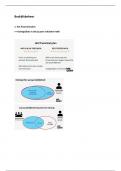
Examenvraag: wat is de gemiddelde grootte van eukaryote cellen, prokaryote cellen en virussen ?
Unaided eye: humans, frog egg…
Light microscope: bacterïen (1-3 μm) gistcellen (10-50 μm) dierlijke cellen (20-50 μm), planten cellen (50-
70 μm), mitochondria, nucleus
Electron microscope: viruses (50-100 nm), organelles, (all examples from light microscope due range overlap)
Examenvraag: waarom werd de bacterie Escherichia coli veel gebruikt voor genetische manipulatie?
Most used for cloning, expression and production for multiple reasons:
• Gram negative (makes secretion of protein of interest difficult)
• Natural habitat: the human gut.
• Non-pathogenic, except for specific strains (EPEC, EHEC, ...) (→ biosafety).
• Very well characterized at the genetic and biochemical level.
• Fully sequenced genome and good annotation.
• Lots of molecular tools (to genetically modify it)
• Very fast growth (1 division every 20 minutes).
• DB3.1, BL21, DH5alpha, DH10B ,S17, Top10, ... (verschillende functies nog besproken doorheen de lessen)
Examenvraag: wat is, met betrekking tot lipopolysaccharide (LPS), het mogelijke nadeel van het
gebruik van bacteriën voor de productie van proteïnen van medisch belang?
The bacterial cell wall also has LPS (endotoxins), when there is residual endotoxin contamination when you buy
commercial recombinant proteins, they could activate the (CD1c+) dendritic cells and so activate the immunse
system like shown in the graph below. When you test this, always use positive and negative control to
determine where the problem is (if positive control doesn’t work you could’ve used the wrong temperature or
forgot top add components for the PCR).
Examenvraag: leg de wetenschappelijke nomenclatuur uit om de naam van een gen, een eiwit en
een bacterie te schrijven met een voorbeeld van uw keuze. Associeer aan elk van hen het concept
"expressie" of "productie" of "cultivatie".
,Part 1A DNA, modification enzymes and cloning strategies
Examenvraag: teken DNA (deoxyribonucleic acid) structuur van de nucleotiden en orientatie met de
chemische groepen (+benoem bindingen).
Examenvraag: teken en benoem het verschil tussen een nucleoside en nucleotide
• Double-stranded helix, with the two strands connected by hydrogen bonds
• Major groove minor groove
• 1 turn: 3.4nm (10 bp)
• DNA is composed of 2 polynucleotides anti-parallel chains that form a double helix (RIGHT handed)
• Phosphodiester links and hydrogen bounds linking nitrogenous bases
• 5’-P to 3’-OH orientation
Nucleosides can be phosphorylated by kinases on the 5’OH, generating
a nucleotide through the binding of a phosphate group to the
nucleoside. Both nucleotides and nucleosides are a sugar with 5C
(pentose=desoxyribose). Nucleotides can undergo polymerisation to
form the DNA molecule (nucleotides linked together by phosphodiester
bonds between the phosphate group (C5’) and the –OH group (3’).
Opm: size of DNA fragment in (k)bp size of protein in (kilo)Dalton
Opm: difference in # hydrogen bonds has consequences for primer design and PCR
Examenvraag: DNA Modification Enzyme – ligase (functie + interesse gentechnologie)
DNA ligases (T4 DNA ligase most commonly used) catalyze formation of a phosphodiester bond between the 5'
phosphate of one strand of DNA and the 3' hydroxyl of the another. ATP acts as cofactor. Each end has to be
compatible: complementarity of the protruding ends / blunt ends are compatible between them. Different
restriction enzymes can generate compatible ends! NB: orientation of genes is important!
, Examenvraag: DNA Modification Enzyme - Klenow Fragment (functie+ interesse gentechnologie)
• Fragment from the DNA polymerase I from E. coli
• DNA synthesis from single stranded (SS) DNA
• Different applications (sequencing (Sanger), mutagenesis, blunting, cDNA)
Examenvraag: DNA Modification Enzyme - Alcaline Phosphatase (functie+ interesse gentechnologie)
• Bacterial alkaline phosphatase (BAP) Calf intestinal alkaline phosphatase
(CIP) Shrimp alkaline phosphatase (SAP)
• Avoid self-ligation of the restricted plasmid as the 5’-Phosphate are absent.
• Removing 5' phosphates from fragments of DNA prior to labeling with
radioactive phosphate
• Orientation not controlled
NB: Phosphates on insert added by T4 polynucleotide kinase or during primer synthesis
Examenvraag: DNA Modification Enzyme - Polynucleotide Kinase (functie+ interesse gentechnologie)
• PNK catalyzes the transfer of a phosphate from ATP to the 5' end of either DNA or RNA.
• Forward reaction: PNK transfers the gamma phosphate from ATP to
the 5' end of a polynucleotide (DNA or RNA) after dephosphorylation
or after being synthesized chemically.
• PNK is inhibited by small amounts of ammonium ions
• Usage: phosphorylating linkers, adaptors and primers, or fragments
of DNA as a prelude to ligation, which requires a 5' phosphate (this
includes also products of PCR) + radiolabeling oligonucleotides,
usually with 32P, for use as hybridization probes.
Examenvraag: DNA Modification Enzyme - DNAse (functie+ interesse gentechnologie)
DNAse is een nuclease (degradeert phosphodiester bond tussen basenparen DNA). Nucleases degraderen DNA
of RNA samples, de meest gebruikte nucleases zijn DNAse I en Rnase A. Nucleases are not specific so they cut
everywhere. Deoxyribonuclease I (DNaseI) cleaves double- stranded or single stranded DNA. DNase I does not
cleave RNA. DNaseI is used for:
• Eliminating DNA (e.g. plasmid) from preparations of RNA (important for RNAseq analyses).
• Analyzing DNA-protein interactions via DNase footprinting.
• Nicking DNA prior to radiolabeling by nick translation.
, Restriction-ligation
Examenvraag: wat zijn restrictive-enzymen (+nut in genetechnologie)
Examenvraag: hoe mbv restrictie-enzymen een gen in juiste oriëntatie klonen?
Examenvraag: voor- en nadeel van RE die stompe of uitstekende uiteinden genereren?
Examenvraag: teken en leg kloneringsmethode met RE uit
Two main steps:
1. Restriction enzyme (endonucleases) cut the DNA and
generate 3'-OH- en 5’- phosphate ends.
2. DNA Ligase binds two DNA fragments by their 3’-OH and 5’-
phosphate extremities to ligate them together.
Eg: adding selective pressure with antibiotics resistance
Correct orientation of the insertion is important for promoters and / or tags
in final plasmids. This is why you add two different restriction enzymes:
Recognition of sites at 4, 5, 6 or 8 bp, often palindrome (because of homo-dimerization), vb BamHI:
The biological function of restriction enzymes is that they offer bacteria protection against foreign DNA
(phages, conjugative plasmids, etc.). The bacterial DNA is not digested by RE due methylation.
There are a lot of different types of RE that can recognize and cut a huge diversity of sites. There can be unique
sites but also multiple sites, we visual this in restriction maps.
DNA ligase catalyzes the formation of a covalent bond between a 3'-OH end and a 5'-phosphate end. The ends
need to be compatible: basic complementarity between protruding ends (bv EcoRI) or blunt ends are
compatible with each other (5’-P and 3’-OH). Het voordeel van blunt ends is dat het geen restrictive-sites in de
sequentie vereist.
Restriction enzymes that recognize different sites can generate compatible ends for ligation event:
Introduction
Examenvraag: wat is de gemiddelde grootte van eukaryote cellen, prokaryote cellen en virussen ?
Unaided eye: humans, frog egg…
Light microscope: bacterïen (1-3 μm) gistcellen (10-50 μm) dierlijke cellen (20-50 μm), planten cellen (50-
70 μm), mitochondria, nucleus
Electron microscope: viruses (50-100 nm), organelles, (all examples from light microscope due range overlap)
Examenvraag: waarom werd de bacterie Escherichia coli veel gebruikt voor genetische manipulatie?
Most used for cloning, expression and production for multiple reasons:
• Gram negative (makes secretion of protein of interest difficult)
• Natural habitat: the human gut.
• Non-pathogenic, except for specific strains (EPEC, EHEC, ...) (→ biosafety).
• Very well characterized at the genetic and biochemical level.
• Fully sequenced genome and good annotation.
• Lots of molecular tools (to genetically modify it)
• Very fast growth (1 division every 20 minutes).
• DB3.1, BL21, DH5alpha, DH10B ,S17, Top10, ... (verschillende functies nog besproken doorheen de lessen)
Examenvraag: wat is, met betrekking tot lipopolysaccharide (LPS), het mogelijke nadeel van het
gebruik van bacteriën voor de productie van proteïnen van medisch belang?
The bacterial cell wall also has LPS (endotoxins), when there is residual endotoxin contamination when you buy
commercial recombinant proteins, they could activate the (CD1c+) dendritic cells and so activate the immunse
system like shown in the graph below. When you test this, always use positive and negative control to
determine where the problem is (if positive control doesn’t work you could’ve used the wrong temperature or
forgot top add components for the PCR).
Examenvraag: leg de wetenschappelijke nomenclatuur uit om de naam van een gen, een eiwit en
een bacterie te schrijven met een voorbeeld van uw keuze. Associeer aan elk van hen het concept
"expressie" of "productie" of "cultivatie".
,Part 1A DNA, modification enzymes and cloning strategies
Examenvraag: teken DNA (deoxyribonucleic acid) structuur van de nucleotiden en orientatie met de
chemische groepen (+benoem bindingen).
Examenvraag: teken en benoem het verschil tussen een nucleoside en nucleotide
• Double-stranded helix, with the two strands connected by hydrogen bonds
• Major groove minor groove
• 1 turn: 3.4nm (10 bp)
• DNA is composed of 2 polynucleotides anti-parallel chains that form a double helix (RIGHT handed)
• Phosphodiester links and hydrogen bounds linking nitrogenous bases
• 5’-P to 3’-OH orientation
Nucleosides can be phosphorylated by kinases on the 5’OH, generating
a nucleotide through the binding of a phosphate group to the
nucleoside. Both nucleotides and nucleosides are a sugar with 5C
(pentose=desoxyribose). Nucleotides can undergo polymerisation to
form the DNA molecule (nucleotides linked together by phosphodiester
bonds between the phosphate group (C5’) and the –OH group (3’).
Opm: size of DNA fragment in (k)bp size of protein in (kilo)Dalton
Opm: difference in # hydrogen bonds has consequences for primer design and PCR
Examenvraag: DNA Modification Enzyme – ligase (functie + interesse gentechnologie)
DNA ligases (T4 DNA ligase most commonly used) catalyze formation of a phosphodiester bond between the 5'
phosphate of one strand of DNA and the 3' hydroxyl of the another. ATP acts as cofactor. Each end has to be
compatible: complementarity of the protruding ends / blunt ends are compatible between them. Different
restriction enzymes can generate compatible ends! NB: orientation of genes is important!
, Examenvraag: DNA Modification Enzyme - Klenow Fragment (functie+ interesse gentechnologie)
• Fragment from the DNA polymerase I from E. coli
• DNA synthesis from single stranded (SS) DNA
• Different applications (sequencing (Sanger), mutagenesis, blunting, cDNA)
Examenvraag: DNA Modification Enzyme - Alcaline Phosphatase (functie+ interesse gentechnologie)
• Bacterial alkaline phosphatase (BAP) Calf intestinal alkaline phosphatase
(CIP) Shrimp alkaline phosphatase (SAP)
• Avoid self-ligation of the restricted plasmid as the 5’-Phosphate are absent.
• Removing 5' phosphates from fragments of DNA prior to labeling with
radioactive phosphate
• Orientation not controlled
NB: Phosphates on insert added by T4 polynucleotide kinase or during primer synthesis
Examenvraag: DNA Modification Enzyme - Polynucleotide Kinase (functie+ interesse gentechnologie)
• PNK catalyzes the transfer of a phosphate from ATP to the 5' end of either DNA or RNA.
• Forward reaction: PNK transfers the gamma phosphate from ATP to
the 5' end of a polynucleotide (DNA or RNA) after dephosphorylation
or after being synthesized chemically.
• PNK is inhibited by small amounts of ammonium ions
• Usage: phosphorylating linkers, adaptors and primers, or fragments
of DNA as a prelude to ligation, which requires a 5' phosphate (this
includes also products of PCR) + radiolabeling oligonucleotides,
usually with 32P, for use as hybridization probes.
Examenvraag: DNA Modification Enzyme - DNAse (functie+ interesse gentechnologie)
DNAse is een nuclease (degradeert phosphodiester bond tussen basenparen DNA). Nucleases degraderen DNA
of RNA samples, de meest gebruikte nucleases zijn DNAse I en Rnase A. Nucleases are not specific so they cut
everywhere. Deoxyribonuclease I (DNaseI) cleaves double- stranded or single stranded DNA. DNase I does not
cleave RNA. DNaseI is used for:
• Eliminating DNA (e.g. plasmid) from preparations of RNA (important for RNAseq analyses).
• Analyzing DNA-protein interactions via DNase footprinting.
• Nicking DNA prior to radiolabeling by nick translation.
, Restriction-ligation
Examenvraag: wat zijn restrictive-enzymen (+nut in genetechnologie)
Examenvraag: hoe mbv restrictie-enzymen een gen in juiste oriëntatie klonen?
Examenvraag: voor- en nadeel van RE die stompe of uitstekende uiteinden genereren?
Examenvraag: teken en leg kloneringsmethode met RE uit
Two main steps:
1. Restriction enzyme (endonucleases) cut the DNA and
generate 3'-OH- en 5’- phosphate ends.
2. DNA Ligase binds two DNA fragments by their 3’-OH and 5’-
phosphate extremities to ligate them together.
Eg: adding selective pressure with antibiotics resistance
Correct orientation of the insertion is important for promoters and / or tags
in final plasmids. This is why you add two different restriction enzymes:
Recognition of sites at 4, 5, 6 or 8 bp, often palindrome (because of homo-dimerization), vb BamHI:
The biological function of restriction enzymes is that they offer bacteria protection against foreign DNA
(phages, conjugative plasmids, etc.). The bacterial DNA is not digested by RE due methylation.
There are a lot of different types of RE that can recognize and cut a huge diversity of sites. There can be unique
sites but also multiple sites, we visual this in restriction maps.
DNA ligase catalyzes the formation of a covalent bond between a 3'-OH end and a 5'-phosphate end. The ends
need to be compatible: basic complementarity between protruding ends (bv EcoRI) or blunt ends are
compatible with each other (5’-P and 3’-OH). Het voordeel van blunt ends is dat het geen restrictive-sites in de
sequentie vereist.
Restriction enzymes that recognize different sites can generate compatible ends for ligation event: