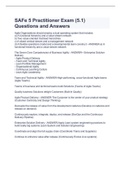
SAFe 5 Practitioner Exam (5.1) Questions and Answers
Agile Organizations should employ a dual operating system that includes a) A functional hierarchy and a value stream network b) Two value-oriented matrixed hierarchies c) A siloed vertical stream and a management network d) A flexible operations model and a developmental team construct - ANSWER-a) A functional hierarchy and a value stream network The Seven Core Competencies of Business Agility - ANSWER-- Enterprise Solution Delivery - Agile Product Delivery - Team and Technical Agility - Lean Portfolio Management - Organizational Agility - Continuous Learning Culture - Lean Agile Leadership Team and Technical Agility - ANSWER-High-performing, cross-functional Agile teams (Agile Teams) Teams of business and technical teams build Solutions (Teams of Agile Teams) Quality business Solutions delight Customers (Built-In Quality) Agile Product Delivery - ANSWER-The Customer is the center of your product strategy (Customer Centricity and Design Thinking) Decouple the release of value from the development cadence (Develop on cadence and release on demand) Continuously explore, integrate, deploy, and release (DevOps and the Continuous Delivery Pipeline) Enterprise Solution Delivery - ANSWER-Apply Lean system engineering practices to build really big systems (Lean System and Solution Engineering) Coordinate and align the full supply chain (Coordinate Trains and Suppliers) Continue to enhance value after release (Continuously Evolve Live systems) Lean Portfolio Management - ANSWER-Align strategy, funding, and execution (Strategy & Investment Funding) Optimize operations across the portfolio (Agile Portfolio Operations) Lightweight governance empowers decentralized decision-making (Lean Governance) Organizational Agility - ANSWER-Create an enterprise-wide, Lean-Agile mindset (Lean-thinking People and Agile Teams) Map and continuously improve business processes (Lean Business Operations) Response quickly to opportunities and threats (Strategy Agility) Continuous Learning Culture - ANSWER-Everyone in the organization learns and grows together (Learning Organization) Exploration and creativity are part of the organization's DNA (Innovation Culture) Continuously improving solutions, services, and processes is everyone's responsibility (Relentless Improvement) Lean-Agile Leadership - ANSWER-Inspire others by modeling desired behaviors (Leading by Example) Align mindset, words, and actions to Lean-Agile values and principles (Mindset & Principles) term-12 Actively lead the change and guide others to the new way of working (Leading Change) SAFe Configurations - ANSWER-- Full configuration - Large solution configuration - Portfolio configuration - Essential configuration Essential SAFe contains: - ANSWER-Roles and activities, and events and processess which Agile Teams use to build and deliver value in the context of the ART - Agile Release Train - Agile Teams SAFe House of Lean - ANSWER- SAFe House of Lean - Value - ANSWER-Achieve the shortest sustainable lead time with: - The best quality and value to people and society - High morale, safety, and Customer delight SAFe House of Lean - Respect for people and culture - ANSWER-- Generative culture - People do all the work - Your Customer is whoever consumes your work - Build long-term partnerships based on trust - To change the culture, you have to change the organization "Culture eats strategy for breakfast" - Peter Drucker SAFe House of Lean - Flow - ANSWER-- Optimize sustainable value delivery - Build in quality - Understand, exploit, and manage variability - Move from projects to products "Operating a product development process near full utilization is an economic disaster" - Don Reinersten SAFe House of Lean - Innovation - ANSWER-- Innovative people - Provide time and space for innovation - Go see - Experimentation and feedback - Innovation riptides - Pivot without mercy or guilt SAFe House of Lean - Relentless improvement - ANSWER-- A constant sense of danger - Optimize the whole -Problem-solving culture - Base improvements on facts - Reflect at key Milestones SAFe House of Lean - Leadership - ANSWER-- Lead by example - Adopt a growth mindset - Exmplify the values and principles of Lean-Agile and SAFe - Develop people - Lead the change - Foster psychological safety The Agile Manifesto - ANSWER-- Individuals and interactions over processes and tools - Working software over comprehensive documentation - Customer collaboration over contract negotiation - Responding to change over following a plan The Agile Manifesto Principles pt.1 - ANSWER-1. Our highest priority is to satisfy the customer through early and continuous delivery of valuable software 2. Welcome changing requirements, even late in development, Agile processes harness change for the customer's competitive advantage 3. Deliver working software frequently, from a couple of weeks to a couple of months, with a preference for the shorter timescale 4. Business people and developers must work together daily throughout the project 5. Build projects around motivated individuals. Give them the environment and support they need, and trust them to get the job done 6. The most efficient and effective method of conveying information to and within a development team is face-to-face conversation The Agile Manifesto Principles pt.2 - ANSWER-7. Working software is the primary measure of progress 8. Agile processes promote sustainable development. The sponsors, developers, and users should be able to maintain a constant pace indefinitely 9. Continuous attention to technical excellence and good design enhances agility 10. Simplicity - the art of maximizing the amount of work not done - is essential 11. The best architectures, requirements, and designs emerge from self-organizing teams 12. At regular intervals, the team reflects on how to become more effective, then tunes and adjusts its behavior accordingly SAFe Lean-Agile Principles - ANSWER-1. Take an economic view 2. Apply systems thinking 3. Assume variability; preserve options 4. Build incrementally with fast, integrated learning cycles 5. Base milestones on objective evaluation of working systems 6. Visualize and limit WIP, reduce batch sizes, and manage queue lengths 7. Apply cadence, synchronize with cross-domain planning 8. Unlock the intrinsic motivation of knowledge workers 9. Decentralize decision-making 10. Organize around value Little's Law - ANSWER-Average wait time = average queue length divided by average processing rate Reduce batch size for higher predictability - ANSWER-See diagram 1-55 on page 40 Agile for teams: Scrum - ANSWER-Scrum is built on transparency, inspection, adaptation, and short learning cycles Agile for teams: Kanban - ANSWER-Visualize work flow. Limit work in process. Improve flow. Quality practices inspired by eXtreme Programming (XP) - ANSWER-- Test-Driven Development - Coding Standards - Pair Work - Refactoring - User Stories - Continuous Integration - Collective Ownership - Automated Testing - Simple Design A CALMR approach to DevOps - ANSWER-1. Culture - of shared responsibility 2. Automation - of continuous delivery pipeline 3. Lean Flow - accelerates delivery 4. Measurement - of flow, quality and value 5. Recovery - reduces risk and preserves value Release on Demand - ANSWER-- Continuous Exploration - Continuous Integration - Continuous Deployment Responsibilities of the Agile Team - ANSWER-- 5 to 11 team members - Create and refine Stories and acceptance criteria - Define, build, test, and deploy Stories - Build quality in to each increment of the solution - Develop and commit to team PI Objectives and Iteration goals Teams on the ART are organized for flow - ANSWER-1. Stream-aligned team - organized around the flow of work and has the ability to deliver value directly to the Customer or end user 2. Complicated subsystem team - organized around specific subsystems 3. Platform team - organized around the development and support of platforms that provide services to other teams 4. Enabling team - organized to assist other teams with specialized capabilities and help them become proficient in new technologies Stream-aligned Teams (best) - ANSWER-- By product, Solution, or service - By Customer or market segment - By Solution feature areas - By steps in the Customer journey - By value streamlets - New product innovation Complicated Subsystem Teams - ANSWER-- Highly specialized system components - Safety critical systems elements - Specialty algorithm or business rules - Part of a cyber-physical system Platform Teams - ANSWER-- Sets of services consumed by other Teams Enabling Teams - ANSWER-- DevOps implementation - Automated testing - Continuous integration and build tooling - Engineering quality practices - Security Environments and configuration Agile Team - Scrum Master - ANSWER-- Coaches the Agile Team in self-management - Helps the team focus on creating increments of value each iteration - Facilitates the removal of impediments to the team's progress - Ensures that all team events take place, are productive and kept within the timebox Agile Team - Product Owner - ANSWER-- Contributes to the Vision and Roadmap - Acts as the Customer for team questions - Creates, clearly communicates and accepts Stories - Prioritizes the Team Backlog Scrum Master in the Enterprise - ANSWER-- Coordinates w/ other SMs, the System Team, & shared resources in the ART PI Planning meetings - Works w/ the above teams throughout each Iteration and PI - Coordinates w/ other SMs & the Release Train Engineer in Scrum of Scrums - Fosters normalized estimating w/in the team - Helps teams operate under architectural & portfolio governance, System Level integration, & System Demos - Fosters adoption of Agile technical practices Product Owner in the Enterprise - ANSWER-- Establishes the sequence of backlog items based on program priorities, events, & dependencies w/ other teams - Operates as part of an extended Product Management Team, usually reporting via a "fat dotted line" - Understands how the Enterprise Backlog Model operates w/ Epics, Capabilities, Features & Stories - Uses PI Objectives & Iteration Goals to communicate w/ management - Coordinates w/ other POs, the System Team, & shared services in the PI Planning meetings - Works w/ other POs & the Product Management team throughout each Iteration & PI Agile Release Trains (ARTs) - ANSWER-- A virtual organization of 5 - 12 teams (50 - 125+ individuals) - Synchronized on a common cadence, a Program Increment (PI) - Aligned to a common mission via a single Program Backlog Continuous Delivery Pipeline - ANSWER-- Continuous Exploration - Continuous Integration - Continuous Deployment Roles on the Agile Release Train - ANSWER-1. Release Train Engineer - acts as the chief Scrum Master for the train 2. System Architect/Engineering - provides architectural guidance and technical enablement to the teams on the train 3. Business Owners - are key stakeholders on the Agile Release Train 4. Product Management - owns, defines, and prioritizes the Program Backlog 5. System team - provides processes and tools to integrate and evaluate assets early and often Features represent - ANSWER-- The Feature benefit hypothesis justifies development cost and provides business perspective for decision-making - Features contain acceptance criteria typically defined during the Program Backlog refinement - They reflect functional and non-functional requirements - Features fit in one PI User Stories - ANSWER-The recommended form of expression is the user-voice form, as follows: As a (user role), I want to (activity), so that (business value). INVEST in a good Story - ANSWER-Independent - Write Stories that can be developed separately Negotiable - Write Stories in which scope can be negotiated Valuable - Write Stories that are valuable to the Customer Estimable - Write Stories that can be estimated Small - Write Stories that can fit in an Iteration Testable - Write Stories that are testable Writing good Stories: The 3Cs - ANSWER-Card - Written on a card or in the tool and may annotate with notes Conversation - The details are in a conversation with the Product Owner Confirmation - Acceptance criteria confirm the Story correctness Four types of Enabler Stories - ANSWER-Infrastructure: Build development and testing frameworks that enable a faster and more efficient development process Architecture: Build the Architectural Runway, which enables smoother and faster development Exploration: Build understanding of what is needed by the Customer to understand prospective Solutions and evaluate alternatives Compliance: Facilitate specific activities such as verification and validation, documentation, signoffs, regulatory submissions, and approvals
Escuela, estudio y materia
- Institución
- SAFe 5
- Grado
- SAFe 5
Información del documento
- Subido en
- 25 de enero de 2023
- Número de páginas
- 13
- Escrito en
- 2022/2023
- Tipo
- Examen
- Contiene
- Preguntas y respuestas
Temas
- safe 5
- team and technical a
-
safe 5 practitioner exam 51 questions and answers
-
agile organizations should employ a dual operating system that includes
-
the seven core competencies of business agility

Documento también disponible en un lote