

Note. These answer keys give more detail than you were expected to write down. You should skip
some of the intermediate skip for space.
Part I: Weeks 1 through 3
1. Technology and Profits. [14 pts.]
(a) Calculate the degree of homogeneity in the CES case
1 1
q = f (z1 , z2 ) = (αz12 + (1 − α)z22 )4
where q is output and z1 and z2 are inputs, all other symbols are parameters. Does a
characterization of the returns to scale depend on the size of the scaling factor (i.e., t ≥ 1
or t < 1)? [5]
(b) Consider a two-input Cobb Douglas function that has increasing returns to scale. Is this
compatible with decreasing marginal products? Support your answer with a calculation.
It is okay to consider a specific example. [6]
z2
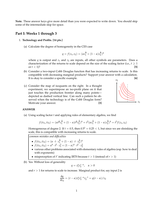
(c) Consider the map of isoquants on the right. In a thought
experiment, we superimpose an iso-profit plane on it that
just touches the production frontier along many points—
depicted as dashed vertical line. Can such a pattern be ob-
served when the technology is of the Cobb Douglas form?
Motivate your answer. [3] z1
ANSWER
(a) Using scaling factor t and applying rules of elementary algebra, we find
1 1 1 1 1 1
f (tz1 , tz2 ) = (αt 2 z12 + (1 − α)t 2 z22 )4 = t2 (αz12 + (1 − α)z22 )4 = t2 f (z1 , z2 )
Homogeneous of degree 2. If t = 0.5, then 0.52 = 0.25 < 1, but since we are shrinking the
scale, this is compatible with increasing returns to scale.
common mistakes and difficulties
1 1
• f (tz1 , tz2 ) = (α · t · z12 + (1 − α) · t · z22 )4
• f (tz1 , tz2 ) = α4 · t2 · z21 + (1 − α)4 · t2 · z22
• various other problems associated with elementary rules of algebra (esp. how to deal
with exponents)
• misperception of tr indicating IRTS because t > 1 (instead of r > 1)
(b) Yes: Without loss of generality
q = z1α zr2−α , α>0
and r > 1 for returns to scale to increase. Marginal product for, say input 2 is
∂q
= (r − α)z1α zr2−α z2−1 = q(r − α)/z2
∂z2
1
some of the intermediate skip for space.
Part I: Weeks 1 through 3
1. Technology and Profits. [14 pts.]
(a) Calculate the degree of homogeneity in the CES case
1 1
q = f (z1 , z2 ) = (αz12 + (1 − α)z22 )4
where q is output and z1 and z2 are inputs, all other symbols are parameters. Does a
characterization of the returns to scale depend on the size of the scaling factor (i.e., t ≥ 1
or t < 1)? [5]
(b) Consider a two-input Cobb Douglas function that has increasing returns to scale. Is this
compatible with decreasing marginal products? Support your answer with a calculation.
It is okay to consider a specific example. [6]
z2
(c) Consider the map of isoquants on the right. In a thought
experiment, we superimpose an iso-profit plane on it that
just touches the production frontier along many points—
depicted as dashed vertical line. Can such a pattern be ob-
served when the technology is of the Cobb Douglas form?
Motivate your answer. [3] z1
ANSWER
(a) Using scaling factor t and applying rules of elementary algebra, we find
1 1 1 1 1 1
f (tz1 , tz2 ) = (αt 2 z12 + (1 − α)t 2 z22 )4 = t2 (αz12 + (1 − α)z22 )4 = t2 f (z1 , z2 )
Homogeneous of degree 2. If t = 0.5, then 0.52 = 0.25 < 1, but since we are shrinking the
scale, this is compatible with increasing returns to scale.
common mistakes and difficulties
1 1
• f (tz1 , tz2 ) = (α · t · z12 + (1 − α) · t · z22 )4
• f (tz1 , tz2 ) = α4 · t2 · z21 + (1 − α)4 · t2 · z22
• various other problems associated with elementary rules of algebra (esp. how to deal
with exponents)
• misperception of tr indicating IRTS because t > 1 (instead of r > 1)
(b) Yes: Without loss of generality
q = z1α zr2−α , α>0
and r > 1 for returns to scale to increase. Marginal product for, say input 2 is
∂q
= (r − α)z1α zr2−α z2−1 = q(r − α)/z2
∂z2
1


