

Urban geography
Session 1
What is “the urban” and “the city”?
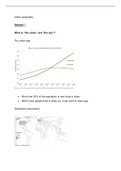
The urban age
• More than 50% of the population is now living in cities
• When more people lived in cities (vs. rural): start of urban age
Globalized urbanization
,
, • Let’s be critical about the urban age frame
• Statistical artifacts: how the urban is measured depends on diverging national
definitions / categories
o → URBANIZATION TRAJECTORIES
• “Chaotic abstractions”: The urban does not neatly overlay cities in the spatial
sense
o → Open up black box of the urban and the rural
• Urbanization was very localized, now increasingly globalized
• But: what kind of material structure does this refer to? E.g. Canada (more
forest, but how can it be urbanized?)
• Also: economic growth and urbanization: mismatch now?
• Not everywhere is more than 50% of the population in cities → e.g. Africa
• Criticism: we need to be way more specific
o 1. Belgium is 98% “urban”, but what is then the definition of urban?
o 2. Urban does not have to be overlapped with cities
Conceptualizations
• The city as a lump of material (“the built environment”)
, o City is a lump of material, a mass in a certain place, “the built
environment”, all about density
▪ But, it is not because you have a form of centrality that you have
something urban or a city
▪ → Talking about central functions e.g. gas station in desert →
important, but does not make it urban
• The city versus the non-city (the rural?)
o City is not the rural
▪ Density vs. woods and rivers
▪ Quite complicated (where ends the city of brussels?)
• The urban as a distinctive way of life
o Community, interaction vs. society (Gemeinschaft & Gesellschaft)
• The city as a complex division of labour
o Systems of accumulation: how you make money
▪ Industrial or society based on speculation?
▪ Could produce a different kind of spatial form
• The urban as epitomizing a particular society
o People became depending on money so they moved to the city to get
jobs: industry (→ increased productivity → going back to middle class in
welfare states)
o 1990s: Keynesian regime (last picture)
▪ We turn to the city, the places that left abandoned became
popular again
• The urban / the city as a projector of symbolic power
o E.g. Mesen, population = 1065 but it’s a city because: it had 8000
inhabitants once and had an important rule in the history for cross-
European trade
• The administrative city
• Urban vs. city
o One is more geographical, the other is more sociological
The urban as a process: urbanization
• The process of becoming urban
Session 1
What is “the urban” and “the city”?
The urban age
• More than 50% of the population is now living in cities
• When more people lived in cities (vs. rural): start of urban age
Globalized urbanization
,
, • Let’s be critical about the urban age frame
• Statistical artifacts: how the urban is measured depends on diverging national
definitions / categories
o → URBANIZATION TRAJECTORIES
• “Chaotic abstractions”: The urban does not neatly overlay cities in the spatial
sense
o → Open up black box of the urban and the rural
• Urbanization was very localized, now increasingly globalized
• But: what kind of material structure does this refer to? E.g. Canada (more
forest, but how can it be urbanized?)
• Also: economic growth and urbanization: mismatch now?
• Not everywhere is more than 50% of the population in cities → e.g. Africa
• Criticism: we need to be way more specific
o 1. Belgium is 98% “urban”, but what is then the definition of urban?
o 2. Urban does not have to be overlapped with cities
Conceptualizations
• The city as a lump of material (“the built environment”)
, o City is a lump of material, a mass in a certain place, “the built
environment”, all about density
▪ But, it is not because you have a form of centrality that you have
something urban or a city
▪ → Talking about central functions e.g. gas station in desert →
important, but does not make it urban
• The city versus the non-city (the rural?)
o City is not the rural
▪ Density vs. woods and rivers
▪ Quite complicated (where ends the city of brussels?)
• The urban as a distinctive way of life
o Community, interaction vs. society (Gemeinschaft & Gesellschaft)
• The city as a complex division of labour
o Systems of accumulation: how you make money
▪ Industrial or society based on speculation?
▪ Could produce a different kind of spatial form
• The urban as epitomizing a particular society
o People became depending on money so they moved to the city to get
jobs: industry (→ increased productivity → going back to middle class in
welfare states)
o 1990s: Keynesian regime (last picture)
▪ We turn to the city, the places that left abandoned became
popular again
• The urban / the city as a projector of symbolic power
o E.g. Mesen, population = 1065 but it’s a city because: it had 8000
inhabitants once and had an important rule in the history for cross-
European trade
• The administrative city
• Urban vs. city
o One is more geographical, the other is more sociological
The urban as a process: urbanization
• The process of becoming urban


