Exam Section 1: Item 1 of 50 National Board of Medical Examiners®
■ Mark Comprehensive Clinical Science Self-Assessment
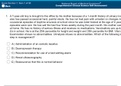
1. A ?-year-old boy is brought to the office by his mother because of a 1-month history of urinary inco
also has passed occasional hard, painful stools. He has not had pain with urination or changes in
occasional episodes of daytime enuresis at school since he was toilet trained at the age of 4 years
episodes were rare. He has wet the bed four times weekly during the past month. His mother cann
at home. He has no history of serious illness and receives no medications. Vaccinations are up-to
P.:s in school. He is at the 25th percentile for height and weight and 35th percentile for BMI. Vital s
Examination shows no abnormalities. Urinalysis shows no abnormalities. Which of the following is
step in management?
Q A) Administration of an osmotic laxative
0 B) Desmopressin therapy
Q C) Recommendation for use of a bed-wetting alarm
0 D) Renal ultrasonography
Q E) Reassurance that this is normal behavior
,Exam Section 1: Item 2 of 50 National Board of Medical Examiners®
■ Mark Comprehensive Clinical Science Self-Assessment
2. A 14-year-old boy is brought to the physician by his mother because she has had difficulty awaken
the start of the school year 3 months ago. She reports that last year he would always get up on his
him several times every morning. She says that he has the same group of friends as he did last ye
the patient says that during the summer he discovered a talk show at 10 PM that he enjoys watchin
tired at 10 PM, which was his bedtime last year. Physical examination shows no abnormalities. Wh
appropriate next step?
Q A) Urine toxicology screening
Q B) Use of an over-the-counter sleeping medication as needed
Q C) Modafinil use in the morning
Q D) Zolpidem use at bedtime
Q E) No further treatment is indicated
,Exam Section 1: Item 3 of 50 National Board of Medical Examiners®
■ Mark Comprehensive Clinical Science Self-Assessment
3. An asymptomatic 37-year-old woman comes to the physician for a follow-up examination after an
positive. Her last HIV antibody test 5 years ago was negative. She has no previous history of sexu
During the past 10 years, she has been sexually active with eight male partners; she uses an oral
know of any partners who are HIV positive. She exercises regularly. Her vital signs are within norm
no abnormalities. A complete blood count and serum electrolyte, urea nitrogen, and creatinine con
reference range. Her CD4+ T-lymphocyte count is 410/mm 3 (Normal>500), and plasma HIV viral lo
Urine pregnancy test is negative. Serologic testing for hepatitis and a PPD skin test are negative.
abnormalities. Antiretroviral therapy is begun. Which of the following is the most appropriate next s
this patient?
0 A) Fluconazole therapy
0 B) lsoniazid therapy
Q C) Pyrimethamine and sulfamethoxazole therapy
Q D) Trimethoprim-sulfamethoxazole therapy
Q E) 23-Valent pneumococcal vaccine
, Exam Section 1: Item 4 of 50 National Board of Medical Examiners®
■ Mark Comprehensive Clinical Science Self-Assessment
4. A 4 ?-year-old woman comes to the physician because of a 1-week history of progressive left-sided
she underwent an uncomplicated pancreatic transplant because of type 1 diabetes mellitus. Her m
mycophenolate mofetil and prednisone. Vital signs are within normal limits. Muscle strength is 4/5
face and left upper extremity. Deep tendon reflexes are increased on the left. Sensation is intact. T
examination shows no abnormalities. An MRI of the brain shows a homogeneously enhancing righ
surrounding edema. A biopsy specimen of the lesion shows proliferation of monoclonal B lymphoc
the most likely causal organism?
0 A) Cytomegalovirus
0 B) Epstein-Barr virus
Q C) Human herpesvirus 6
0 D)JCvirus
Q E) Varicella-zoster virus
■ Mark Comprehensive Clinical Science Self-Assessment
1. A ?-year-old boy is brought to the office by his mother because of a 1-month history of urinary inco
also has passed occasional hard, painful stools. He has not had pain with urination or changes in
occasional episodes of daytime enuresis at school since he was toilet trained at the age of 4 years
episodes were rare. He has wet the bed four times weekly during the past month. His mother cann
at home. He has no history of serious illness and receives no medications. Vaccinations are up-to
P.:s in school. He is at the 25th percentile for height and weight and 35th percentile for BMI. Vital s
Examination shows no abnormalities. Urinalysis shows no abnormalities. Which of the following is
step in management?
Q A) Administration of an osmotic laxative
0 B) Desmopressin therapy
Q C) Recommendation for use of a bed-wetting alarm
0 D) Renal ultrasonography
Q E) Reassurance that this is normal behavior
,Exam Section 1: Item 2 of 50 National Board of Medical Examiners®
■ Mark Comprehensive Clinical Science Self-Assessment
2. A 14-year-old boy is brought to the physician by his mother because she has had difficulty awaken
the start of the school year 3 months ago. She reports that last year he would always get up on his
him several times every morning. She says that he has the same group of friends as he did last ye
the patient says that during the summer he discovered a talk show at 10 PM that he enjoys watchin
tired at 10 PM, which was his bedtime last year. Physical examination shows no abnormalities. Wh
appropriate next step?
Q A) Urine toxicology screening
Q B) Use of an over-the-counter sleeping medication as needed
Q C) Modafinil use in the morning
Q D) Zolpidem use at bedtime
Q E) No further treatment is indicated
,Exam Section 1: Item 3 of 50 National Board of Medical Examiners®
■ Mark Comprehensive Clinical Science Self-Assessment
3. An asymptomatic 37-year-old woman comes to the physician for a follow-up examination after an
positive. Her last HIV antibody test 5 years ago was negative. She has no previous history of sexu
During the past 10 years, she has been sexually active with eight male partners; she uses an oral
know of any partners who are HIV positive. She exercises regularly. Her vital signs are within norm
no abnormalities. A complete blood count and serum electrolyte, urea nitrogen, and creatinine con
reference range. Her CD4+ T-lymphocyte count is 410/mm 3 (Normal>500), and plasma HIV viral lo
Urine pregnancy test is negative. Serologic testing for hepatitis and a PPD skin test are negative.
abnormalities. Antiretroviral therapy is begun. Which of the following is the most appropriate next s
this patient?
0 A) Fluconazole therapy
0 B) lsoniazid therapy
Q C) Pyrimethamine and sulfamethoxazole therapy
Q D) Trimethoprim-sulfamethoxazole therapy
Q E) 23-Valent pneumococcal vaccine
, Exam Section 1: Item 4 of 50 National Board of Medical Examiners®
■ Mark Comprehensive Clinical Science Self-Assessment
4. A 4 ?-year-old woman comes to the physician because of a 1-week history of progressive left-sided
she underwent an uncomplicated pancreatic transplant because of type 1 diabetes mellitus. Her m
mycophenolate mofetil and prednisone. Vital signs are within normal limits. Muscle strength is 4/5
face and left upper extremity. Deep tendon reflexes are increased on the left. Sensation is intact. T
examination shows no abnormalities. An MRI of the brain shows a homogeneously enhancing righ
surrounding edema. A biopsy specimen of the lesion shows proliferation of monoclonal B lymphoc
the most likely causal organism?
0 A) Cytomegalovirus
0 B) Epstein-Barr virus
Q C) Human herpesvirus 6
0 D)JCvirus
Q E) Varicella-zoster virus