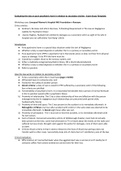
Evaluating the law on pure psychiatric harm in relation to secondary victims - Exam Essay Template:
Workshop case: Liverpool Women’s Hospital NHS Foundation v Ronayne
Critics articles:
● Andrew S. Burrows and John H Burrows, ‘A Shocking Requirement in The Law on Negligence
Liability for Psychiatric Illness’
● Joanne Hughes, Husband not entitled to damages as a secondary victim as sight of his wife in
hospital was not sufficiently ‘horrifying’ (2015)
Introduction
● Pure psychiatric harm is a special duty situation under the tort of Negligence
● Whether a duty is owed depends on whether the V is a primary or secondary victim
● Pure psychiatric harm (PPH) is psychiatric harm that stands alone so does not flow from physical
injury or damage. To be PPH the harm must be:
a) Caused by a sudden shock to the nervous system; and
b) Either a medically recognised psychiatric illness, OR a shock induced physical
● Whether a duty is owed depends on whether the V is a primary or secondary victim
● Refer to question
How the law works in relation to secondary victims
● To be a secondary victim the C must have (page v Smith):
● Witnessed injury to someone else; and
● Feared for the safety of another person
● Alcock criteria: a duty of care is owed for PPH suffered by a secondary victim if the following
four criteria are satisfied:
a) Foreseeability of psychiatric harm: It is reasonably foreseeable that a person of normal fortitude
in the Cs position would suffer a psychiatric illness
b) Proximity of relationship: The C has a close relationship of love and affection with the person
endangered by the Ds negligence (such relationships are presumed with parent-child,
husband-wife, fiance)
c) Proximity of time and space: The C was present at the accident or its immediate aftermath. In
Mcloughlin v O’Brian one hour after accident with victims in the same state was deemed to be
immediate aftermath. In Alcock eight hours after was not.
d) Proximity of perception: The C must see or hear the accident, or its immediate aftermath with
his own senses.
● Facts of Alcock: Concerned secondary victims of Hillsborough disaster, most had not actually
been present at the time, some had witnessed on TV or heard about the events on the radio and
suffered nervous shock. Brought claim against the police for damages, none of them were able
to claim.
● Criticise Alcock criteria in that it seems relevant to the facts of Alcock but perhaps does not
transfer well to other cases. Successfully stops lots of claims but isn’t satisfactory area of the law.
Critical evaluation:
● Why a person of ‘normal fortitude’ when the eggshell skull rule is normal in tort? Hardly fair if
someone suffers from severe anxiety but cannot claim for their loss.
Workshop case: Liverpool Women’s Hospital NHS Foundation v Ronayne
Critics articles:
● Andrew S. Burrows and John H Burrows, ‘A Shocking Requirement in The Law on Negligence
Liability for Psychiatric Illness’
● Joanne Hughes, Husband not entitled to damages as a secondary victim as sight of his wife in
hospital was not sufficiently ‘horrifying’ (2015)
Introduction
● Pure psychiatric harm is a special duty situation under the tort of Negligence
● Whether a duty is owed depends on whether the V is a primary or secondary victim
● Pure psychiatric harm (PPH) is psychiatric harm that stands alone so does not flow from physical
injury or damage. To be PPH the harm must be:
a) Caused by a sudden shock to the nervous system; and
b) Either a medically recognised psychiatric illness, OR a shock induced physical
● Whether a duty is owed depends on whether the V is a primary or secondary victim
● Refer to question
How the law works in relation to secondary victims
● To be a secondary victim the C must have (page v Smith):
● Witnessed injury to someone else; and
● Feared for the safety of another person
● Alcock criteria: a duty of care is owed for PPH suffered by a secondary victim if the following
four criteria are satisfied:
a) Foreseeability of psychiatric harm: It is reasonably foreseeable that a person of normal fortitude
in the Cs position would suffer a psychiatric illness
b) Proximity of relationship: The C has a close relationship of love and affection with the person
endangered by the Ds negligence (such relationships are presumed with parent-child,
husband-wife, fiance)
c) Proximity of time and space: The C was present at the accident or its immediate aftermath. In
Mcloughlin v O’Brian one hour after accident with victims in the same state was deemed to be
immediate aftermath. In Alcock eight hours after was not.
d) Proximity of perception: The C must see or hear the accident, or its immediate aftermath with
his own senses.
● Facts of Alcock: Concerned secondary victims of Hillsborough disaster, most had not actually
been present at the time, some had witnessed on TV or heard about the events on the radio and
suffered nervous shock. Brought claim against the police for damages, none of them were able
to claim.
● Criticise Alcock criteria in that it seems relevant to the facts of Alcock but perhaps does not
transfer well to other cases. Successfully stops lots of claims but isn’t satisfactory area of the law.
Critical evaluation:
● Why a person of ‘normal fortitude’ when the eggshell skull rule is normal in tort? Hardly fair if
someone suffers from severe anxiety but cannot claim for their loss.