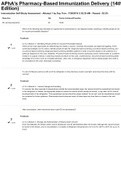
APhA's Pharmacy-Based Immunization Delivery (14th Edition) Immunization Self-Study Assessment Passed - 92.5% score
Which of the following best describes an opportunity for pharmacists to use diagnosis-based screening to identify people at risk for vaccine-preventable diseases? Feedback LO 4.2; Module 4—Identifying People at Risk for Vaccine-Preventable Disease There are two main approaches for determining who needs a vaccine: universal immunization and high-risk targeting. Three screening strategies can be used to identify people at high-risk: diagnosis-based screening, procedure-based screening, and occurrence-based screening. Diagnosis-based screening identifies patients in need of vaccines based on the presence of a particular diagnosis (in this case, diabetes). Procedure-based screening involves assessing vaccine needs based on a patient’s receipt of a surgical, medical, or pharmacy-based procedure (in this case, a splenectomy). Occurrence-based screening takes advantage of an event, such as a hospital admission, clinic visit, or emergency department visit to identify people who need to be vaccinated (in this case, discharge counseling). 2 1 point If a vial of influenza vaccine is left out of the refrigerator on the pharmacy counter overnight, what should be done with the vaccine? Feedback LO 5.4; Module 5— Vaccine Storage and Handling. If a vaccine has been exposed to temperatures outside the recommended range, the vaccine should be quarantined and stored in the refrigerator or freezer (as appropriate based on where the vaccine should usually be stored). In the case, the IIV should be placed back in the refrigerator. This quarantined vaccine should be clearly marked “do not use” and the manufacturer should be contacted for further guidance. Pharmacists should document each of these steps any time there is a break in the cold chain. 3 1 point After reconstitution, within what time frame must HZV be administered? Feedback LO 3.2; Module 3—Storage and Administration of Herpes Zoster Vaccine Once reconstituted, the herpes zoster vaccine (Zostavax) must be administered within 30 minutes. Although this vaccine should be stored in the freezer, prior to reconstitution, it is stable at refrigerator temperatures of 2°C to 8°C (36°F to 46°F) for up to 72 hours. APhA's Pharmacy-Based Immunization Delivery (14th Edition) Immunization Self-Study Assessment - Attempt 1 by Duy Tran - 7/26/2019 3:35:25 AM - Passed - 92.5% Objective Qty Points Achieved/Possible All Learning Objectives 80 74/80 4 1 point Which of the following is recognized by sociologists as a factor in a patient’s decision whether to be vaccinated? Feedback Module 4—Educating Patients About Vaccines. Sociologists have identified five key factors in a person’s decision to be vaccinated: 1) perceived susceptibility to a disease, 2) perceived seriousness of a disease, 3) perceived vaccine benefits, 4) perceived vaccine barriers (e.g., adverse effects, access), and 5) social influence (e.g., recommendation from a health care provider)
Escuela, estudio y materia
Información del documento
- Subido en
- 7 de enero de 2023
- Número de páginas
- 21
- Escrito en
- 2022/2023
- Tipo
- Examen
- Contiene
- Preguntas y respuestas
Temas
-
aphas pharmacy based immunization delivery 14th edition immunization self study assessment passed 925 score

Documento también disponible en un lote