Amphibians – Adapting to Life on Land
Class: Amphibia >6000 extant species
Subclass: Lissamphibia (living members) - 3
lineages of extant amphibians
Orders:
Anura (frogs and toads) ~5500 species
(cosmopolitan distribution)
Caudata (salamanders) ~560 species (tropical)
Gymnophiona (caecilians) >121 species (tropical)
All possess very different body forms but
identified as a monophyletic lineage by several shared derived characters
Some of the characters (moist, permeable skin) have channelled evolution of 3
lineages in similar directions
All amphibians are carnivorous
Phylogeny
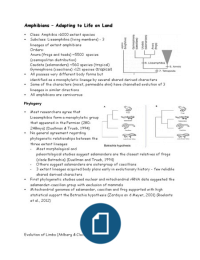
Most researchers agree that
Lissamphibia form a monophyletic group
that appeared in the Permian (280-
248mya) (Duellman & Trueb, 1994)
No general agreement regarding
phylogenetic relationships between the
three extant lineages
- Most morphological and
paleontological studies suggest salamanders are the closest relatives of frogs
(clade Batrachia) (Duellman and Trueb, 1994)
- Others suggest salamanders are sistergroup of caecillians
- 3 extant lineages acquired body plans early in evolutionary history – few reliable
shared derived characters
First phylogenetic studies used nuclear and mitochondrial rRNA data suggested the
salamander-caecilian group with exclusion of mammals
Mitochondrial genomes of salamander, caecilian and frog supported with high
statistical support the Batrachia hypothesis (Zardoya an d Meyer, 2001) (Roelants
et al., 2012)
Evolution of Limbs (Ahlberg & Clack,2006)
,The Rise of Tetrapods from the Sarcopterygii
- Early Devonian – robably the most complete transitional series in the fossil record
Eusthenopteron - Osteolepiform
(to some extent - Lobefins and skull place it close to ancestry of
Panderichthys) tetrapods
- Skull roof flattened, parietal bone paired, eyes
moved upwards and posteriorly – resembles
conditions in early tetrapods
- Pectoral girdle attached to skull – pelvic girdle was
weak: could not support weight out of water
Tiktaalik (380 mya) - Intermediate link between fishes and land
Late Devonian vertebrates
- Exhibit body covered in rhombic and cosmoid bony
scales
- Flattened skull likely advantageous for quick snaps
at prey in shallow water
- Loss of bony gill cover suggest change in fill
ventilation to ward supplementary use of lung
- Large ribs: better support when on land
- Pectoral fins – not quite forelimbs but terminate as
fin rays, not digit, first moveable elbow joints,
girdle now attached to archtube
- Dorsally and ventrally flattened skull – more
terrestrial feeding mechanism, first neck
Labyrinthodonts - Showed similar signs of the early tetropod condition
Paraphyletic stem group
in late Devonian
Acantostega - Similar to previous sarcopteryigians
- Radial fin rays supporting tail fin
- Intercranial joint present like fish
- Tetrapod characteristics – dermal skull bones, limbs
with digits, weight-bearing girdles
- 8 fingers and 8 toes (ie. pentadactyl chiridium
standard, not fixed in early tetrapods)
- Lacked auditory system or airborne sounds
Overlapping ribs protect organs – better neck
, Icthyostega - 7 fingers, 7 toes
- Uncontricted notochord extended into brain case
- Similar structure to Acanthostega – though internal
gills absent
- Withstand pressures of running – robustly
connected ribs
- Reduced phalanges, well structured pectoral and
pelvic girdle (eg. Stronger humerus and ulna bones
compared to Eusthenopteron)
- Vertebrates first stepped onto land late Paleozoic
- Lived mostly in water but used forelimbs to navigate shallow fresh water
- Extensive radiation : flying, aquatic, amphibious
- Tetrapods characterised by chiridium – muscular limb with well defined joints and
digits
Class: Amphibia >6000 extant species
Subclass: Lissamphibia (living members) - 3
lineages of extant amphibians
Orders:
Anura (frogs and toads) ~5500 species
(cosmopolitan distribution)
Caudata (salamanders) ~560 species (tropical)
Gymnophiona (caecilians) >121 species (tropical)
All possess very different body forms but
identified as a monophyletic lineage by several shared derived characters
Some of the characters (moist, permeable skin) have channelled evolution of 3
lineages in similar directions
All amphibians are carnivorous
Phylogeny
Most researchers agree that
Lissamphibia form a monophyletic group
that appeared in the Permian (280-
248mya) (Duellman & Trueb, 1994)
No general agreement regarding
phylogenetic relationships between the
three extant lineages
- Most morphological and
paleontological studies suggest salamanders are the closest relatives of frogs
(clade Batrachia) (Duellman and Trueb, 1994)
- Others suggest salamanders are sistergroup of caecillians
- 3 extant lineages acquired body plans early in evolutionary history – few reliable
shared derived characters
First phylogenetic studies used nuclear and mitochondrial rRNA data suggested the
salamander-caecilian group with exclusion of mammals
Mitochondrial genomes of salamander, caecilian and frog supported with high
statistical support the Batrachia hypothesis (Zardoya an d Meyer, 2001) (Roelants
et al., 2012)
Evolution of Limbs (Ahlberg & Clack,2006)
,The Rise of Tetrapods from the Sarcopterygii
- Early Devonian – robably the most complete transitional series in the fossil record
Eusthenopteron - Osteolepiform
(to some extent - Lobefins and skull place it close to ancestry of
Panderichthys) tetrapods
- Skull roof flattened, parietal bone paired, eyes
moved upwards and posteriorly – resembles
conditions in early tetrapods
- Pectoral girdle attached to skull – pelvic girdle was
weak: could not support weight out of water
Tiktaalik (380 mya) - Intermediate link between fishes and land
Late Devonian vertebrates
- Exhibit body covered in rhombic and cosmoid bony
scales
- Flattened skull likely advantageous for quick snaps
at prey in shallow water
- Loss of bony gill cover suggest change in fill
ventilation to ward supplementary use of lung
- Large ribs: better support when on land
- Pectoral fins – not quite forelimbs but terminate as
fin rays, not digit, first moveable elbow joints,
girdle now attached to archtube
- Dorsally and ventrally flattened skull – more
terrestrial feeding mechanism, first neck
Labyrinthodonts - Showed similar signs of the early tetropod condition
Paraphyletic stem group
in late Devonian
Acantostega - Similar to previous sarcopteryigians
- Radial fin rays supporting tail fin
- Intercranial joint present like fish
- Tetrapod characteristics – dermal skull bones, limbs
with digits, weight-bearing girdles
- 8 fingers and 8 toes (ie. pentadactyl chiridium
standard, not fixed in early tetrapods)
- Lacked auditory system or airborne sounds
Overlapping ribs protect organs – better neck
, Icthyostega - 7 fingers, 7 toes
- Uncontricted notochord extended into brain case
- Similar structure to Acanthostega – though internal
gills absent
- Withstand pressures of running – robustly
connected ribs
- Reduced phalanges, well structured pectoral and
pelvic girdle (eg. Stronger humerus and ulna bones
compared to Eusthenopteron)
- Vertebrates first stepped onto land late Paleozoic
- Lived mostly in water but used forelimbs to navigate shallow fresh water
- Extensive radiation : flying, aquatic, amphibious
- Tetrapods characterised by chiridium – muscular limb with well defined joints and
digits