Introduction to Vertebrates
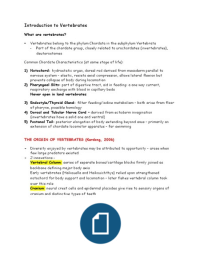
What are vertebrates?
Vertebrates belong to the phylum Chordata in the subphylum Vertebrata
- Part of the chordate group, closely related to urochordates (invertebrates),
deuterostomes
Common Chordate Characteristics (at some stage of life):
1) Notochord: hydrostatic organ, dorsal rod derived from mesoderm parallel to
nervous system – elastic, resists axial compression, allows lateral flexion but
prevents collapse of body during locomotion
2) Pharyngeal Slits: part of digestive tract, aid in feeding: a one way current,
respiratory exchange with blood in capillary beds
Never open in land vertebrates
3) Endostyle/Thyroid Gland: filter feeding/iodine metabolism – both arise from floor
of pharynx, possible homology
4) Dorsal and Tubular Nerve Cord – derived from ectoderm invagination
(invertebrates have a solid one and ventral)
5) Postanal Tail: posterior elongation of body extending beyond anus – primarily an
extension of chordate locomotor apparatus – for swimming
THE ORIGIN OF VERTEBRATES (Kardong, 2006)
- Diversity enjoyed by vertebrates may be attributed to opportunity – arose when
few large predators existed
- 2 innovations -
Vertebral Column: series of separate bones/cartilage blocks firmly joined as
backbone defining major body axis
Early vertebrates (Haikouella and Haikouichthys) relied upon strengthened
notochord for body support and locomotion – later fishes vertebral column took
over this role
Cranium: neural crest cells and epidermal placodes give rise to sensory organs of
cranium and distinctive types of teeth
,- Most fossils found in freshwater/delta deposits (Ordovician) – fish fossils
fragments of bony armour
- Cambrian fish fossils in marine waters
- Vertebrates evolved ~590Mya
- Vertebrate genomes are generally more complex than their invertebrate relatives
Unique embryonic features (Donoghue et al., 2009)
Hox genes (Kuraku, 2011): vertebrates unique in having undergone duplications of
entire Hox complex
- First duplication event occurred at the start of vertebrate evolution (amphioxus
have 1, jawless vertebrates have 2)
- 2nd duplication taken place by evolution of gnathostomes – all jawed vertebrates
have at least 4 clusters
- Additional duplication in teleost fishes and frogs
- Interactions among genes allows more structural complexity
Neural crest: new tissue in embryological development – forms many novel
structures in vertebrates (especially in head region)
MicroRNAs: genetic innovation in vertebrates, regulate protein synthesis by
complementary binding to mRNA – plays roles in regulating development of kidney,
liver
- Phylum chordata characterised by addition of 2 new microRNAs, 3 shared by
vertebrates and tunicates
- Vertebrates have an additional 41 unique microRNAs
- On top of that many lineages have acquired more microRNAs – mammals in
particular possess a great number of novel microRNAs
Vertebrate phylogeny and diversity
Phylogenetic hypothesis for major lineages of
vertebrates based on morphological, paleontological,
molecular evidence – disputed relationships
displayed as polytomies (Meyer and Zardoya, 2003)
History of vertebrates relatively well documented
in fossil record (Carroll, 1997) many debates arise
due to large gaps in fossil record, rapid lineage
diversification, highly derived morphologies of
extant lineages (complicates reconstruction of
evolutionary events)
, Debate: Monophylyly or Paraphyly of
Agnathans
Fossils of the earliest
vertebrates found in Chengjiang
(eg. Myllokunmingia,
Haikouichthys) suggest
vertebrates were part of
Cambrian explosion (Shu et al,, 2003)
Jawless vertebrates (agnathans) are a paraphyletic group when extinct lineages
taken in consideration (Janvier, 1996)
Debate = whether or not living hagfishes (Mixiniformes) and lampreys
(Petromyzontiformes) form a
monophyletic group (round
mouths/cyclostomes) or are
paraphyletic (vertebrate hypothesis )
- Paleontologists favour the vertebrate
hypothesis (Janvier, 1996)
-morphology (eg. horny teeth,
respiratory velum) and fossil record
(Chenjiang)
- Monophyly of cyclostomes supported
by molecular data (eg, nuclear 18S
and 28S rRNA genes – Mallat et al.,
2001)
- BUT analysis of mitochondrial protein-coding genes seem to support paraphyly –
lampreys as closes living sistergroup to jawed vertebrates (Rasmussen et al, 1998)
Main structures of the skull
Vertebrate skull (cranium)
composite structure
formed of 3 distinct, each
part arose from separate
phylogenetic source
Splanchnocranium
(visceral cranium): first
arose to support the
pharyngeal slits in
protochordates, generally
What are vertebrates?
Vertebrates belong to the phylum Chordata in the subphylum Vertebrata
- Part of the chordate group, closely related to urochordates (invertebrates),
deuterostomes
Common Chordate Characteristics (at some stage of life):
1) Notochord: hydrostatic organ, dorsal rod derived from mesoderm parallel to
nervous system – elastic, resists axial compression, allows lateral flexion but
prevents collapse of body during locomotion
2) Pharyngeal Slits: part of digestive tract, aid in feeding: a one way current,
respiratory exchange with blood in capillary beds
Never open in land vertebrates
3) Endostyle/Thyroid Gland: filter feeding/iodine metabolism – both arise from floor
of pharynx, possible homology
4) Dorsal and Tubular Nerve Cord – derived from ectoderm invagination
(invertebrates have a solid one and ventral)
5) Postanal Tail: posterior elongation of body extending beyond anus – primarily an
extension of chordate locomotor apparatus – for swimming
THE ORIGIN OF VERTEBRATES (Kardong, 2006)
- Diversity enjoyed by vertebrates may be attributed to opportunity – arose when
few large predators existed
- 2 innovations -
Vertebral Column: series of separate bones/cartilage blocks firmly joined as
backbone defining major body axis
Early vertebrates (Haikouella and Haikouichthys) relied upon strengthened
notochord for body support and locomotion – later fishes vertebral column took
over this role
Cranium: neural crest cells and epidermal placodes give rise to sensory organs of
cranium and distinctive types of teeth
,- Most fossils found in freshwater/delta deposits (Ordovician) – fish fossils
fragments of bony armour
- Cambrian fish fossils in marine waters
- Vertebrates evolved ~590Mya
- Vertebrate genomes are generally more complex than their invertebrate relatives
Unique embryonic features (Donoghue et al., 2009)
Hox genes (Kuraku, 2011): vertebrates unique in having undergone duplications of
entire Hox complex
- First duplication event occurred at the start of vertebrate evolution (amphioxus
have 1, jawless vertebrates have 2)
- 2nd duplication taken place by evolution of gnathostomes – all jawed vertebrates
have at least 4 clusters
- Additional duplication in teleost fishes and frogs
- Interactions among genes allows more structural complexity
Neural crest: new tissue in embryological development – forms many novel
structures in vertebrates (especially in head region)
MicroRNAs: genetic innovation in vertebrates, regulate protein synthesis by
complementary binding to mRNA – plays roles in regulating development of kidney,
liver
- Phylum chordata characterised by addition of 2 new microRNAs, 3 shared by
vertebrates and tunicates
- Vertebrates have an additional 41 unique microRNAs
- On top of that many lineages have acquired more microRNAs – mammals in
particular possess a great number of novel microRNAs
Vertebrate phylogeny and diversity
Phylogenetic hypothesis for major lineages of
vertebrates based on morphological, paleontological,
molecular evidence – disputed relationships
displayed as polytomies (Meyer and Zardoya, 2003)
History of vertebrates relatively well documented
in fossil record (Carroll, 1997) many debates arise
due to large gaps in fossil record, rapid lineage
diversification, highly derived morphologies of
extant lineages (complicates reconstruction of
evolutionary events)
, Debate: Monophylyly or Paraphyly of
Agnathans
Fossils of the earliest
vertebrates found in Chengjiang
(eg. Myllokunmingia,
Haikouichthys) suggest
vertebrates were part of
Cambrian explosion (Shu et al,, 2003)
Jawless vertebrates (agnathans) are a paraphyletic group when extinct lineages
taken in consideration (Janvier, 1996)
Debate = whether or not living hagfishes (Mixiniformes) and lampreys
(Petromyzontiformes) form a
monophyletic group (round
mouths/cyclostomes) or are
paraphyletic (vertebrate hypothesis )
- Paleontologists favour the vertebrate
hypothesis (Janvier, 1996)
-morphology (eg. horny teeth,
respiratory velum) and fossil record
(Chenjiang)
- Monophyly of cyclostomes supported
by molecular data (eg, nuclear 18S
and 28S rRNA genes – Mallat et al.,
2001)
- BUT analysis of mitochondrial protein-coding genes seem to support paraphyly –
lampreys as closes living sistergroup to jawed vertebrates (Rasmussen et al, 1998)
Main structures of the skull
Vertebrate skull (cranium)
composite structure
formed of 3 distinct, each
part arose from separate
phylogenetic source
Splanchnocranium
(visceral cranium): first
arose to support the
pharyngeal slits in
protochordates, generally