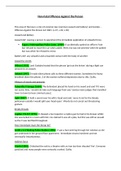
Non-Fatal Offences Against the Person
This area of the law is a mix of common law (common assault and battery) and statute –
Offences Against the Person Act 1861. (s.47, s.20, s.18)
Assault and Battery
Assault def: causing a person to apprehend the immediate application of unlawful force.
Fagan v Metropolitan Police Comr. (1969): D accidentally parked on officers' foot
but refused to move the car when asked. Mens rea was not promise when he parked
but was when he refused to move.
Battery def: any unlawful and unwanted contact with the body of another
Assault by words
Wilson (1955): Lord Goddard stated that the phrase ‘get out the knives’ during a fight can
amount to an assault.
Ireland (1997): D made silent phone calls to three different women. Sometimes he heavy
breathed down the phone. 2 of the women suffered depression due to this. Guilty.
Mixture of words and gestures
Tuberville V Savage (1669): The defendant placed his hand on his sword and said ‘if it were
not assize time, I would not take such language from you’ [assizes were judges that travelled
town to town to hear criminal cases].
Light (1857): D held a sword over his wife's head and said, ‘were it not for the bloody
policeman outside I would split your head open’. Words do not cancel out threatening
gesture.
Empty threats
Logdon V D.P.P (1976): D showed a tax inspector a replica gun he had in his drawer whilst
she was locked in a room with him. He claimed it was all a joke, but this was still an assault
as the V was terrified throughout.
How immediate must the threat be?
Smith v C.S Woking Police Station (1983): V saw a face peering through her window as she
got undressed in her ground floor apartment. ‘Immediate means imminent and not
necessarily instantaneous.
Indirect force
Martin (1881): D blocked the exit to a theatre with an iron bar then shouted ‘fire’. Everyone
panicked and many people were seriously crushed. Guilty.
This area of the law is a mix of common law (common assault and battery) and statute –
Offences Against the Person Act 1861. (s.47, s.20, s.18)
Assault and Battery
Assault def: causing a person to apprehend the immediate application of unlawful force.
Fagan v Metropolitan Police Comr. (1969): D accidentally parked on officers' foot
but refused to move the car when asked. Mens rea was not promise when he parked
but was when he refused to move.
Battery def: any unlawful and unwanted contact with the body of another
Assault by words
Wilson (1955): Lord Goddard stated that the phrase ‘get out the knives’ during a fight can
amount to an assault.
Ireland (1997): D made silent phone calls to three different women. Sometimes he heavy
breathed down the phone. 2 of the women suffered depression due to this. Guilty.
Mixture of words and gestures
Tuberville V Savage (1669): The defendant placed his hand on his sword and said ‘if it were
not assize time, I would not take such language from you’ [assizes were judges that travelled
town to town to hear criminal cases].
Light (1857): D held a sword over his wife's head and said, ‘were it not for the bloody
policeman outside I would split your head open’. Words do not cancel out threatening
gesture.
Empty threats
Logdon V D.P.P (1976): D showed a tax inspector a replica gun he had in his drawer whilst
she was locked in a room with him. He claimed it was all a joke, but this was still an assault
as the V was terrified throughout.
How immediate must the threat be?
Smith v C.S Woking Police Station (1983): V saw a face peering through her window as she
got undressed in her ground floor apartment. ‘Immediate means imminent and not
necessarily instantaneous.
Indirect force
Martin (1881): D blocked the exit to a theatre with an iron bar then shouted ‘fire’. Everyone
panicked and many people were seriously crushed. Guilty.