
summary paleoenvironments –
key techniques and concepts –
lectures
Focus on:
- (late) Quaternary (~last 25.000 yrs)
- Biological proxies and processes
- Terrestrial and freshwater biosphere
- Drivers, disturbance, and internal changes
- Do-it-yourself approach
To do this we need to:
- Get background knowledge in plant & geosciences
- Understand pros and cons different methods
- Switch between spatial and time scales
- Need support from statistical, experimental and
- physical methods
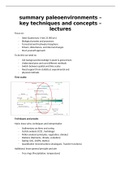
Time scales:
Techniques and proxies
Main; know aims, techniques and interpretation
- Sedimentary archives and coring
- Cuticle analysis (CO2 , hydrology)
- Pollen analysis (principles, vegetation, climate)
- Diatoms (Nutrients, climate, evolution)
- Dating (14C, 210Pb, tephra)
- Quantitative reconstructions (Analogues, Transfer functions)
Additional, know general principle and aim
- Tree rings (Precipitation, temperature)
, - Chironomids (summer temperature)
- Isotopes (δ 18O; ice volume, temperature)
Sediment archives with biological, physical, and chemical information
- Climate, geology, and land use control lake processes mixing, decomposition,
chemistry
- Sediments reflect controls and in-lake processes
Variation and preservation of microfossils (Taphonomy)
- Biota in wet habitats highly variable
- Only small part of biological activity in top sediment compared to benthic
community on plants and in the water samples
o Oxygen and light levels are limiting at the sediment-water interface
o Sediments reflect biological patterns from water and plants relatively well for
siliceous organisms, not very well for macroinvertebrates
- Relevance: proxy from fossil data resemble 1-2% of actual biology in lake or swamp
o Bioturbation is important but not “destructive” for assemblages
o Limited “view” of fossils on the real diversity, especially macroinvertebrates
o Preservation in sediment is very selective, mostly silica and some resistant
organic fossils (pollen, insect head capsules, some algae)
Lateral and vertical zonation
key techniques and concepts –
lectures
Focus on:
- (late) Quaternary (~last 25.000 yrs)
- Biological proxies and processes
- Terrestrial and freshwater biosphere
- Drivers, disturbance, and internal changes
- Do-it-yourself approach
To do this we need to:
- Get background knowledge in plant & geosciences
- Understand pros and cons different methods
- Switch between spatial and time scales
- Need support from statistical, experimental and
- physical methods
Time scales:
Techniques and proxies
Main; know aims, techniques and interpretation
- Sedimentary archives and coring
- Cuticle analysis (CO2 , hydrology)
- Pollen analysis (principles, vegetation, climate)
- Diatoms (Nutrients, climate, evolution)
- Dating (14C, 210Pb, tephra)
- Quantitative reconstructions (Analogues, Transfer functions)
Additional, know general principle and aim
- Tree rings (Precipitation, temperature)
, - Chironomids (summer temperature)
- Isotopes (δ 18O; ice volume, temperature)
Sediment archives with biological, physical, and chemical information
- Climate, geology, and land use control lake processes mixing, decomposition,
chemistry
- Sediments reflect controls and in-lake processes
Variation and preservation of microfossils (Taphonomy)
- Biota in wet habitats highly variable
- Only small part of biological activity in top sediment compared to benthic
community on plants and in the water samples
o Oxygen and light levels are limiting at the sediment-water interface
o Sediments reflect biological patterns from water and plants relatively well for
siliceous organisms, not very well for macroinvertebrates
- Relevance: proxy from fossil data resemble 1-2% of actual biology in lake or swamp
o Bioturbation is important but not “destructive” for assemblages
o Limited “view” of fossils on the real diversity, especially macroinvertebrates
o Preservation in sediment is very selective, mostly silica and some resistant
organic fossils (pollen, insect head capsules, some algae)
Lateral and vertical zonation


