TEEX Paramedic - PA Exam Study Guide
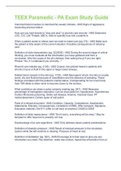
Clenched facial muscles or clenched fist usually indicate - ANS Signs of aggressive impending physical attack. How can you best decide to "stay and play" or provide care enroute - ANS Determine LOC, C/C, Life Threats, ABC's. Able to quantify how sick a patient is. When a patient wants to refuse care we need to make sure (pg.174) - ANS Make sure the patient is fully aware of the current situation. Possible consequences of refusing care. Definition of data interpretation (pg. 522/608) - ANS During the second stage of critical thinking, you must evaluate all the information you have gathered and form a conclusion. Infer the cause of the pt's distress, then asking the pt if you are right. Phrase: "So, if I understand you correctly..." Rhonchi can indicate (pg. 2130) - ANS Coarse, low pitched heard in patients with chronic mucus or fluid in the upper or larger lower airways. Dilated blood vessels in the skin (pg. 1723) - ANS Neurogenic shock, the skin is usually warm, dry and flushed because of vasodilation and the absence of sweating. These findings correlated with the patient's mental status. Compensating for too much body heat. Will dilate to allow veins to become closer to the surface. What conditions can skew a pulse oximetry reading (pg. 547) - ANS Measures percentage of hemoglobin saturation. Can be inaccurate for: Hypotension, Hypothermia, Carbon Monoxide poisoning, Sickle cell disease, Anemia, Vascular Dyes, PT motion/placement, Certain types of nail polish Parts of a refusal document - ANS Condition, Capacity, Competence, Assessment, Statements, Educate, Consequences, Limitations of EMS, Offer transport, Signature, Education material, Dial 911 (offer to call back at anytime) CASECLOSED Definition of false reassurance - ANS "Don't worry, everything will be okay." May be tempted to offer hope but is possibly not true. Disadvantage of pt care algorithms - ANS Only address classic patient presentations. Definition of diastolic pressure - ANS Result of residual pressure in the circulatory system while the left ventricle is relaxing. Pressure of heart at rest. Definition of facilitation (pg. 522) - ANS Encourage pt to feel open to give you any information you need. Pay attention, make eye contact, repeat key information from pt response, nod your head. Phrases: "That's helpful" "Anything else you can think of?" "Please go on" Definition of percussion - ANS Gently striking the surface of the body, overlying various body cavities to detect changes in the densities of the structure. Normal lungs = medium to loud, low pitched, resonant (deep) sounds. Muscle and bone = soft, high pitched, and flat. Hollow organs (intestines) = loud, high pitched and tympanic (like a drum) Assessment of gross motor skills (pg. 515) - ANS Pulse, Motor, Sensation. Move all extremities, Bilateral motor strength or weakness against resistance, Loss of sensation by touching distal portions Pitting edema measurement (pg. 581) - ANS Bilateral occurs with systemic conditions such as heart failure, hepatic cirrhosis. Unilateral occurs with local conditions such as deep vein occlusion, 4 Point scale: +1 = 0in. - 1/4in. +2 = 1/4in. - 1/2in. +3 = 1/2in. - 1in. +4 = Greater than 1in. Definition of reflection (pg. 522) - ANS Pause to consider something significant your patient has told you. Pt: "I couldn't catch my breath. Medic: "That's very helpful. Hold on a second, and let me think about that for a moment." Reflection in/on Action (pg. 609) - ANS In action, actively treating your pt while monitoring the effects of your interventions. "Thinking while doing" On action, is associated with run review, run critiques, or debriefings. Reflect on how you gathered and processed information and reached the decisions that you did. Definition of visceral pain (pg. 1831) - ANS Described as a deep ache with cramping. "Can radiate to other locations such as back and chest" Opioids are most effective for this type of pain. Pertinent negatives (pg. 537) - ANS The absence of certain signs and symptoms normally expected of specific illnesses or conditions; these findings warrant no medical care or intervention, but demonstrate the thoroughness of the patient exam and hx. Abdominal guarding is seen with (pg. 1830,1592) - ANS Peritoneal irritation, Internal bleeding, Closed fracture could be hemorrhaging Definition of bruits (pg. 995) - ANS An abnormal whooshing sound of turbulent blood flow moving through a narrowed artery; usually heard in the carotid arteries. If heard, do not perform vagal maneuvers or carotid sinus massage. S/S of inflamed joint - ANS Redness, Swelling, Pain, Stiffness, Loss of joint function Definition of pathologic fractures - ANS Fracture caused by disease process rather than trauma. Osteoporosis, decreased bone mass and density and increased susceptibility to fractures. Definition/location of brachioradialis tendon - ANS Muscle of the lateral forearm that flexes at the elbow. S/S of basilar skull fractures (pg. 1734) - ANS Generally result from the extension of a linear fracture into the base of the skull. Fracture of the temporal bone represents 75% of basilar skull fractures. Assess DCAP-BTLS. S/S - CSF drainage from ears and nose. May experience loss of hearing/sense of smell. Balance disorder. Raccoon eyes/Battle signs. Definition of concept formation as it applies to pt assessment (pg. 608) - ANS Gathering information - See, hear, smell, feel. This is known as the scene size-up in regards to pt assessment. MOI/NOI, LOC. Quiet and still affect on a pt may indicate (pg. 548) - ANS Experiencing substantial and incapacitating pain to present with a quiet and still affect. (physical expression of inner feelings) Definition of subjective finding (pg. 170) - ANS Information that is obtained from the patient, but which cannot be seen, such as the symptoms a patient describes. Definition of cognitive function (pg. 554,552) - ANS The ability to use reasoning. AVPU/LOC What defines orthostatic vital signs "Tilt Test" (pg. 571) - ANS Multiple sets of vitals taken from the patient in different positions (supine and sitting or standing) to determine the degree of hypovolemia. Positive findings: (1min intervals between moving) Systolic BP decreases up to 20mmHg, Diastolic BP increases by more than 10mmHg (narrowing pulse pressure), Pulse Rate increases by 20bpm Definition of ascites (pg. 421) - ANS Abnormal accumulation of fluid in the peritoneal cavity, typically signals liver failure. Is a type of edema.
Document information
- Uploaded on
- December 9, 2022
- Number of pages
- 3
- Written in
- 2022/2023
- Type
- Exam (elaborations)
- Contains
- Questions & answers