Overview Endocrine System
Monday, 03 October 2022 07:41
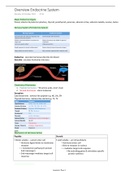
Major Endocrine Organs
Pineal, anterior & posterior pituitary, thyroid, parathyroid, pancreas, adrenal cortex, adrenal medulla, ovaries, testes
Nervous System VS Endocrine System
Endocrine : secretes hormones directly into blood
Exocrine : secretes hormones into duct
Chemistry of Hormones
1. Peptide hormones : ~30 amino acids, short chain
2. Steroid hormones : sterol molecule
Exception
Catecholamines : behave like peptide e.g. NE, DA, EPI
Thyroid hormone : behave like steroid e.g. T3, T4
oste
Mechanism of Hormone Action
Peptide Steroid
• Water soluble cannot enter cell • Lipid soluble act intracellularly
○ Hormone ligand binds to membrane ○ Hormone enters cell
receptor ○ Bind to receptor in nucleus
○ = transduction pathway (G-protein ○ = mediates target cell response
2nd messenger) ▪ By activating genes & stimulates specific
○ 2nd messenger mediates target cell protein synthesis
response
Target Cell Activation
Anatomy Page 1
Monday, 03 October 2022 07:41
Major Endocrine Organs
Pineal, anterior & posterior pituitary, thyroid, parathyroid, pancreas, adrenal cortex, adrenal medulla, ovaries, testes
Nervous System VS Endocrine System
Endocrine : secretes hormones directly into blood
Exocrine : secretes hormones into duct
Chemistry of Hormones
1. Peptide hormones : ~30 amino acids, short chain
2. Steroid hormones : sterol molecule
Exception
Catecholamines : behave like peptide e.g. NE, DA, EPI
Thyroid hormone : behave like steroid e.g. T3, T4
oste
Mechanism of Hormone Action
Peptide Steroid
• Water soluble cannot enter cell • Lipid soluble act intracellularly
○ Hormone ligand binds to membrane ○ Hormone enters cell
receptor ○ Bind to receptor in nucleus
○ = transduction pathway (G-protein ○ = mediates target cell response
2nd messenger) ▪ By activating genes & stimulates specific
○ 2nd messenger mediates target cell protein synthesis
response
Target Cell Activation
Anatomy Page 1