

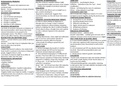
THERAPIES: ANTIDEPRESSANTS ADDICTION EVALUATION
PSYCHOLOGICAL PROBLEMS
Selective serotonin reuptake inhibitor (SSRI) Dependence – psychological reliance +Supporting research.
DEPRESSION - Drug selectively targets serotonin at the synapse Addiction – dependence plus the ‘buzz’ , mood Farhat reviewed 40 stu
Unipolar – the person only experiences one - Inhibits the reuptake of serotonin molecules modification correlation between p
emotional state.
EVALUATION Misuse – not following the rules of a substance +Real world application
Bipolar - the person experiences changes between
-have serious side effects such as weight loss or Abuse – using substance to get high. peer-pressure resistan
two mood states.
gain, anxiety sweating etc. DIAGNOSING ADDICTION prevent young people
DIAGNOSIS AND SYMPTOMS
-Regarded as reductionist. Suggests that ICD-10 states that a diagnoses requires 3 or more THERAPIES FOR ADDIC
1) Low mood
neurotransmitters are the only factor that causes symptoms present together during the previous year AVERSION THERAPY
2) Loss of interest and pleasure
depression. SYMPTOMS/CHARACTERISTICS Based on classical cond
3) Reduced energy levels
THERAPIES: COGNITIVE BEHAVIOUR THERAPY 1) Strong desire to use substance between addiction and
4) Changes in sleep patterns
In order to reduce feelings of depression a 2) Persisting despite known harm learnt.
5) Changes in appetite
therapist aims to change a client’s irrational 3) Difficulty controlling use EVALUATION
6) Decrease in self confidence
negative thinking to rational thinking. Disputing – 4) Higher priority given to substance -Many people drop ou
BIOLOGICAL EXPLANATION
aiming to challenge the client’s irrational thoughts. 5) Withdrawal symptoms completed, so difficult
Low levels of serotonin represent an imbalance of
Clients asked to keep a thought diary and required 6) Evidence of tolerance effectiveness.
this neurotransmitter, which means that mood-
to write a rational response to the automatic BIOLOGICAL EXPLANATIONS -Poor long term effecti
relevant information is not passed to the
thoughts. Hereditary factors – addiction gene SELF MANAGEMENT P
postsynaptic neuron. The effect is a lower mood
EVALUATION Genetic vulnerability – multiple genes increase risk of 12 step recovery progr
and can also affect memory, sleep and appetite.
+Lasting effectiveness. Client might have difficulties addiction. Stressors in the environment act as a trigger. EVALUATION
REASONS FOR LOW SEROTONIN LEVELS
later on and can avoid another episode of KAIJ’S TWIN STUDY OF ALCOHOL ABUSE -Lack of clear evidence
Nature – a person inherits a poor ability to produce
depression using the skills from therapy. A- to see if alcohol addiction is due to nature or nurture who leave without suc
serotonin.
-some people not willing to spend time and M- male twins registered with temperance board for +Focuses on whole per
Nurture – if your diet is low in tryptophan then you
thought required. alcohol problems were interviewed as well as their to cope with emotions
wont produce much serotonin.
WILE’S STUDY relatives
EVALUATIONS
A- further investigate the benefit of a holistic R- 61% of identical and 39% non identical twins both
+Supporting research evidence. One study found
approach (drugs and CBT) and its impact on alcoholic. Twins with social problems were over
lower levels in serotonin in the brains of depressed
treatment resistant depression patients. represented.
people. Suggests there is a link.
M- 469 participants belonging to 73 different GP C- Alcohol abuse related to genetic vulnerability.
-Low levels of serotonin might be an effect of
practices. They had a BDI score of more than 14 EVALUATION
depression rather than the cause.
(BDI-measures symptoms of depression). Randomly -Flawed study. Temperance data only includes drinkers
PSYCHOLOGICAL EXPLANATION
assigned to conditions. Drugs only and drugs + CBT. who made a public display of their alcohol abuse, so
-faulty thinking
R- Drugs only – 21.6% had more than 50% results may lack validity.
-negative schemas
reduction in symptoms -Misunderstanding genetic vulnerability. Inheriting
-attributions
Drugs + CBT – 46.1% had more than 50% reduction certain genes does not make addiction inevitable as life
EVALUATIONS
C – CBT + antidepressants are more effective events also play a role.
+Real world application. Cognitive explanations
EVALUATION PSYCHOLOGICAL EXPLANATION
lead to ways of treating depression. CBT.
+Well designed study. Participants randomly Peer influence
-Negative beliefs may simply be realistic. A negative
assigned to groups so EV were carefully controlled. Social norms
attributional style may actually be a more accurate
- Assessment of depression. Using self report Social identity
way of looking at the world
methods may no score their depression accurately. Creating opportunities for addictive behaviour.
Lacks validity.
,MEMORY MULTISTORE MODEL recall it again and repeated this. None of the EVALUATION
ENCODING, STORAGE AND RETRIEVAL participants knew the purpose of this study. -artificial tasks
Visual encoding-some memories are stored visually. R-Story was shortened. Phrases were changed to -recall was short term. P
Acoustic encoding-some memories are stored in language and concepts from P’s own culture. E.g boats words almost immediat
terms of what they sound like instead of canoe. FALSE MEMORIES-LOFT
Semantic encoding-semantic refers to meaning. Your C-The reconstructed version of events is simpler to A-to see if false memor
ability to understand and use words and concepts. remember and therefore became our memory for the through suggestions.
PROCESS OF MEMORY event. M-4 stories about childh
Encoding-information translated in a form so that it EVALUATION EVALUATION where 3 were true and
can be held in your brain. +There is evidence for different memory stores. -Study conducted casually, with no set standards about mall)
Storage-information then kept in your brain. Baddeley found we tend to mix up words that sound where and how people recalled information. P’s R-25% of participants re
Retrieval-information has to be located and brought similar when we are using our STM but mix up weren’t given specific instructions. Suggests recall is fully or partially.
back out of your brain. words that have similar meanings when using our more accurate than Bartlett suggested. C-Imagining an event ca
BADDELEY’S STUDY OF ENCODING LTM. So they are different and are separated & -Bartlett’s own belief may have affected the way he memory in a person, re
A-if there was a difference in the type of encoding independent. interpreted the data. memory.
used in short and long term memory. -Model too simple. It suggests we only have one ACCURACY OF MEMORY – INTERFERENCE EVALUATION
M-P’s learned words similar or dissimilar sounding STM and one LTM. MCGEOCH AND MCDONALDS STUDY -artificial task
and had to immediately recall it. Others learned MURDOCKS SERIAL POSITION CURVE STUDY A-what affect a second activity has on memory. +real world application.
words with similar or dissimilar meanings and A-see if memory of words was affected by the M-12 participants had to learn a list of words until they implications for eyewitn
recalled after 20 minutes. number of words a person has to remember. could remember them accurately. Then shown a new questioning could accid
R-Similar sounding words were poorly recalled in M-103 students. Murdock randomly selected words. list with either – synonyms, antonyms etc. memories.
STM, words with similar meanings poorly recalled in Each P listened to 20 words lists, 40 word lists etc. R-When asked to recall original list of words,
LTM. After each list the P had to recall the words they just performance depended on the nature of the second
C-STM is encoded by sound and LTM by meaning. heard. list. The most similar material produced the least
EVALUATION R-higher recall for the first few words – primacy accurate recall.
+Controlled experiment. It is well controlled as EV effect. Highest recall for the final few words – C-interference is strongest when an intervening activity
like P’s hearing were controlled by a hearing test. recency effect. is similar.
-LTM may have not been tested as they only waited C-Serial position effect. The position of a word EVALUATION
20 minutes before recall, so conclusion lacks validity. determines the likelihood of its recall. -artificial task. We do not learn similar words everyday.
TYPES OF LONG TERM MEMORY EVALUATION –not really forgetting, it may be that information isn’t
Episodic-memory for events in your life +Controlled conditions. He controlled the familiarity forgotten but just can not be accessed.
Semantic-memory of what things mean of the words, the speed they were read at and CONTEXT-GODDEN AND BADDELEY’S STUDY
Procedural memory-memory of how to do things ensured practice had no effect on performance. A-to see if context improved recall.
EVALUATION Therefore nothing affected the DV. M-divers listened to and recalled words in the same or
+Brain scans have shown separate locations in the -Way of studying memory is artificial. We don’t different settings on the beach and underwater.
brain for each of the 3 types of memory , supporting remember lists of words everyday. R-Recall was highest in the same environment for
the idea of different kinds of memory. ACTIVE PROCESS - BARTLETTS WAR OF GHOSTS learning and recall.
+Amnesic patients. HM. A-use a story from a different culture to see how C-context of learning acts as a trigger or cue, improving
cultural expectations affect memory the accuracy of memory.
M-Serial reproductions. He showed the P’s a story
and asked them to reproduce it and then showed
the new version to another P and asked them to
PSYCHOLOGICAL PROBLEMS
Selective serotonin reuptake inhibitor (SSRI) Dependence – psychological reliance +Supporting research.
DEPRESSION - Drug selectively targets serotonin at the synapse Addiction – dependence plus the ‘buzz’ , mood Farhat reviewed 40 stu
Unipolar – the person only experiences one - Inhibits the reuptake of serotonin molecules modification correlation between p
emotional state.
EVALUATION Misuse – not following the rules of a substance +Real world application
Bipolar - the person experiences changes between
-have serious side effects such as weight loss or Abuse – using substance to get high. peer-pressure resistan
two mood states.
gain, anxiety sweating etc. DIAGNOSING ADDICTION prevent young people
DIAGNOSIS AND SYMPTOMS
-Regarded as reductionist. Suggests that ICD-10 states that a diagnoses requires 3 or more THERAPIES FOR ADDIC
1) Low mood
neurotransmitters are the only factor that causes symptoms present together during the previous year AVERSION THERAPY
2) Loss of interest and pleasure
depression. SYMPTOMS/CHARACTERISTICS Based on classical cond
3) Reduced energy levels
THERAPIES: COGNITIVE BEHAVIOUR THERAPY 1) Strong desire to use substance between addiction and
4) Changes in sleep patterns
In order to reduce feelings of depression a 2) Persisting despite known harm learnt.
5) Changes in appetite
therapist aims to change a client’s irrational 3) Difficulty controlling use EVALUATION
6) Decrease in self confidence
negative thinking to rational thinking. Disputing – 4) Higher priority given to substance -Many people drop ou
BIOLOGICAL EXPLANATION
aiming to challenge the client’s irrational thoughts. 5) Withdrawal symptoms completed, so difficult
Low levels of serotonin represent an imbalance of
Clients asked to keep a thought diary and required 6) Evidence of tolerance effectiveness.
this neurotransmitter, which means that mood-
to write a rational response to the automatic BIOLOGICAL EXPLANATIONS -Poor long term effecti
relevant information is not passed to the
thoughts. Hereditary factors – addiction gene SELF MANAGEMENT P
postsynaptic neuron. The effect is a lower mood
EVALUATION Genetic vulnerability – multiple genes increase risk of 12 step recovery progr
and can also affect memory, sleep and appetite.
+Lasting effectiveness. Client might have difficulties addiction. Stressors in the environment act as a trigger. EVALUATION
REASONS FOR LOW SEROTONIN LEVELS
later on and can avoid another episode of KAIJ’S TWIN STUDY OF ALCOHOL ABUSE -Lack of clear evidence
Nature – a person inherits a poor ability to produce
depression using the skills from therapy. A- to see if alcohol addiction is due to nature or nurture who leave without suc
serotonin.
-some people not willing to spend time and M- male twins registered with temperance board for +Focuses on whole per
Nurture – if your diet is low in tryptophan then you
thought required. alcohol problems were interviewed as well as their to cope with emotions
wont produce much serotonin.
WILE’S STUDY relatives
EVALUATIONS
A- further investigate the benefit of a holistic R- 61% of identical and 39% non identical twins both
+Supporting research evidence. One study found
approach (drugs and CBT) and its impact on alcoholic. Twins with social problems were over
lower levels in serotonin in the brains of depressed
treatment resistant depression patients. represented.
people. Suggests there is a link.
M- 469 participants belonging to 73 different GP C- Alcohol abuse related to genetic vulnerability.
-Low levels of serotonin might be an effect of
practices. They had a BDI score of more than 14 EVALUATION
depression rather than the cause.
(BDI-measures symptoms of depression). Randomly -Flawed study. Temperance data only includes drinkers
PSYCHOLOGICAL EXPLANATION
assigned to conditions. Drugs only and drugs + CBT. who made a public display of their alcohol abuse, so
-faulty thinking
R- Drugs only – 21.6% had more than 50% results may lack validity.
-negative schemas
reduction in symptoms -Misunderstanding genetic vulnerability. Inheriting
-attributions
Drugs + CBT – 46.1% had more than 50% reduction certain genes does not make addiction inevitable as life
EVALUATIONS
C – CBT + antidepressants are more effective events also play a role.
+Real world application. Cognitive explanations
EVALUATION PSYCHOLOGICAL EXPLANATION
lead to ways of treating depression. CBT.
+Well designed study. Participants randomly Peer influence
-Negative beliefs may simply be realistic. A negative
assigned to groups so EV were carefully controlled. Social norms
attributional style may actually be a more accurate
- Assessment of depression. Using self report Social identity
way of looking at the world
methods may no score their depression accurately. Creating opportunities for addictive behaviour.
Lacks validity.
,MEMORY MULTISTORE MODEL recall it again and repeated this. None of the EVALUATION
ENCODING, STORAGE AND RETRIEVAL participants knew the purpose of this study. -artificial tasks
Visual encoding-some memories are stored visually. R-Story was shortened. Phrases were changed to -recall was short term. P
Acoustic encoding-some memories are stored in language and concepts from P’s own culture. E.g boats words almost immediat
terms of what they sound like instead of canoe. FALSE MEMORIES-LOFT
Semantic encoding-semantic refers to meaning. Your C-The reconstructed version of events is simpler to A-to see if false memor
ability to understand and use words and concepts. remember and therefore became our memory for the through suggestions.
PROCESS OF MEMORY event. M-4 stories about childh
Encoding-information translated in a form so that it EVALUATION EVALUATION where 3 were true and
can be held in your brain. +There is evidence for different memory stores. -Study conducted casually, with no set standards about mall)
Storage-information then kept in your brain. Baddeley found we tend to mix up words that sound where and how people recalled information. P’s R-25% of participants re
Retrieval-information has to be located and brought similar when we are using our STM but mix up weren’t given specific instructions. Suggests recall is fully or partially.
back out of your brain. words that have similar meanings when using our more accurate than Bartlett suggested. C-Imagining an event ca
BADDELEY’S STUDY OF ENCODING LTM. So they are different and are separated & -Bartlett’s own belief may have affected the way he memory in a person, re
A-if there was a difference in the type of encoding independent. interpreted the data. memory.
used in short and long term memory. -Model too simple. It suggests we only have one ACCURACY OF MEMORY – INTERFERENCE EVALUATION
M-P’s learned words similar or dissimilar sounding STM and one LTM. MCGEOCH AND MCDONALDS STUDY -artificial task
and had to immediately recall it. Others learned MURDOCKS SERIAL POSITION CURVE STUDY A-what affect a second activity has on memory. +real world application.
words with similar or dissimilar meanings and A-see if memory of words was affected by the M-12 participants had to learn a list of words until they implications for eyewitn
recalled after 20 minutes. number of words a person has to remember. could remember them accurately. Then shown a new questioning could accid
R-Similar sounding words were poorly recalled in M-103 students. Murdock randomly selected words. list with either – synonyms, antonyms etc. memories.
STM, words with similar meanings poorly recalled in Each P listened to 20 words lists, 40 word lists etc. R-When asked to recall original list of words,
LTM. After each list the P had to recall the words they just performance depended on the nature of the second
C-STM is encoded by sound and LTM by meaning. heard. list. The most similar material produced the least
EVALUATION R-higher recall for the first few words – primacy accurate recall.
+Controlled experiment. It is well controlled as EV effect. Highest recall for the final few words – C-interference is strongest when an intervening activity
like P’s hearing were controlled by a hearing test. recency effect. is similar.
-LTM may have not been tested as they only waited C-Serial position effect. The position of a word EVALUATION
20 minutes before recall, so conclusion lacks validity. determines the likelihood of its recall. -artificial task. We do not learn similar words everyday.
TYPES OF LONG TERM MEMORY EVALUATION –not really forgetting, it may be that information isn’t
Episodic-memory for events in your life +Controlled conditions. He controlled the familiarity forgotten but just can not be accessed.
Semantic-memory of what things mean of the words, the speed they were read at and CONTEXT-GODDEN AND BADDELEY’S STUDY
Procedural memory-memory of how to do things ensured practice had no effect on performance. A-to see if context improved recall.
EVALUATION Therefore nothing affected the DV. M-divers listened to and recalled words in the same or
+Brain scans have shown separate locations in the -Way of studying memory is artificial. We don’t different settings on the beach and underwater.
brain for each of the 3 types of memory , supporting remember lists of words everyday. R-Recall was highest in the same environment for
the idea of different kinds of memory. ACTIVE PROCESS - BARTLETTS WAR OF GHOSTS learning and recall.
+Amnesic patients. HM. A-use a story from a different culture to see how C-context of learning acts as a trigger or cue, improving
cultural expectations affect memory the accuracy of memory.
M-Serial reproductions. He showed the P’s a story
and asked them to reproduce it and then showed
the new version to another P and asked them to


