
2.1 - testing for biological molecules:
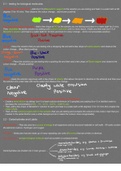
Reducing sugars (Glucose) - Add 5cm^3 of Benedict’s reagent to the solution you are testing and heat in a water bath at 80
degrees C for 10 mins. Then observe the colour change... (red-brown positive)
Non-reducing sugars (sucrose) - Add a few drops of HCl to the sample you are testing and place in a water bath for 5 mins.
Then, neutralise the acidic solution by adding solid sodium hydroxide until no more reacts. Shake and then add 5cm^3 of
Benedict’s solution and heat in a water bath for 10 mins and look for colour change... (brick-red precipitate positive)
Starch - Place the solution that you are testing into a dropping tile and add a few drops of iodine solution and observe the
colour change... (Blue-black positive)
Proteins - Place the solution you are testing into a spotting tile and then add a few drops of Biuret reagent and observe the
colour change... (Purple positive)
Lipids - shake the solution vigorously with a few drops of ethanol (this allows the lipids to dissolve in the ethanol) and then pour
the solution into a test tube with some water and observe the change...
Semi-quantitative Benedict’s test to estimate the concentrations of solutions...
• Create a serial dilution by taking 1cm^3 of each solution (minimum of 5 samples) and adding 9cm^3 of distilled water to
decrease the concentration (10% - 1% - 0.1% - 0.01% - 0.001% etc).
• Then, add a few drops of Benedict’s’ solution to each and heat in a water bath at 80 degrees C for 10 mins (this creates the
colour chart).
• Then, do the reducing sugars test on the samples that you are testing and compare the colours to the colour chart that you
created in the serial dilution (use a white background as it makes the colours more recognisable).
2.2 - Carbohydrates and Lipids:
Carbohydrates - They are used as a source of energy in all organisms and as structural materials in cell walls - All carbs contain
the elements Carbon, Hydrogen and oxygen
Polymers - Molecules that are made up of many repeating sub-units (Monomer) that are similar or identical.
Macromolecule - a large biological molecule such as a protein or polysaccharide.
Carbohydrates are divided into 3 main groups ...
, Glucose:
• Glucose is a monosaccharide (hexose sugar) and is the main source of energy for most organisms.
• In common with other hexose sugars, Glucose has an aldehyde group in the structure.
• The C = O carbonyl group has reducing properties, such that all monosaccharides are reducing sugars.
• Glucose and fructose are structural isomers - have the same atoms but different arrangement.
• Glucose, fructose and maltose are all reducing sugars, but sucrose is not as it bonds between a1-a6, so the carbonyl group
isn’t free and cant reduce the Benedict’s.
DISACCHARIDES - Sugars composed of two Monosaccharides covalently bonded by a glycosidic linkage.
• MALTOSE = GLUCOSE + GLUCOSE
• LACTOSE = GLUCOSE + GALACTOSE
• SUCROSE = GLUCOSE + FRUCTOSE
Condensation - the formation of a glycosidic linkage when 2 a-glucose molecules are
bonded together between a1-a4. Water is removed from the molecules.
Hydrolysis - The breakage of a glycosidic bond between two monosaccharides due to
the addition of water. In the non-reducing sugars test, the HCL seperates the
disaccharide into its sub units by hydrolysis.
Reducing sugars (Glucose) - Add 5cm^3 of Benedict’s reagent to the solution you are testing and heat in a water bath at 80
degrees C for 10 mins. Then observe the colour change... (red-brown positive)
Non-reducing sugars (sucrose) - Add a few drops of HCl to the sample you are testing and place in a water bath for 5 mins.
Then, neutralise the acidic solution by adding solid sodium hydroxide until no more reacts. Shake and then add 5cm^3 of
Benedict’s solution and heat in a water bath for 10 mins and look for colour change... (brick-red precipitate positive)
Starch - Place the solution that you are testing into a dropping tile and add a few drops of iodine solution and observe the
colour change... (Blue-black positive)
Proteins - Place the solution you are testing into a spotting tile and then add a few drops of Biuret reagent and observe the
colour change... (Purple positive)
Lipids - shake the solution vigorously with a few drops of ethanol (this allows the lipids to dissolve in the ethanol) and then pour
the solution into a test tube with some water and observe the change...
Semi-quantitative Benedict’s test to estimate the concentrations of solutions...
• Create a serial dilution by taking 1cm^3 of each solution (minimum of 5 samples) and adding 9cm^3 of distilled water to
decrease the concentration (10% - 1% - 0.1% - 0.01% - 0.001% etc).
• Then, add a few drops of Benedict’s’ solution to each and heat in a water bath at 80 degrees C for 10 mins (this creates the
colour chart).
• Then, do the reducing sugars test on the samples that you are testing and compare the colours to the colour chart that you
created in the serial dilution (use a white background as it makes the colours more recognisable).
2.2 - Carbohydrates and Lipids:
Carbohydrates - They are used as a source of energy in all organisms and as structural materials in cell walls - All carbs contain
the elements Carbon, Hydrogen and oxygen
Polymers - Molecules that are made up of many repeating sub-units (Monomer) that are similar or identical.
Macromolecule - a large biological molecule such as a protein or polysaccharide.
Carbohydrates are divided into 3 main groups ...
, Glucose:
• Glucose is a monosaccharide (hexose sugar) and is the main source of energy for most organisms.
• In common with other hexose sugars, Glucose has an aldehyde group in the structure.
• The C = O carbonyl group has reducing properties, such that all monosaccharides are reducing sugars.
• Glucose and fructose are structural isomers - have the same atoms but different arrangement.
• Glucose, fructose and maltose are all reducing sugars, but sucrose is not as it bonds between a1-a6, so the carbonyl group
isn’t free and cant reduce the Benedict’s.
DISACCHARIDES - Sugars composed of two Monosaccharides covalently bonded by a glycosidic linkage.
• MALTOSE = GLUCOSE + GLUCOSE
• LACTOSE = GLUCOSE + GALACTOSE
• SUCROSE = GLUCOSE + FRUCTOSE
Condensation - the formation of a glycosidic linkage when 2 a-glucose molecules are
bonded together between a1-a4. Water is removed from the molecules.
Hydrolysis - The breakage of a glycosidic bond between two monosaccharides due to
the addition of water. In the non-reducing sugars test, the HCL seperates the
disaccharide into its sub units by hydrolysis.


