Psychology Schachter & Singer
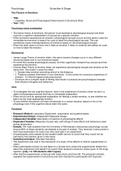
Two Factors in Emotions
• Title:
• Cognitive, Social and Physiological Determinants of Emotional State
• Year: 1962
Psychology being investigated
• Two-factor theory of emotions: the person must experience physiological arousal and there
must be a cognitive interpretation of arousal as a speci c emotion.
• When someone experiences an emotion, physiological arousal occurs and the person uses the
immediate environment to search for cues to label the physiological arousal. This can
sometimes cause misinterpretations of emotions based on the physiological arousal.
• When the brain does not know why it feels an emotion it relies on external stimulation for cues
on how to label the emotion.
Background
• James Lange Theory of emotion state: ‘the same visceral changes occur in very di erent
emotional states and in non-emotional states’.
• An event rst causes physiological arousal, we then cognitively interpret thus arousal and then
experience the emotion.
• Cannon-Bard Theory of emotion state: we experience physiological arousal and emotion at the
same time. One doesn’t cause the other.
• 1. Senses relay emotion-provoking stimuli to the thalamus
• 2. Thalamus passes information in two directions - to the cortex for conscious experience of
emotion - to internal organs producing arousal.
• Emotions are a complex state of feeling that results in physical and psychological changes
that in uence thoughts and behaviour.
Aims
• To investigate the role cognitive factors, have in the experience of emotion when we are in a
state of physiological arousal that has no immediate explanation.
• When we do have an appropriate explanation for feeling a certain emotion, to see whether we
bale it as the most appropriate emotion.
• To see whether the person will react emotionally to a certain situation based on his or her
physiology even if the cognitive elects realm the same.
Procedure
• Research Method: Laboratory Experiment, observation and questionnaires
• Experimental Design: Independent Measures Design
• Independent Variable: Description of injection & physiological e ects
• Dependent Variable: Measures of pulse rate, self-ratings of side e ects and behaviours seen
during observation
• Sample: 184 male students from the University of Minnesota’s introductory psychology course.
Around 90% of these students volunteered to be part of studies. They received 2 extra points in
their nal examination for every hour they took part in an experiment.
• All participants were cleared by the student health service to check that they would not be
harmed by the injection given in this study
• Sampling technique: Volunteer Sampling
• The experiment was cast in the framework of a study of the e ects of vitamin supplements on
vision.
• When participants arrived, he was taken to a private room where the experimenter briefed him
about the experiment and asked if he would mind received a Suproxin (name given to the drug)
injection. [only 1 in 185 students didn’t agree]
• After that the experimenter continued with instructions and then left. The physician entered,
repeated the experimenter’s instructions and then injected the participants with Suproxin.
fifl fi fi ff ff ff ff
Two Factors in Emotions
• Title:
• Cognitive, Social and Physiological Determinants of Emotional State
• Year: 1962
Psychology being investigated
• Two-factor theory of emotions: the person must experience physiological arousal and there
must be a cognitive interpretation of arousal as a speci c emotion.
• When someone experiences an emotion, physiological arousal occurs and the person uses the
immediate environment to search for cues to label the physiological arousal. This can
sometimes cause misinterpretations of emotions based on the physiological arousal.
• When the brain does not know why it feels an emotion it relies on external stimulation for cues
on how to label the emotion.
Background
• James Lange Theory of emotion state: ‘the same visceral changes occur in very di erent
emotional states and in non-emotional states’.
• An event rst causes physiological arousal, we then cognitively interpret thus arousal and then
experience the emotion.
• Cannon-Bard Theory of emotion state: we experience physiological arousal and emotion at the
same time. One doesn’t cause the other.
• 1. Senses relay emotion-provoking stimuli to the thalamus
• 2. Thalamus passes information in two directions - to the cortex for conscious experience of
emotion - to internal organs producing arousal.
• Emotions are a complex state of feeling that results in physical and psychological changes
that in uence thoughts and behaviour.
Aims
• To investigate the role cognitive factors, have in the experience of emotion when we are in a
state of physiological arousal that has no immediate explanation.
• When we do have an appropriate explanation for feeling a certain emotion, to see whether we
bale it as the most appropriate emotion.
• To see whether the person will react emotionally to a certain situation based on his or her
physiology even if the cognitive elects realm the same.
Procedure
• Research Method: Laboratory Experiment, observation and questionnaires
• Experimental Design: Independent Measures Design
• Independent Variable: Description of injection & physiological e ects
• Dependent Variable: Measures of pulse rate, self-ratings of side e ects and behaviours seen
during observation
• Sample: 184 male students from the University of Minnesota’s introductory psychology course.
Around 90% of these students volunteered to be part of studies. They received 2 extra points in
their nal examination for every hour they took part in an experiment.
• All participants were cleared by the student health service to check that they would not be
harmed by the injection given in this study
• Sampling technique: Volunteer Sampling
• The experiment was cast in the framework of a study of the e ects of vitamin supplements on
vision.
• When participants arrived, he was taken to a private room where the experimenter briefed him
about the experiment and asked if he would mind received a Suproxin (name given to the drug)
injection. [only 1 in 185 students didn’t agree]
• After that the experimenter continued with instructions and then left. The physician entered,
repeated the experimenter’s instructions and then injected the participants with Suproxin.
fifl fi fi ff ff ff ff