
PATHOPHYSIOLOGY EXAM 3 STUDY GUIDE
Endocrine
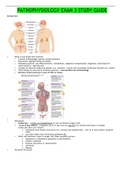
What is the Endocrine system?
• Control & Messenger system using hormones
• Hormones regulate body processes
• Modulates growth, sex differentiation, metabolism, adaption/compensation, digestion, electrolyte &
water balance, reproduction
• Consists of discrete endocrine glands ( ex. thyroid) + tissue with secondary endocrine function (ex. heart)
• Tied closely to nervous & immune systems – neuroendocrine-immunology
• Review stress lecture if any of this is fuzzy
Hormones
• Endocrine – travels via bloodstream to act on distant target cells
• “Lock & Key effect”- receptors on or in the cell are specific for certain hormones or similar
molecules that can “block”
o hormones have similar structures (ex. cortisol and aldosterone) – can sit in each others receptor
sides
o can also make most hormones synthetically
• What will hormone cause in target cell? Many possible actions:
o Alteration in membrane potential or permeability
o Protein synthesis
o Enzyme activation or deactivation
o Secretion
o Mitosis
Hormone Structure
, PATHOPHYSIOLOGY EXAM 3 STUDY GUIDE
• 1. Protein derivative (amino acids or polypeptides)
o water soluble, need plasma membrane receptor
o 2nd messenger – helps it get down into cell
o Travel free in blood (except thyroid hormone)
o Extra hormone stored in vesicles in cytoplasm
• 2. Lipid derivative hormones (steroids)
o Fat soluble, pass through the cell membrane
▪ Don’t need 2nd messenger
o Travel bound to carrier proteins in blood
o Secreted upon synthesis
• The half-life of a hormone is generally shortest for water-soluble hormones, longer for carrier-
bound hormones (Thyroid hormone = 6 days)
o Have stores of some hormones in body ready to work
o Missing a hormone med for one day will not drop your levels drastically
o BUT, if you have a drip going and bag goes dry, BP will drop drastically
Hormone Action Depends on:
• 1. Blood levels of hormone – enough? Too much?
• 2. Presence of other hormones that synergize or antagonize
o is there another hormone sitting in receptor blocking hormone from where it needs to go
o GH and insulin antagonize each other
• 3. Affinity of hormone & receptor
o cell has to be able to respond to hormone
• 4. Number of Receptors – body breaks down or adds depending on need
o Up-regulation – ê hormone = é sensitivity
▪ Not enough hormone in blood, every receptor becomes more sensitive to the little bit that
is present
, PATHOPHYSIOLOGY EXAM 3 STUDY GUIDE
o Down-regulation - é hormone = ê sensitivity
▪ Ex. nagging husband constantly, he will tune you out
• The concentration of a hormone reflects its rate of release, and the rate of inactivation and removal from
the body
o Kidneys and liver are usually what gets rid of hormones when they have been used up
o Use negative-feedback for hormones
Concepts related to hormone Levels
• A. Diurnal fluctuations – GH, Cortisol
o GH – stage 3 and 4 of sleep (deep stages)
o Cortisol – early hours of morning
▪ Typically have heart attacks before 10am
• B. Cyclical – female sex hormones
o Not always going to have a steady level of estrogen, LH, etc.
▪ Depend on age, pregnancy, etc.
• C. Feedback Mechanisms
o Positive
o Negative
▪ Hypothalamic-Pituitary Regulation (HPA axis)
Compare & contrast positive and negative feedback controls
• Positive Feedback = MORE (until you get to end point)
o Birth process
o Sneezing
o Blood clotting
o
, PATHOPHYSIOLOGY EXAM 3 STUDY GUIDE
• Negative Feedback – Thermostat of the Body
o
o body cuts on and off in order to maintain homeostasis
o tumors secreting hormones, will NOT respond to negative feedback
• Simple Negative Feedback Loop
o Parathyroid Hormone – looking directly at blood calcium levels
▪ Increase serum calcium
▪ Increase vitamin D
▪ Break down some bone to release calcium
o
Hypothalamus
• Executive Chef
• Coordinating Center
o Neuro and endocrine bridge
• Communicates w/ Pituitary via “Releasing” & “Inhibiting” hormones & Neuronal Input

