

DIGITAL PRODUCT DEVELOPMENT (DPD)
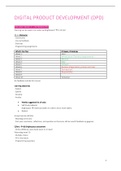
COLLEGE WEEK 1 – INTRODUCTIE
Planning van de week is te vinden op Brightspace! → to do lijst
All on Discourse
- Community
- Course feedback
- Exercises
- Programming assignments
What’s the Plan 8 Weeks, 8 Modules
Week 1: Intro
Week 2: Infrastructure (Technical requirements)
Week 3: Network
Week 4: Data
Week 5: Software
Week 6: Business (Organisation, process and role)
Week 7: Development
Week 8: Responsibility
Week 9:
Week 10: Tentamen
No feedback outside this course
Learning objectives
- Explain
- Specify
- Develop
- Analise
• Weekly suggested list of tasks
• Self-Study Material
Brightspace → materiaal (taken en video’s die je moet kijken)
• Boeken
Group Exercise → Miro
- Maandag 10:45 (2h)
- Post your conclusion, reflections, and question on Discourse → hier wordt feedback op gegeven
Cijfers: → kijk Brightspace assessment
- Online (Möbius), open-book exam on 13 April
Woensdag week 10
- Multiple choice
- Fill in the blacks
- Programming questions
1
,BELANGRIJKE INFORMATIE:
The course consists of eight modules, a weekly cycle mixing theory and practice. There is a mix of online and
offline activities. Each week involves 14hrs including:
o the introduction of theoretical concepts (5hrs) through video and reading materials (2hrs on Monday
morning, 1hr on Wednesday afternoon, 2hrs on self-study).
o live sessions (3hrs) including a programming sandpit with demo/Q&A, and a panel of lecturers walking
through some of the concepts in practice and offering students a critical moment for questions
(Wednesday afternoon).
o a programming assignment (4hrs) to individually practice coding in the self-content, digital product
context, with gradual complexity (self-study).
o a knowledge exercise (2hrs) to experience key concepts covered during the course (Monday morning,
in groups).
Here are a few concrete examples:
o In the first week, you map a digital product to create a holistic view of its components across seven
dimensions
o In weeks 2 and 3, you specify the Internet Architecture and Network requirements
o In week 5, you specify algorithms
o In week 6, you use the Business Model Canvas to analyse a digital product
o In week 7, you develop a prototyping plan
o In week 8, you map the ethical concerns
o Throughout the course, you practice computational thinking with Python programming
2
,LEERDOELEN
Upon finishing this course, you should be able to:
1. explain core concepts related to the realization of digital products, such as technical architecture,
networks, databases, software development methods, business models, web technology and digital
responsibility (2.5.2, 2.4.1, 2.4.3, 2.10.2)
2. specify algorithms and data structures driving the behaviour of a digital product through pseudo code
and UML diagrams (2.5.2)
3. read and write (develop) basic Python code to prototype a digital product (2.4.1)
4. analyse and evaluate the technical aspects (code, data, network) and business aspects (canvas) of a
connected product (2.4.3, 2.10.2)
LEARNING OBJECTIVES AND FINAL ATTAINMENT LEVELS
Thus, this course contributes to the following Final Attainment Levels of the BSc program:
2.5.2 Architecture specification – Students are able to use semi-formal and formal methods to develop
(alternative) architectures with respect to technical, business and sustainability aspects
2.4.1 Software development – Students are able to apply knowledge about algorithms, programming and
software development methods to design, develop and analyse digital products and services
2.4.3 Networking and connected system – Students are able to apply knowledge about networking technologies,
web technologies, the Internet of Things and cloud computing to develop connected products and services
2.10.2 Business models – Students are able to distinguish between and apply different types of business models
in designing a product-service system
3
, WEEK 2 – INFRASTRUCTURE
VIDEO 1: DPD – THE CONNECTED LIGHTBULB
Conceptual Model → How the user understands the system
Infrastructure → The fundamental facilities and systems that support the sustainable functionality (of a digital
product).
Dat meerdere producten met elkaar verbonden zijn en het zich dus niet allemaal afspeelt op één product en één
locatie
The Internet → Global Network to exchange information
Examples of applications: emails, video streaming, web page
Communicate – connectie tussen modellen
Technical Model → versturen van berichten die rondgaan en zo informatie geven
Internet Architectures
Influence of design choices
World-wide-web
- Infrastructure, fundamental facilities, and systems
- The Internet, a global network
- The web, an Internet application
- Client, requesting information over the network
→ consuming servers from the server
- Server, serving information over the network in response to a client request
→ a computer serving a service
Client (Bink) → de client connect met de server. De client is de browser. Soort tussenpersoon want jij bent het
niet helemaal zelf. Google chrome. In de browser kan jij allemaal dingen zien en invullen en dit wordt allemaal
verstuurd naar de server en daar reageert de server op en de server reageert daarop en stuurt jouw als client
weer data waardoor jouw browser er anders uitziet.
Server (Bink) → heel grote computer (hosten). Google.
“Een computer is een heel complex apparaat, maar om het zo simpel mogelijk te houden. Het is een apparaat dat
input binnenkrijgt, bijvoorbeeld via, in het geval van een laptop bijvoorbeeld, het toetsenbord (niet alle computers
hebben per se een toetsenbord tho), en dat verwerkt door middel van allerlei elektrische signalen en daarmee
output creëert voor op bijvoorbeeld een scherm (maar kan dus ook iets anders zijn).”
4
COLLEGE WEEK 1 – INTRODUCTIE
Planning van de week is te vinden op Brightspace! → to do lijst
All on Discourse
- Community
- Course feedback
- Exercises
- Programming assignments
What’s the Plan 8 Weeks, 8 Modules
Week 1: Intro
Week 2: Infrastructure (Technical requirements)
Week 3: Network
Week 4: Data
Week 5: Software
Week 6: Business (Organisation, process and role)
Week 7: Development
Week 8: Responsibility
Week 9:
Week 10: Tentamen
No feedback outside this course
Learning objectives
- Explain
- Specify
- Develop
- Analise
• Weekly suggested list of tasks
• Self-Study Material
Brightspace → materiaal (taken en video’s die je moet kijken)
• Boeken
Group Exercise → Miro
- Maandag 10:45 (2h)
- Post your conclusion, reflections, and question on Discourse → hier wordt feedback op gegeven
Cijfers: → kijk Brightspace assessment
- Online (Möbius), open-book exam on 13 April
Woensdag week 10
- Multiple choice
- Fill in the blacks
- Programming questions
1
,BELANGRIJKE INFORMATIE:
The course consists of eight modules, a weekly cycle mixing theory and practice. There is a mix of online and
offline activities. Each week involves 14hrs including:
o the introduction of theoretical concepts (5hrs) through video and reading materials (2hrs on Monday
morning, 1hr on Wednesday afternoon, 2hrs on self-study).
o live sessions (3hrs) including a programming sandpit with demo/Q&A, and a panel of lecturers walking
through some of the concepts in practice and offering students a critical moment for questions
(Wednesday afternoon).
o a programming assignment (4hrs) to individually practice coding in the self-content, digital product
context, with gradual complexity (self-study).
o a knowledge exercise (2hrs) to experience key concepts covered during the course (Monday morning,
in groups).
Here are a few concrete examples:
o In the first week, you map a digital product to create a holistic view of its components across seven
dimensions
o In weeks 2 and 3, you specify the Internet Architecture and Network requirements
o In week 5, you specify algorithms
o In week 6, you use the Business Model Canvas to analyse a digital product
o In week 7, you develop a prototyping plan
o In week 8, you map the ethical concerns
o Throughout the course, you practice computational thinking with Python programming
2
,LEERDOELEN
Upon finishing this course, you should be able to:
1. explain core concepts related to the realization of digital products, such as technical architecture,
networks, databases, software development methods, business models, web technology and digital
responsibility (2.5.2, 2.4.1, 2.4.3, 2.10.2)
2. specify algorithms and data structures driving the behaviour of a digital product through pseudo code
and UML diagrams (2.5.2)
3. read and write (develop) basic Python code to prototype a digital product (2.4.1)
4. analyse and evaluate the technical aspects (code, data, network) and business aspects (canvas) of a
connected product (2.4.3, 2.10.2)
LEARNING OBJECTIVES AND FINAL ATTAINMENT LEVELS
Thus, this course contributes to the following Final Attainment Levels of the BSc program:
2.5.2 Architecture specification – Students are able to use semi-formal and formal methods to develop
(alternative) architectures with respect to technical, business and sustainability aspects
2.4.1 Software development – Students are able to apply knowledge about algorithms, programming and
software development methods to design, develop and analyse digital products and services
2.4.3 Networking and connected system – Students are able to apply knowledge about networking technologies,
web technologies, the Internet of Things and cloud computing to develop connected products and services
2.10.2 Business models – Students are able to distinguish between and apply different types of business models
in designing a product-service system
3
, WEEK 2 – INFRASTRUCTURE
VIDEO 1: DPD – THE CONNECTED LIGHTBULB
Conceptual Model → How the user understands the system
Infrastructure → The fundamental facilities and systems that support the sustainable functionality (of a digital
product).
Dat meerdere producten met elkaar verbonden zijn en het zich dus niet allemaal afspeelt op één product en één
locatie
The Internet → Global Network to exchange information
Examples of applications: emails, video streaming, web page
Communicate – connectie tussen modellen
Technical Model → versturen van berichten die rondgaan en zo informatie geven
Internet Architectures
Influence of design choices
World-wide-web
- Infrastructure, fundamental facilities, and systems
- The Internet, a global network
- The web, an Internet application
- Client, requesting information over the network
→ consuming servers from the server
- Server, serving information over the network in response to a client request
→ a computer serving a service
Client (Bink) → de client connect met de server. De client is de browser. Soort tussenpersoon want jij bent het
niet helemaal zelf. Google chrome. In de browser kan jij allemaal dingen zien en invullen en dit wordt allemaal
verstuurd naar de server en daar reageert de server op en de server reageert daarop en stuurt jouw als client
weer data waardoor jouw browser er anders uitziet.
Server (Bink) → heel grote computer (hosten). Google.
“Een computer is een heel complex apparaat, maar om het zo simpel mogelijk te houden. Het is een apparaat dat
input binnenkrijgt, bijvoorbeeld via, in het geval van een laptop bijvoorbeeld, het toetsenbord (niet alle computers
hebben per se een toetsenbord tho), en dat verwerkt door middel van allerlei elektrische signalen en daarmee
output creëert voor op bijvoorbeeld een scherm (maar kan dus ook iets anders zijn).”
4


