
Absolute poverty is where someone cannot a ord to ful l their basic needs. The trickle-down e ect
is where the rich ge ng richer bene ts those poorer as they spend this increased income, pu ng
the money back into the economy.
Fig 1.
Good B
B2
PPB2
B1
PPB1
A1 A2 Good A
Free market economists may argue that inequality is ‘good for us all’ as it ‘creates incen ves’ (as
stated by extract E) for workers to improve their skills and increase their produc vity as doing so
should increase their income as ‘each factor receives what it is worth in terms of the value of
marginal revenue product’ (as stated by extract E) in a more unequal society. Extract E also states
that growing inequality shall ‘kick-start enterprise’ as in an unequal society there shall be more of a
reward for a business venture. Therefore, as there is an increase in both the labour and enterprise
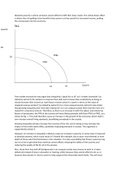
factors of produc on, the PPB of the country will most likely posi vely shi from PPB1 to PPB2, as is
shown by g. 1. This shall therefore cause an increase in the growth of the economy, which shall in
turn increase overall living standards, bene ng everybody in the society.
Growing inequality will also increase the incomes of the rich, and in doing so may increase the
impact of the trickle-down e ect, posi vely impac ng everyone in society. This argument is
supported by extract E.
However, an increase in inequality is likely to cause an increase in poverty. In some cases it may lead
to absolute poverty, which could result in ill health (for example, due to poor nourishment) or even
death of those who nd themselves in this situa on. It is also a possibility that those in poverty may
turn to crime to get what they need but cannot a ord, reducing the safety of the country, and
reducing the quality of life for all in the process.
Also, those from less well-o backgrounds in an unequal society may choose to work in a lower
skilled job instead of stay in educa on or training, either because they cannot a ord to do so, or
because they decide it is best to work to help support their nancially weak family. This will most

