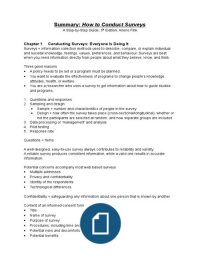
Summary: How to Conduct Surveys
A Step-by-Step Guide, 5th Edition, Arlene Fink
Chapter 1 Conducting Surveys: Everyone Is Doing It
Surveys = information collection methods used to describe, compare, or explain individual
and societal knowledge, feelings, values, preferences, and behaviour. Surveys are best
when you need information directly from people about what they believe, know, and think.
Three good reasons
A policy needs to be set or a program must be planned.
You want to evaluate the effectiveness of programs to change people’s knowledge,
attitudes, health, or welfare.
You are a researcher who uses a survey to get information about how to guide studies
and programs.
1. Questions and responses
2. Sampling and design
Sample = number and characteristics of people in the survey
Design = how often the survey takes place (cross-sectional/longitudinal), whether or
not the participants are selected at random, and how separate groups are included
3. Data processing or ‘management’ and analysis
4. Pilot testing
5. Response rate
Questions = Items
A well-designed, easy-to-use survey always contributes to reliability and validity.
A reliable survey produces consistent information, while a valid one results in accurate
information.
Potential concerns accompany most web based surveys
Multiple addresses
Privacy and confidentiality
Identity of the respondents
Technological differences
Confidentiality = safeguarding any information about one person that is known by another
Content of an informed-consent form
Title
Name of survey
Purpose of survey
Procedures, including time and place
Potential risks and discomforts
Potential benefits
A Step-by-Step Guide, 5th Edition, Arlene Fink
Chapter 1 Conducting Surveys: Everyone Is Doing It
Surveys = information collection methods used to describe, compare, or explain individual
and societal knowledge, feelings, values, preferences, and behaviour. Surveys are best
when you need information directly from people about what they believe, know, and think.
Three good reasons
A policy needs to be set or a program must be planned.
You want to evaluate the effectiveness of programs to change people’s knowledge,
attitudes, health, or welfare.
You are a researcher who uses a survey to get information about how to guide studies
and programs.
1. Questions and responses
2. Sampling and design
Sample = number and characteristics of people in the survey
Design = how often the survey takes place (cross-sectional/longitudinal), whether or
not the participants are selected at random, and how separate groups are included
3. Data processing or ‘management’ and analysis
4. Pilot testing
5. Response rate
Questions = Items
A well-designed, easy-to-use survey always contributes to reliability and validity.
A reliable survey produces consistent information, while a valid one results in accurate
information.
Potential concerns accompany most web based surveys
Multiple addresses
Privacy and confidentiality
Identity of the respondents
Technological differences
Confidentiality = safeguarding any information about one person that is known by another
Content of an informed-consent form
Title
Name of survey
Purpose of survey
Procedures, including time and place
Potential risks and discomforts
Potential benefits