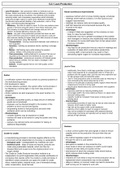
5.3.1 Lean Production
• Lean Production - lean production refers to methods such as Kaizen (continuous improvement):
Kansan, Kaizen and Andon which increase efficiency in relation to
the output produced by a business. The methods work towards
reducing waste, and unnecessary expenditure whilst ultimately • Japanese method which involves holding regular, schedules
producing a larger output in a given time. Methods include Kaizen meetings where staff are invited to I’ve their opinions and
(continuous improvement) Kanban, Cell production, Just-in-Time, suggest improvements
Andon, and Total Quality Management • meetings can reduce costs and increase quality
• Efficiency - the ratio of output to input. If a firm can produce more • staff feel respected and empowered because they are
goods or services using the same or even fewer resources, then involved in the team
the company is more efficient and average cost per unit will • advantages
decline. Increased efficiency reduces costs. • a range of ideas are suggested, so the company is more
• Waste - any part of the production process that does not add likely to make the best decision
value to the final consumer. If waste can be reduced, costs are
• employees may have a greater knowledge of the problem
also reduced, leading to higher total profit. Main sources of waste
than managers or directors who traditionally make decisions
include: (remember using TIM WOOD)
• Transportation - moving components between work stations or • the decision to involve staff helps them to feel valued which
from suppliers improves motivation
• Inventory - building up excessive stocks, resulting in storage • disadvantages
costs • may lead to lost production time as a result of meetings and
• Motion - staff risking injury while making the product evaluation of ideas which could reduce productivity
• waiting - delays in the production process • involving staff in improvements may result in them
• Over-processing - adding features to a product that are not demanding higher wages for increases responsibility
required by the customer and therefore do not add value
• Over-production - producing an inventory of finished goods
before they are needed. This can lead to wastage in fast-
moving markets
• Defects - finished goods that do not meet quality control
standards Just-in-Time:
• traditionally, firms liked to hold large quantities of stock just in
case it was required for an unexpected order or if there as a
Andon: problem with the supply chain, but this was very expensive due
to high storage costs and potential waste
• Just-in-Time production aims to minimise costs by reducing or
• a notification system that alerts workers to potential problems in even eliminating the stock being held by a firm
the manufacturing process
• works on the principle of placing smaller, regular orders that are
• first developed in Japan ordered just in time for it to be used
• if Andon detects a problem, the system either communicates it • require good relationships and communication with suppliers
by displaying a warning light or may even stop production • advantages
altogether • improves cash flow by reducing holding stock
• Andon systems can alert engineers to the exact location of a • encourages staff to be more careful as there is no spare stock
problem • reduced holding costs
• advantages • capacity could be increased if less space is being used for
holding stock
• problems are spotted quickly, so large amount of defected
goods are not produced • disadvantages
• purchasing economies of scale may be lost as order sizes are
• engineers can be directed straight to the location of the reduces, which leads to higher costs
problem so that it can be fixed quickly • high risk as the supply chain could breakdown
• empowering worker to halt production and solve their • restricts a firm’s ability to react to surges in demand
problems which can be motivating • may not be suitable for businesses with seasonal demand
• disadvantages where large inventories are typically built up ready for short
• complex systems may be expensive to install periods of high demand
• workers will need to be trained in using the system and fixing
problems
• workers may demand extra remuneration for taking on
additional responsibility
Kanban:
• a stock control system that uses signals or adds to ensure
Cradle-to-cradle: supplies arrive at the production line just when they are
needed
• a manufacturing principle to minimise negative effects on the • the method regulates supply of components in a factory
environment and all stakeholders by focusing on sustainability through the use of a card system
• biological cycle - biodegradable raw materials are used • advantages
• technical cycle - ideas of reuse and recycle, products are • less space is needed on the production line
made using sustainable material, which can then be • lower levels of stock put pressure on staff to avoid waste
disassembled and reused once the original product is no • mistakes are less likely and quality will rise
longer needed • total amount of stock the company holds should reduce,
• The Cradle to Cradle Products Innovation Institute is an which reduces stock holding costs
independent non-profit organisation that provides certification of • disadvantages
companies that operate within the cradle-to-cradle principles. It • mistakes are more likely to stop the entire production line as
identified 5 areas companies can apply the cradle-to-cradle replacement stock components may not be available
ethos: material safety, material reuse, use of renewable energy, • delays in delivery or incorrect orders can lead to production
water conservation, social fairness staff running out of material to work with
• Lean Production - lean production refers to methods such as Kaizen (continuous improvement):
Kansan, Kaizen and Andon which increase efficiency in relation to
the output produced by a business. The methods work towards
reducing waste, and unnecessary expenditure whilst ultimately • Japanese method which involves holding regular, schedules
producing a larger output in a given time. Methods include Kaizen meetings where staff are invited to I’ve their opinions and
(continuous improvement) Kanban, Cell production, Just-in-Time, suggest improvements
Andon, and Total Quality Management • meetings can reduce costs and increase quality
• Efficiency - the ratio of output to input. If a firm can produce more • staff feel respected and empowered because they are
goods or services using the same or even fewer resources, then involved in the team
the company is more efficient and average cost per unit will • advantages
decline. Increased efficiency reduces costs. • a range of ideas are suggested, so the company is more
• Waste - any part of the production process that does not add likely to make the best decision
value to the final consumer. If waste can be reduced, costs are
• employees may have a greater knowledge of the problem
also reduced, leading to higher total profit. Main sources of waste
than managers or directors who traditionally make decisions
include: (remember using TIM WOOD)
• Transportation - moving components between work stations or • the decision to involve staff helps them to feel valued which
from suppliers improves motivation
• Inventory - building up excessive stocks, resulting in storage • disadvantages
costs • may lead to lost production time as a result of meetings and
• Motion - staff risking injury while making the product evaluation of ideas which could reduce productivity
• waiting - delays in the production process • involving staff in improvements may result in them
• Over-processing - adding features to a product that are not demanding higher wages for increases responsibility
required by the customer and therefore do not add value
• Over-production - producing an inventory of finished goods
before they are needed. This can lead to wastage in fast-
moving markets
• Defects - finished goods that do not meet quality control
standards Just-in-Time:
• traditionally, firms liked to hold large quantities of stock just in
case it was required for an unexpected order or if there as a
Andon: problem with the supply chain, but this was very expensive due
to high storage costs and potential waste
• Just-in-Time production aims to minimise costs by reducing or
• a notification system that alerts workers to potential problems in even eliminating the stock being held by a firm
the manufacturing process
• works on the principle of placing smaller, regular orders that are
• first developed in Japan ordered just in time for it to be used
• if Andon detects a problem, the system either communicates it • require good relationships and communication with suppliers
by displaying a warning light or may even stop production • advantages
altogether • improves cash flow by reducing holding stock
• Andon systems can alert engineers to the exact location of a • encourages staff to be more careful as there is no spare stock
problem • reduced holding costs
• advantages • capacity could be increased if less space is being used for
holding stock
• problems are spotted quickly, so large amount of defected
goods are not produced • disadvantages
• purchasing economies of scale may be lost as order sizes are
• engineers can be directed straight to the location of the reduces, which leads to higher costs
problem so that it can be fixed quickly • high risk as the supply chain could breakdown
• empowering worker to halt production and solve their • restricts a firm’s ability to react to surges in demand
problems which can be motivating • may not be suitable for businesses with seasonal demand
• disadvantages where large inventories are typically built up ready for short
• complex systems may be expensive to install periods of high demand
• workers will need to be trained in using the system and fixing
problems
• workers may demand extra remuneration for taking on
additional responsibility
Kanban:
• a stock control system that uses signals or adds to ensure
Cradle-to-cradle: supplies arrive at the production line just when they are
needed
• a manufacturing principle to minimise negative effects on the • the method regulates supply of components in a factory
environment and all stakeholders by focusing on sustainability through the use of a card system
• biological cycle - biodegradable raw materials are used • advantages
• technical cycle - ideas of reuse and recycle, products are • less space is needed on the production line
made using sustainable material, which can then be • lower levels of stock put pressure on staff to avoid waste
disassembled and reused once the original product is no • mistakes are less likely and quality will rise
longer needed • total amount of stock the company holds should reduce,
• The Cradle to Cradle Products Innovation Institute is an which reduces stock holding costs
independent non-profit organisation that provides certification of • disadvantages
companies that operate within the cradle-to-cradle principles. It • mistakes are more likely to stop the entire production line as
identified 5 areas companies can apply the cradle-to-cradle replacement stock components may not be available
ethos: material safety, material reuse, use of renewable energy, • delays in delivery or incorrect orders can lead to production
water conservation, social fairness staff running out of material to work with