Scuba Diving Final Exam 2022 with complete solution
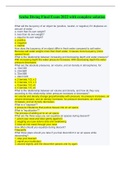
Scuba Diving Final Exam 2022 with complete solution What will the buoyancy of an object be (positive, neutral, or negative) if it displaces an amount of water: a. more than its own weight? b. less than its own weight? c. equal to its own weight? a. positive b. negative c. neutral How does the buoyancy of an object differ in fresh water compared to salt water. Because salt water weighs more than fresh water, it causes more buoyancy (more upward force) What is the relationship between increasing and decreasing depth and water pressure? With increasing depth the water pressure increases. With decreasing depth the water pressure decreases. What are the absolute pressures, air volume, and air density in atmospheres, for: a. 10m/33ft b. 20m/66ft b. 30m/99ft c. 40m/132ft a. 2 bar/ata, 1/2, x 2 b. 3 bar/ata, 1/3, x 3 c. 4 bar/ata, 1/4, x4 d. 5 bar/ata, 1/5, x5 What is the relationship between air volume and density, and how do they vary according to this relationship when pressure increases or decreases? Air volume and density change proportionately with pressure. As pressure increases, air volume decreases, and air density increases. As pressure decreases, air volume increases, and air density decreases. What is a "squeeze"? A pressure imbalance that pushes tissues into an air space. What is "equalization"? The process of adding air to an air space. What are the three ways you can equalize air spaces during descent? 1. pinch your nose and blow gently against it 2. wiggling your jaw side-to-side and swallowing 3. blow air into mask through your nose How often should you equalize during descent? Frequently
Escuela, estudio y materia
- Institución
- Scuba Diving
- Grado
- Scuba Diving
Información del documento
- Subido en
- 2 de septiembre de 2022
- Número de páginas
- 6
- Escrito en
- 2022/2023
- Tipo
- Examen
- Contiene
- Preguntas y respuestas
Temas
- neutral
-
scuba diving final exam 2022 with complete solution what will the buoyancy of an object be positive
-
or negative if it displaces an amount of water a more than its own weight b less t