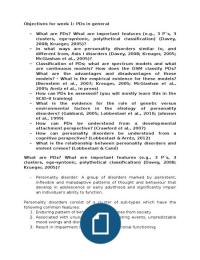
Objectives for week 1: PDs in general
- What are PDs? What are important features (e.g., 3 P`s, 3
clusters, ego-syntonic, polythetical classification) (Davey,
2008; Krueger, 2005)?
- In what ways are personality disorders similar to, and
different from, Axis I disorders (Davey, 2008; Kreuger, 2005;
McGlashan et al., 2005)?
- Classification of PDs; what are spectrum models and what
are continuous models? How does the DSM classify PDs?
What are the advantages and disadvantages of these
models? - What is the empirical evidence for these models?
(Bernstein et al., 2007; Kreuger, 2005; McGlashan et al.,
2005; Arntz et al., in press)
- How can PDs be assessed? (you will mostly learn this in the
SCID-II training)
- What is the evidence for the role of genetic versus
environmental factors in the etiology of personality
disorders? (Gabbard, 2005; Lobbestael et al., 2010; Johnson
et al., 1999)
- How can PDs be understood from a developmental
attachment perspective? (Crawford et al., 2007)
- How can personality disorders be understood from a
cognitive perspective? (Lobbestael & Arntz, 2012)
- What is the relationship between personality disorders and
violent crimes? (Lobbestael & Cané)
What are PDs? What are important features (e.g., 3 P`s, 3
clusters, ego-syntonic, polythetical classification) (Davey, 2008;
Krueger, 2005)?
- Personality disorder: A group of disorders marked by persistent,
inflexible and maladaptive patterns of thought and behaviour that
develop in adolescence or early adulthood and significantly impair
an individual’s ability to function.
Personality disorders consist of a cluster of sub-types which have the
following common features:
1. Enduring pattern of behaviour that deviates from society
2. Associated with unusual ways of interpreting events, unpredictable
mood swings and disruptive behaviour
3. Result in impairment in social and occupational functioning
, 4. Represent a stable pattern of behaviour that can be traced back to
adolescence or childhood
Well known examples of PD:
- Borderline: Shifts in mood, impulsivity, temper trantums, unstable
self-image,
- Antisocial personality disorder (APD): indifference to feelings and
rights of others, lack of remorse, impulsivity and pursuit of individual
goals at all costs. Also knows as sociopaths.
In DSM-IV-TR personality disorders are labelled as axis 2 disorders because
they represent pervasive and inflexible patterns of behaviour. No
‘ziektebesef’.
Personality disorders are often accompanied with axis 1 disorders such as
depression and anxiety.
The DSM lists 10 types of PD divided in 3 clusters:
1. A: odd/eccentric personality disorder: paranoid PD, schizotypal PD
and schizoid PD
2. B: Dramatic/emotional personality disorders: antisocial PD,
borderline, narcissistic PD and histrionic PD
3. C: Anxious/fearful personality disorders: anxious and fearful
symptoms oftenly linked with axis 1 disorders.
- What are PDs? What are important features (e.g., 3 P`s, 3
clusters, ego-syntonic, polythetical classification) (Davey,
2008; Krueger, 2005)?
- In what ways are personality disorders similar to, and
different from, Axis I disorders (Davey, 2008; Kreuger, 2005;
McGlashan et al., 2005)?
- Classification of PDs; what are spectrum models and what
are continuous models? How does the DSM classify PDs?
What are the advantages and disadvantages of these
models? - What is the empirical evidence for these models?
(Bernstein et al., 2007; Kreuger, 2005; McGlashan et al.,
2005; Arntz et al., in press)
- How can PDs be assessed? (you will mostly learn this in the
SCID-II training)
- What is the evidence for the role of genetic versus
environmental factors in the etiology of personality
disorders? (Gabbard, 2005; Lobbestael et al., 2010; Johnson
et al., 1999)
- How can PDs be understood from a developmental
attachment perspective? (Crawford et al., 2007)
- How can personality disorders be understood from a
cognitive perspective? (Lobbestael & Arntz, 2012)
- What is the relationship between personality disorders and
violent crimes? (Lobbestael & Cané)
What are PDs? What are important features (e.g., 3 P`s, 3
clusters, ego-syntonic, polythetical classification) (Davey, 2008;
Krueger, 2005)?
- Personality disorder: A group of disorders marked by persistent,
inflexible and maladaptive patterns of thought and behaviour that
develop in adolescence or early adulthood and significantly impair
an individual’s ability to function.
Personality disorders consist of a cluster of sub-types which have the
following common features:
1. Enduring pattern of behaviour that deviates from society
2. Associated with unusual ways of interpreting events, unpredictable
mood swings and disruptive behaviour
3. Result in impairment in social and occupational functioning
, 4. Represent a stable pattern of behaviour that can be traced back to
adolescence or childhood
Well known examples of PD:
- Borderline: Shifts in mood, impulsivity, temper trantums, unstable
self-image,
- Antisocial personality disorder (APD): indifference to feelings and
rights of others, lack of remorse, impulsivity and pursuit of individual
goals at all costs. Also knows as sociopaths.
In DSM-IV-TR personality disorders are labelled as axis 2 disorders because
they represent pervasive and inflexible patterns of behaviour. No
‘ziektebesef’.
Personality disorders are often accompanied with axis 1 disorders such as
depression and anxiety.
The DSM lists 10 types of PD divided in 3 clusters:
1. A: odd/eccentric personality disorder: paranoid PD, schizotypal PD
and schizoid PD
2. B: Dramatic/emotional personality disorders: antisocial PD,
borderline, narcissistic PD and histrionic PD
3. C: Anxious/fearful personality disorders: anxious and fearful
symptoms oftenly linked with axis 1 disorders.