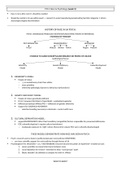
P114: Race & Psychology (week 3)
Race is not a dirty word t. should be avoided
Should be careful in its use within psych. + research to avoid reproducing/perpetuating harmful categories t. inform
stereotypes/stigma/discrimination
_________________________________________________________________________________________________________
HISTORY OF RACE IN SA PSYCH:
PSYCH. KNOWLEDGE PRODUCED WESTERN/EUROCENTRIC FRAME OF REFERENCE:
3 SCHOOLS OF THOUGHT
PSYCHOANALYSIS BEHAVIOURISM HUMANISM
Freud Watson Skinner Pavlov Rogers Maslow
3 MODELS TO GUIDE/CONCEPTUALISE RESEARCH ON PEOPLE OF COLOUR
(pathological focus)
Inferiority Genetic Deficiency Culturally Deprived
Model Model Model
1. INFERIORITY MODEL:
People of Colour
↓ on evolutionary chain than whites
more primitive
inherently pathological (prone to behaviour dysfunctions)
2. GENETIC DEFICIENCY MODEL:
People of Colour genetically deficient
Dr H.F Verwoerd (Architect of Apartheid) = unabashed supporter
Differences between Whites/POC = reflections of genetic inferiority
Support for EUGENICS MOVEMENT:
selective breeding necessary to eliminate + control unfit races
3. CULTURAL DEPRIVATION MODEL:
argued ENVIRONMENT rather than hereditary (oorgeërfde) factors responsible for presumed deficiencies
POC culturally deprived + require cultural enrichment
Inadequate exposure to ‘right’ culture (Eurocentric values) POC were culturally disadvantaged
THESE MODELS DEMONSTRATE HOW RACE WAS SEEN IN PSYCH:
Psych. research used as basis to justify/perpetuate racist policies (APARTHEID)
can trace scientific support for racist policies through history of SA
Psychologists R.W. WILCOCKS + J.A.J. VAN RENSBURG research became key pillars of Apartheid + instated as laws:
1. severe penalties on sexual intercourse between races
2. social legislation be revised + extended to keep “racial groups” apart
3. Blacks shouldn’t be allowed to compete for work w. Whites
_______________________________________________________________________________________________
WHAT IS RACE?
, DEF: grouping/categorisation of people based on physical/biological differences
e.g. skin colour, hair texture, facial features, eye formation
Apartheid government used these categories to group citizens
Many people continue to see race as physically distinct populations
BUT no validity for racial categories
Human physical variation overlap
Genetic analysis shows t. no genes can identify distinct groups
RACE IS A SOCIAL CONSTRUCT:
Developed by society to group or categorise various people by physical appearance/social attributes
EVIDENCE FOR SOCIAL CONSTRUCTIONIST VIEWPOINT:
criteria for categorisation are not universal/fixed
each society creates own
Apartheid manufactured its own particular understanding of race
4 legally divided population groups + hierarchically arranged:
(most to least human)
1. Whites
2. Indians/Asian,
3. Coloureds
4. Blacks/Natives
PENCIL TEST: arbitrary test
put pencil into hair + whether fell out/not determined racial group
HOW WAS SOCIAL CONSTRUCT OF RACE CONSTRUED/PERPETUATED THROUGH SOCIETY:
1. LEWIN’S EQUATION 2. BRONFENBRENNER’S ECOLOGICAL THEORY
Kurt Lewin Urie Bronfenbrenner
1. LEWIN’S EQUATION:
Context is important in understanding behaviour
Behaviour is function of interaction between person + environment
B = f(P+E)
2. BRONFENBRENNER’S ECOLOGICAL THEORY:
Any individual exists in different sub-systems which interact w. each other
5 DIVIDED LEVELS:
1. MICROSYSTEM person + individuals in immediate social environment
e.g. immediate family
2. MESOSYSTEM Interactions between microsystems
e.g. neighbourhood, peer groups, school/work
3. EXOSYSTEM social setting surrounding person
e.g. religious institution, media
4. MACROSYSTEM broader spheres of influence
e.g. cultures, subcultures, economic/political systems, COVID pandemic
5. CHRONOSYSTEM systems may be influenced over period of time
e.g. individual’s lifespan
All these systems have effect on individual:
Individual’s behaviour is product of ecological system grew up in
Race is not a dirty word t. should be avoided
Should be careful in its use within psych. + research to avoid reproducing/perpetuating harmful categories t. inform
stereotypes/stigma/discrimination
_________________________________________________________________________________________________________
HISTORY OF RACE IN SA PSYCH:
PSYCH. KNOWLEDGE PRODUCED WESTERN/EUROCENTRIC FRAME OF REFERENCE:
3 SCHOOLS OF THOUGHT
PSYCHOANALYSIS BEHAVIOURISM HUMANISM
Freud Watson Skinner Pavlov Rogers Maslow
3 MODELS TO GUIDE/CONCEPTUALISE RESEARCH ON PEOPLE OF COLOUR
(pathological focus)
Inferiority Genetic Deficiency Culturally Deprived
Model Model Model
1. INFERIORITY MODEL:
People of Colour
↓ on evolutionary chain than whites
more primitive
inherently pathological (prone to behaviour dysfunctions)
2. GENETIC DEFICIENCY MODEL:
People of Colour genetically deficient
Dr H.F Verwoerd (Architect of Apartheid) = unabashed supporter
Differences between Whites/POC = reflections of genetic inferiority
Support for EUGENICS MOVEMENT:
selective breeding necessary to eliminate + control unfit races
3. CULTURAL DEPRIVATION MODEL:
argued ENVIRONMENT rather than hereditary (oorgeërfde) factors responsible for presumed deficiencies
POC culturally deprived + require cultural enrichment
Inadequate exposure to ‘right’ culture (Eurocentric values) POC were culturally disadvantaged
THESE MODELS DEMONSTRATE HOW RACE WAS SEEN IN PSYCH:
Psych. research used as basis to justify/perpetuate racist policies (APARTHEID)
can trace scientific support for racist policies through history of SA
Psychologists R.W. WILCOCKS + J.A.J. VAN RENSBURG research became key pillars of Apartheid + instated as laws:
1. severe penalties on sexual intercourse between races
2. social legislation be revised + extended to keep “racial groups” apart
3. Blacks shouldn’t be allowed to compete for work w. Whites
_______________________________________________________________________________________________
WHAT IS RACE?
, DEF: grouping/categorisation of people based on physical/biological differences
e.g. skin colour, hair texture, facial features, eye formation
Apartheid government used these categories to group citizens
Many people continue to see race as physically distinct populations
BUT no validity for racial categories
Human physical variation overlap
Genetic analysis shows t. no genes can identify distinct groups
RACE IS A SOCIAL CONSTRUCT:
Developed by society to group or categorise various people by physical appearance/social attributes
EVIDENCE FOR SOCIAL CONSTRUCTIONIST VIEWPOINT:
criteria for categorisation are not universal/fixed
each society creates own
Apartheid manufactured its own particular understanding of race
4 legally divided population groups + hierarchically arranged:
(most to least human)
1. Whites
2. Indians/Asian,
3. Coloureds
4. Blacks/Natives
PENCIL TEST: arbitrary test
put pencil into hair + whether fell out/not determined racial group
HOW WAS SOCIAL CONSTRUCT OF RACE CONSTRUED/PERPETUATED THROUGH SOCIETY:
1. LEWIN’S EQUATION 2. BRONFENBRENNER’S ECOLOGICAL THEORY
Kurt Lewin Urie Bronfenbrenner
1. LEWIN’S EQUATION:
Context is important in understanding behaviour
Behaviour is function of interaction between person + environment
B = f(P+E)
2. BRONFENBRENNER’S ECOLOGICAL THEORY:
Any individual exists in different sub-systems which interact w. each other
5 DIVIDED LEVELS:
1. MICROSYSTEM person + individuals in immediate social environment
e.g. immediate family
2. MESOSYSTEM Interactions between microsystems
e.g. neighbourhood, peer groups, school/work
3. EXOSYSTEM social setting surrounding person
e.g. religious institution, media
4. MACROSYSTEM broader spheres of influence
e.g. cultures, subcultures, economic/political systems, COVID pandemic
5. CHRONOSYSTEM systems may be influenced over period of time
e.g. individual’s lifespan
All these systems have effect on individual:
Individual’s behaviour is product of ecological system grew up in